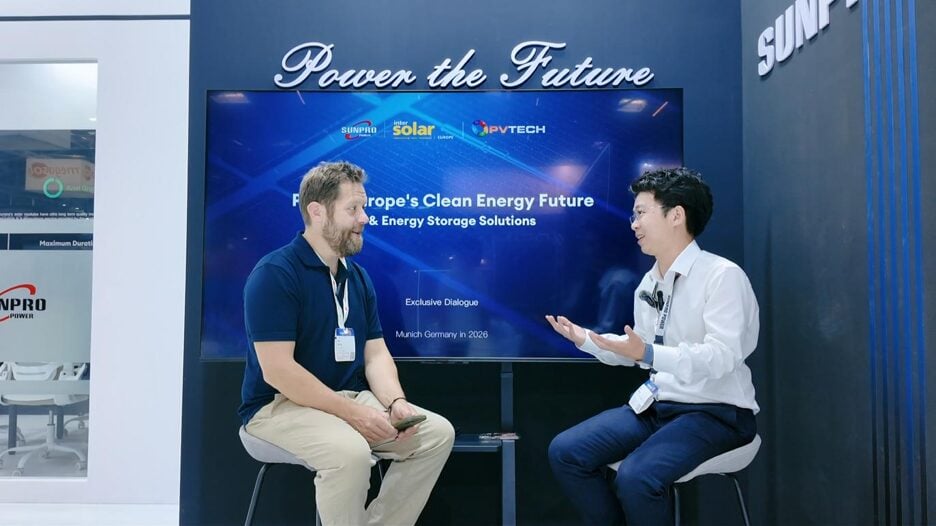
Chinese PV manufacturer Sunpro Power showcased a range of new products at last week’s Intersolar exhibition in Munich, including several new high-efficiency back-contact modules. The company also actively discussed its first foray into the battery energy storage business, aiming to position itself as a turnkey supplier of energy storage system and to make a mark in this field. We interviewed Sunpro’s director, Sam Zhang, at the exhibition to hear more.
PV Tech: What are the main products and new technologies that Sunpro is showcasing at Intersolar this year?
Try Premium for just $1
- Full premium access for the first month at only $1
- Converts to an annual rate after 30 days unless cancelled
- Cancel anytime during the trial period
Premium Benefits
- Expert industry analysis and interviews
- Digital access to PV Tech Power journal
- Exclusive event discounts
Or get the full Premium subscription right away
Or continue reading this article for free
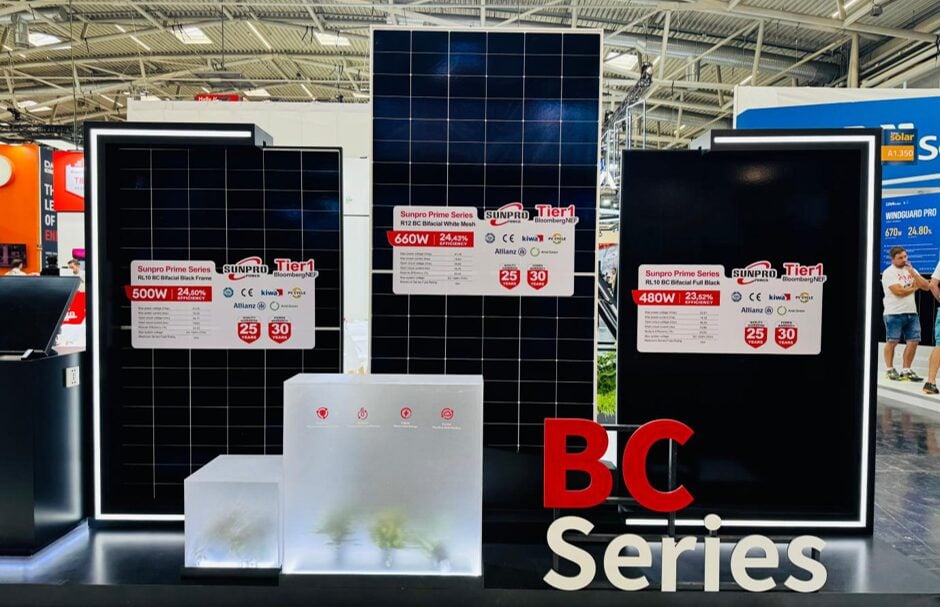
Sam Zhang: Compared with last year, we have brought a range of new products. In terms of modules, we are highlighting back-contact (BC) modules. This year, we offer a large-format module with a power output of around 660W, as well as high-efficiency small-format modules with a power output of around 500W.
In addition, we are showcasing flexible, lightweight modules, anti-glare modules, agri-PV modules designed specifically for applications such as greenhouses and carports. We are also introducing a new quarter-cell technology, which we plan to bring to market in Q4 of this year.
What led you to focus on back-contact modules, and why launch them now?
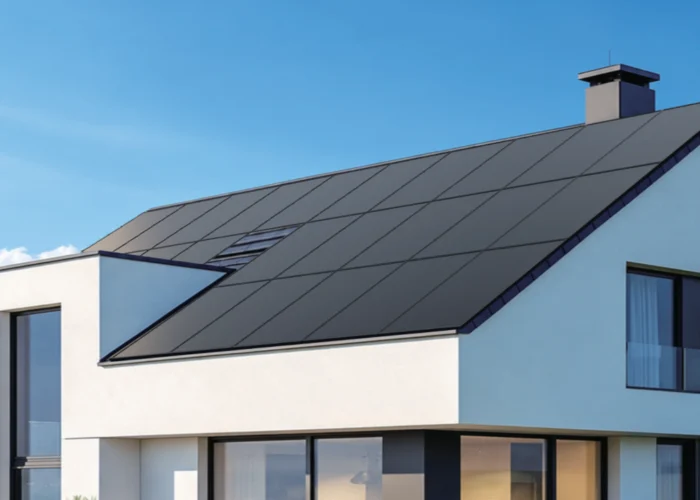
Compared with conventional modules, back-contact (BC) technology offers two main advantages: a more aesthetic appearance and higher efficiency. This makes BC modules particularly well suited for residential or balcony systems. Not only do they look better, but given the limited roof space in residential applications, we aim to provide customers with higher efficiency modules. In addition, another technology advantage of BC modules is their superior anti-shading performance, making them an ideal solution for residential rooftops, where shading from surrounding buildings can affect power generation.
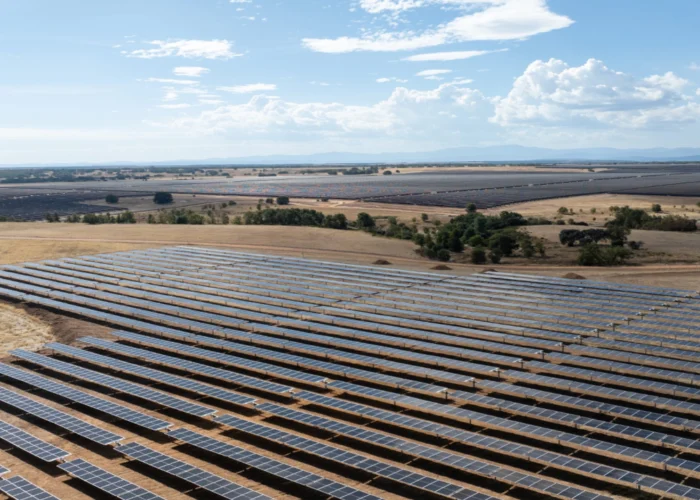
Higher-power 660W BC modules are also widely favoured in utility-scale and commercial, and industrial (C&I) projects, because for a given area, they generate more power, thereby helping customers reduce balance-of-system costs and improve project economics.
You also mentioned lightweight and agri-PV modules. Where do those fit in?
The lightweight modules we are showcasing have a power output of around 430W and weigh less than 3kg per square meter. This makes them an ideal solution for rooftops with limited mechanical load capacity, for example, older industrial or commercial buildings, where standard framed glass modules might be too heavy.
The version currently on display is frameless, but a framed option is also available. The frame is plastic rather than aluminium, further reducing the weight.
We currently have obtained Class 1 fire safety certification for the Italian market, and we have already delivered a large volume of modules to Italy, where customer feedback has been very positive.
As for our agri-PV modules, they are mainly used in applications such as greenhouses and carports. These modules are designed to allow more sunlight to pass through to the ground or crops, striking a balance between power generation and the specific needs of agricultural operations.
What does Sunpro’s presence in Europe look like today, and why is the region so important to you?
Sunpro’s core business remains solar modules, and Europe is one of our most strategically important markets. We have an office in Frankfurt and a warehouse in the Netherlands, enabling us to provide localized service, faster delivery and timely feedback to our customers.
Last year, our total module shipments to Europe exceeded 1.2 GW. Germany alone accounted for around 50% of this volume, making it our largest market in Europe, with the remaining 50% delivered across many other countries.
From our perspective, this year’s situation at Intersolar is better than last year. Customers are increasingly focusing not only on PV, but also on ”PV + storage” solutions. Due to low or sometimes even negative electricity prices in certain markets and periods, more and more customers are considering battery storage to improve returns on investment.
You’ve started a battery energy storage (BESS) business as well. What exactly is Sunpro doing in BESS?
This year, we officially started our BESS business in Europe. At this stage, we are not doing distribution of batteries. Instead, we act as a general EPC, providing turnkey, one‑stop solutions that include engineering design, procurement, construction, commissioning and operation and maintenance.
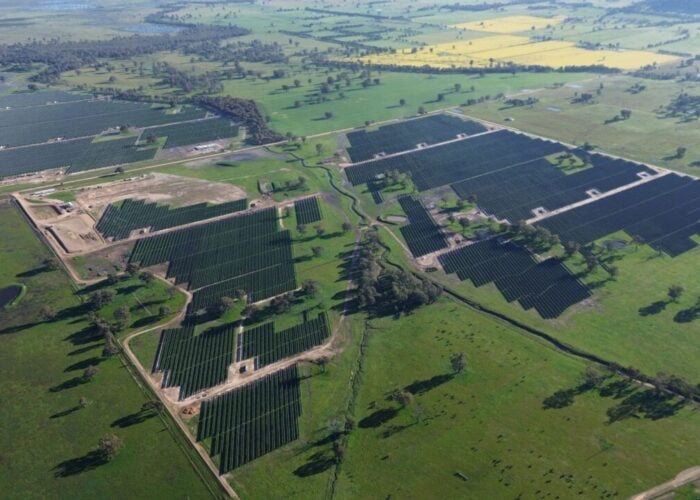
So far, we havesigned three contracts, all of which are utility-scale projects, with a total capacity exceeding 30MWh. In these cases, there is already a PV plant in place; we are adding the BESS to complement the existing solar asset.
We have found that customers are not only looking for hardware, but also for complete technical solutions, maintenance services and professional operations teams with the expertise to manage integrated PV-plus-storage systems.
Chinese manufacturers are facing intense competition and challenges. How is Sunpro responding in terms of production and quality?
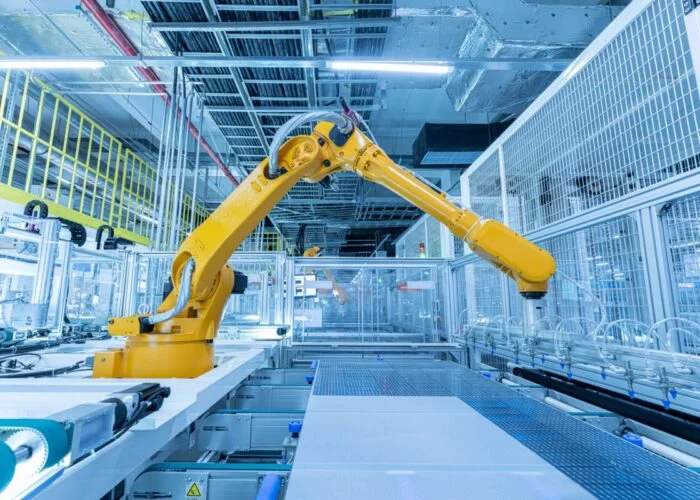
Several years ago, we anticipated the need for overseas manufacturing capacity. Today, we have production bases in Indonesia, Poland, the United States, and China. In the US, for example, we operate a 2GW module factory in Georgia – this is a fully operational production line, not just a show line. This allows us to offer customers multiple origin options: modules made in the EU, the US, or China.
In terms of competition, we believe quality is the bottom line; without a high-quality product, we cannot survive in the market. This year, our products passed a “thresher test” that is approximately three times more stringent than standard testing, demonstrating robustness in harsh environments.
On top of that, we provide product reliability warranties backed by Allianz, with reinsurance support from Lloyd’s. For us, a warranty is not just a piece of paper.
Looking ahead over the next one to two years, what are your main strategic priorities in Europe?
Our strategy is straightforward: we aim to build win–win partnerships with our customers.