
With the industry pushing the boundaries of solar efficiency, multi-cut technology has emerged as a critical pathway for boosting module power. By dividing solar cells into smaller units—such as 1/3-cut, 1/4-cut, or even smaller—this technique effectively reduces current losses and enhances optical utilization, leading to a significant increase in overall module efficiency.
However, while multi-cut technology offers substantial efficiency dividends, it also introduces comprehensive process challenges across the entire production chain. From cell processing to module assembly, manufacturers must address several critical questions: Can the precision of scribed cells meet interconnection requirements? Does the edge profile match the passivation process? Can passivation effectively compensate for recombination losses caused by cutting damage? Furthermore, can cell sorting ensure high consistency in both electrical performance and dimensions to adapt to the positioning accuracy of high-speed stringers? The synergy between these equipment stages determines whether the potential of multi-cut technology can be fully converted into mass-production competitiveness.
Traditional multi-cut processes often suffer from “equipment silos” and disconnected workflows. Once cells enter the module stage, issues like dimensional deviations, micro-cracks and poor performance matching frequently lead to yield loss, making it difficult to fully realize the efficiency gains of multi-cut technology.
Leveraging its full-stack expertise, ATW has launched an integrated multi-cut cell and module solution. By combining its complete capabilities in laser edge p-n junction isolation, cell-side scribing, passivation and sorting with proven module-side packaging solutions (stringing, layup and busbar welding), the company has created a seamless synergy across the entire production chain. This integration ensures stable, high-yield mass production, helping customers transform the technical dividends of multi-cut technology into a decisive market advantage.
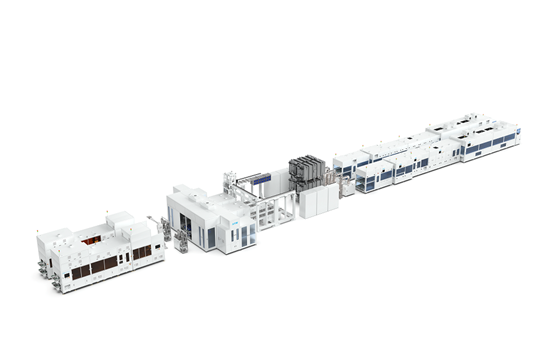
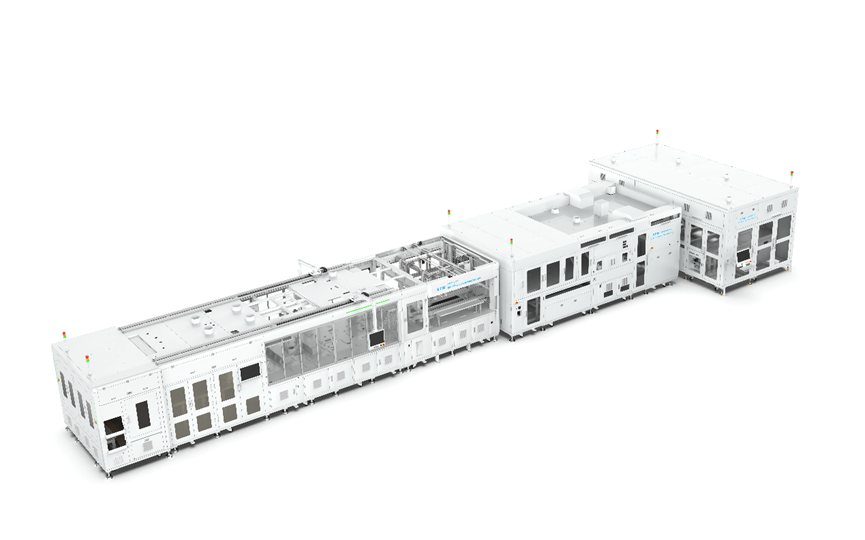
Cell Processing: Laser Edge p-n Junction Isolation (Optional):
This process creates an electrically inactive isolation zone at the diced edge followed by ALD edge passivation. Together, they form a synergistic isolation-plus-passivation barrier that effectively eliminates both edge shunt paths and recombination losses. The integrated solution minimizes cell efficiency degradation, enhances module power output, and provides a high-yield manufacturing route for high-efficiency multi-cut cells.
Cell Pre-treatment:
The process utilizes low-damage laser scribing to strictly control cutting loss, repairing edge damage through passivation and employing high-precision automated sorting. This ensures that every multi-cut cell entering the module stage is consistent in size, performance and quality, minimizing encapsulation risks at the source.
Module Packaging:
ATW high-speed stringers achieve precise welding with zero-micro-crack control to meet high-capacity demands. The integrated layup system shortens material flow and reduces physical contact, significantly lowering defect rates. Finally, the busbar welding machines provide precise circuit conduction, ensuring stable electrical connections and enhancing long-term module reliability.
In the realm of software-hardware synergy and smart manufacturing, the company achieves a high degree of integration between its multi-cut intelligent equipment and the Stringer Health Manager and Module Manufacturing Operations Management (MOM) systems.
The Stringer Health Manager System leverages a vast operational database combined with advanced analytical modelling. Deeply integrated with the hardware, it reduces fault determination time by 70% and troubleshooting time by 50%, significantly enhancing equipment management efficiency. Meanwhile, the Module MOM system serves as a specialized manufacturing operations platform for the PV industry, covering the entire lifecycle from production scheduling and process monitoring to quality traceability. Through real-time data collection and intelligent analysis, it boosts production efficiency and yield while lowering operational costs, empowering the creation of transparent and efficient smart factories.
Ultimately, through comprehensive equipment synergy and a closed-loop process, ATW has successfully bridged the critical link from cell to module. This integration fully unleashes the efficiency potential of multi-cut technology—delivering higher yields, greater capacity and lower losses for customers. By doing so, the company empowers the large-scale production of high-efficiency modules and significantly enhances their overall market competitiveness.
