In the solar industry, the “nameplate” wattage of PV modules is often treated as a benchmark for performance, procurement and project economics. Yet measured power data frequently tells a more nuanced story.
When measured power falls below the nameplate rating, project owners may receive less capacity than expected, potentially affecting energy yield projections, financial models and contract compliance. In tightly wrapped project financing, even a 1% gap can become critical: on a multi-gigawatt installation base, it can represent megawatts of missing capacity.
Try Premium for just $1
- Full premium access for the first month at only $1
- Converts to an annual rate after 30 days unless cancelled
- Cancel anytime during the trial period
Premium Benefits
- Expert industry analysis and interviews
- Digital access to PV Tech Power journal
- Exclusive event discounts
Or get the full Premium subscription right away
Or continue reading this article for free
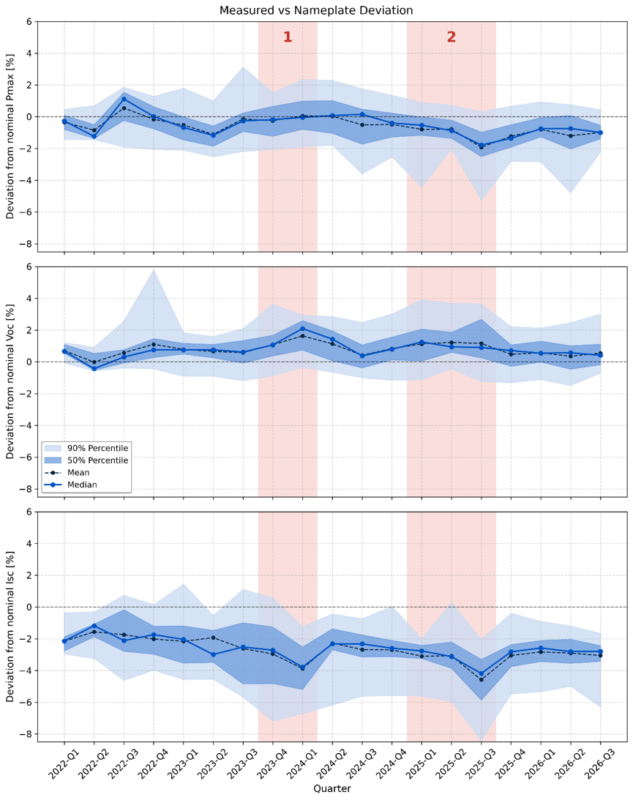
At Kiwa PVEL, every module is flash-tested at Standard Test Conditions (1,000W/m2, 25°C and air mass 1.5) before any light-exposure preconditioning occurs, capturing its as-received power at maximum power point (Pmax). We have compared those measured values with manufacturer nameplate ratings across 9,828 samples tested between January 2022 and September 2026, either as part of our Product Qualification Program (PQP) or batch testing projects.
Our findings: most modules don’t deliver their promised power output, and the gap widened as the industry went through a severe economic downturn.
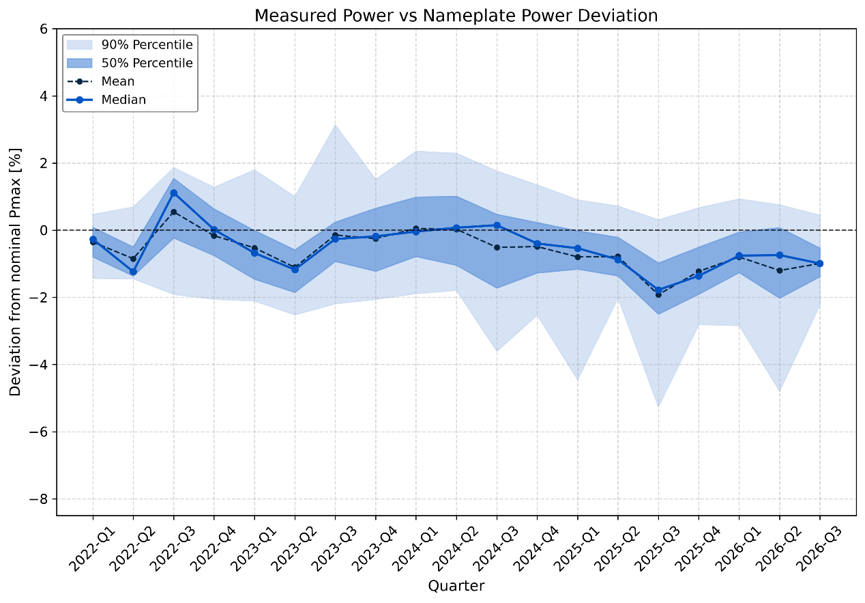
 and expressed as a percentage.
Understanding nameplate ratings
A nameplate rating is not an individual test result. At the end of the manufacturing line, modules are characterised in a solar simulator and typically binned in 5W steps. For example, every module measured with a power output between 630.0 and 634.9W is labelled as 630W. Then generic open-circuit voltage (Voc) and short-circuit current (Isc) values are assigned for the corresponding power bin. Discrepancies between actual performance and nameplate values thus originate from measurement accuracy, binning protocols and the manufacturer’s rating risk management practices.
Trend over the years
For the period Q3 2023 to Q2 2024, agreement between Kiwa PVEL measured and nameplate power was at its best: the median deviation sat near 0%, and the 50% band stayed tight around it. Then came the dip. From Q3 2024 through Q3 2025, the median deviation fell to -2%, coinciding with a time of significant industry-wide financial losses. A partial but hesitant recovery has been visible after Q4 2025, with median deviation fluctuating around -1% over the last three quarters.
The forces behind the gap
One key driver of the deviation trend is cell technology. In late 2023, laser-enhanced contact optimisation (LECO) entered mass production for TOPCon cells, boosting Voc and fill factor. Actual performance improved, but nameplate Voc and Isc values were not updated promptly. This technology leap is consistent with the rating anomaly observed in 2023Q4–2024Q1: a positive Voc deviation peak alongside an Isc trough. At this time, manufacturers were able to sustain a relatively quick increase in module efficiencies with incremental technology improvements.
Another key driver is market conditions. The industry economic downturn began around Q4 2023, further worsening from Q4 2024 through Q3 2025 with substantial industry-wide losses. This correlates to the period when the Pmax and Isc deviations reached their largest negative deviations, suggesting that as module margins went negative, manufacturers relaxed their power rating tolerances and risk management policies in an effort to mitigate their financial losses.
Why it matters
Pmax deviations create direct project economic loss and uncertainty for degradation warranty claims. Negative deviations in Isc ratings do not create system-level risks, but can lead to oversizing of wiring and overcurrent protection, also impacting project economics. Designers also rely on nameplate Voc voltage values to design systems, setting module string length to prevent overvoltage at the inverter DC input. Large positive Voc deviations beyond the IEC 61215 requirements may mislead system design and introduce safety risks.
For asset owners, the practical takeaway is simple: don’t stop at nameplate power ratings. Verify nameplate ratings on the manufacturing floor and via batch testing at a trusted third-party lab. These results should be kept as a traceable baseline for warranty claims.
One open question remains. China’s new mandatory energy-efficiency standard GB47834-2026, released in June 2026 and fully enforced from 1 January 2027, sets a legal minimum market-access efficiency threshold for n-type crystalline-silicon modules. Will it affect nameplate power ratings in either direction? Now more than ever, the number worth watching is not just the label, but the measured power behind it.
Tristan Erion-Lorico is VP of market and sales at Kiwa PVEL. Song Hao is a data analyst at Kiwa PVEL.