
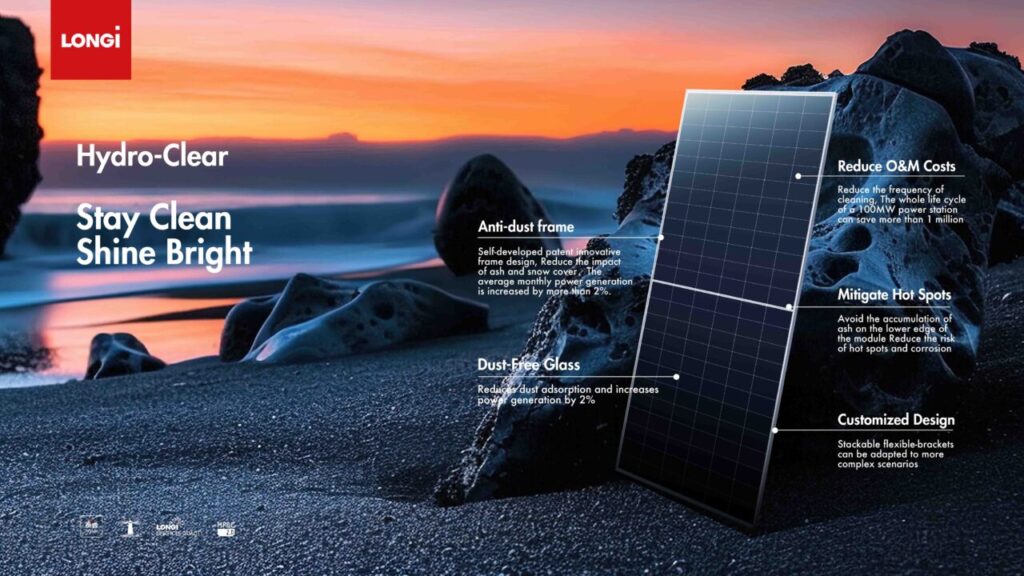
Field performance results for LONGi’s Hi-MO 9 HydroClear module have been released from Mohe, Heilongjiang—China’s northernmost and most frigid region. Under the extreme combined stress of heavy snow accumulation and severe cold, the module achieved a 2.34% increase in energy yield per watt compared to conventional modules, with a maximum instantaneous gain reaching 39.89%. These results underscore its outstanding value proposition of higher energy output, superior reliability and reduced O&M. To guarantee efficient, high-reliability power generation throughout a plant’s entire lifecycle, LONGi subjected the product to even more extreme simulated climate conditions in the laboratory before its launch, ensuring enduring safety and stability in power generation performance.
In a dynamic mechanical load test, a robotic arm simulated the impact of outdoor storms, applying a bidirectional cyclic load of ±1000 Pa to the module over 1,000 consecutive intense push-pull cycles, the equivalent of withstanding thousands of storms over a module’s lifecycle. Thanks to its unique stress-resistant structural design, the HydroClear module’s internal core components remained totally secure when subjected to the cumulative effects of high-frequency alternating stress.
In a static mechanical load test, the laboratory replicated the extreme conditions of heavy snow accumulation in severe cold, combined with strong wind pressure. The test standards were exceptionally strict: a constant pressure of 5,400 Pa was applied to the front side—equivalent to approximately 540 kg of snow piled on each square meter of the module—while a powerful wind suction of -2,400 Pa was applied to the rear side. Unlike standard impact tests, the load was applied gradually and maintained for up to one hour, with three cycles repeated on both the front and back. Leveraging its superior structural strength, the module maintained perfect glass integrity and electrical connectivity under extreme suction and pressure, effectively protecting internal circuitry from compression damage, enabling reliable, high-efficiency power generation.
In a hail impact test, ice balls measuring 25 mm in diameter and weighing approximately 7.53 g were propelled perpendicularly at key vulnerable points—the centre, edges and corners of the module’s front side—at a high speed of 23 m/s (approximately 83 km/h). The HydroClear module withstood repeated violent impact with no glass breakage observed on the surface. High-precision EL (electroluminescence) inspection revealed no new micro-cracks or grid fractures in the internal cells, with final power degradation firmly controlled within less than 5%, and all insulation and wet leakage current tests passed.
Finally, in a DH1000 damp heat accelerated aging test lasting over 1,000 hours, the module successfully resisted the combined assault of moisture and high temperature, effectively preventing internal corrosion, power loss and insulation failure.
