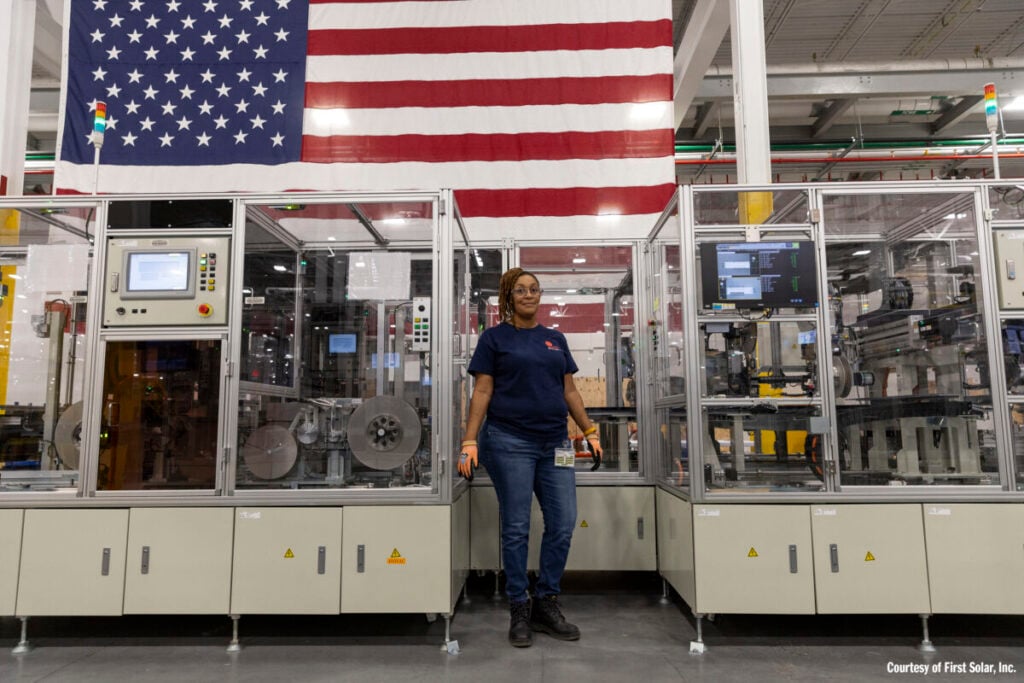
US cadmium telluride (CdTe) thin-film solar manufacturer First Solar has posted increased sales and income for the first quarter of 2026.
In its presentation, the company said it showed “record sales and strong margin expansion” in the first three months of the year. First Solar’s position is supported by US trade protections against crystalline silicon solar products, its ongoing patent dispute over tunnel oxide passivated contact (TOPCon) technology and the remaining 45X and domestic content bonuses for US manufacturing.
Try Premium for just $1
- Full premium access for the first month at only $1
- Converts to an annual rate after 30 days unless cancelled
- Cancel anytime during the trial period
Premium Benefits
- Expert industry analysis and interviews
- Digital access to PV Tech Power journal
- Exclusive event discounts
Or get the full Premium subscription right away
Or continue reading this article for free
Net sales in Q1 2025 were US$1.04 billion, a 24% increase on the same period in 2025. The company shipped a “record” 3.8GW of CdTe thin-film modules in the first three months of the year, hitting a 96% utilisation rate at its US manufacturing operations. First Solar said its module sales backlog sits at 47.9GW – or around US$14.4 billion – through 2030.
Net income was US$347 million, or US$3.22 per share, up from US$210 million (US$1.90 per share) in Q1 2025. Adjusted EBITDA was US$520 million compared with US$379 million in the first quarter of 2025, a 37% jump.
The company ended Q1 2026 with a 47% gross margin, six percentage points higher than 2025, largely due to increased benefits from products qualifying for the 45X Advanced Manufacturing credit.
“We delivered a strong start to 2026, with record first-quarter revenue, record sales in India, meaningful margin expansion, and Adjusted EBITDA above the top end of our first quarter preview range,” said Mark Widmar, CEO of First Solar. “Our competitive position continues to strengthen, underpinned by differentiated technology, a domestic manufacturing footprint, and independence from Chinese crystalline silicon supply chains.”
In Q1, First Solar introduced its “CuRe” (Copper Reduction) technology, producing the first such module on 26 March at its facility in Perrysburg, Ohio. In its earnings presentation, the company claimed that CuRe increases energy yield, lowers degradation and offers enhanced bifaciality. In opening remarks of its earnings call, the company claimed CuRe would offer “up to 8% more lifetime specific energy yield than crystalline silicon TOPCon.”
First Solar’s strong position
First Solar’s US position has been strengthened by the combination of domestic manufacturing incentives and barriers to importing and producing US crystalline silicon solar products. Both are tied to its CdTe thin-film technology.
The company has benefited from 45X tax credits and the domestic content bonus introduced under the Biden administration’s Inflation Reduction Act (IRA). Access to these incentives has become harder for most solar manufacturers following the Trump administration’s introduction of Foreign Entity of Concern (FEOC) rules, restricting exposure to Chinese-made or owned technology, components and intellectual property. However, First Solar is largely insulated from the crystalline silicon supply chain, by virtue of its CdTe tech, and thus is less exposed to these restrictions.
The company has also brought trade complaints to the US government around antidumping and countervailing duty (AD/CVD) tariffs for products entering the US from Southeast Asia and India, and begun a patent infringement case against TOPCon products in the US market, seeking an import exclusion order. In its earnings presentation, First Solar described these factors as “tailwinds” for its US operations.