Over the past few weeks, PV Tech Premium has heard from experts in European solar about changing trends in its financing methods, following the publication of a report from SolarPower Europe that found that government auctions were the most popular form of securing finance, as opposed to corporate power purchase agreements (PPAs) and other private offtake arrangements.
SolarPower Europe itself told PV Tech Premium that, ideally, Europe would benefit from a more “complimentary” relationship between government auctions and private investment. And while examples of a perfectly balanced relationship between these two financing approaches is impossible to find, the US residential solar sector can serve as a useful comparison point as a market where private investment priorities are driving solar installations.
Try Premium for just $1
- Full premium access for the first month at only $1
- Converts to an annual rate after 30 days unless cancelled
- Cancel anytime during the trial period
Premium Benefits
- Expert industry analysis and interviews
- Digital access to PV Tech Power journal
- Exclusive event discounts
Or get the full Premium subscription right away
Or continue reading this article for free
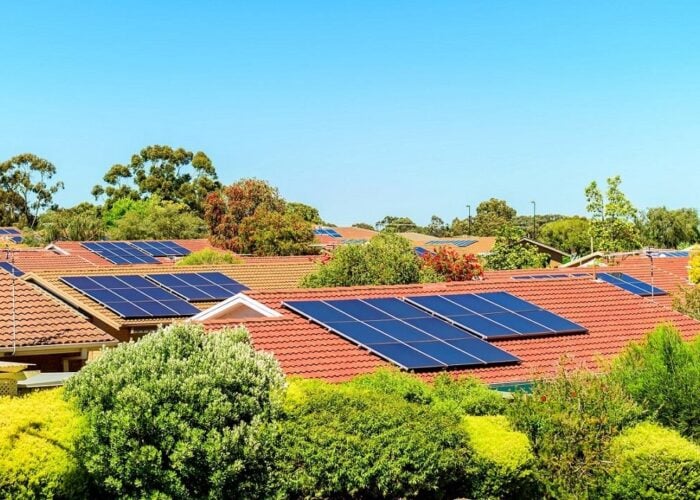
Indeed, the latest report from Aurora Solar found that third-party ownership (TPO) models were the driving force behind what it called “the new shape of solar”; the analyst surveyed more than 1,000 US homeowners and residential installers, and over half said that models like TPOs and PPAs were the most popular financing options for the residential sector. According to Fox Swim, Aurora’s senior solar industry researcher, the strong market fundamentals of residential solar in the US has helped drive this appetite for private financing mechanisms.
“Solar buildout in the US has still been relatively strong [and] some of that is because the fundamentals for solar are really strong,” Swim tells PV Tech Premium. “The big number that drives a lot of this is cost-per-watt for new power installation, as well as time it takes to bring that installation online.”
“Technically, if you squint at the numbers correctly, some implementations of nuclear and some implementations of LNG have similar cost-to-watt ratios, but the time to stand up capacity for nuclear is measured in decades and the time to stand up LNG is measured in years,” she continues, pointing to the global supply chain issues affecting the fossil fuel sector stemming from the current war in the Middle East.
TPOs and PPAs drive current residential financing
As Swim says, the low cost of solar in the US is a driving force behind the current state of its financing mechanisms. An April 2025 report from the US Energy Information Administration (EIA) found that the levelised cost of electricity (LCOE) of solar PV was US$31.86/MWh, lower than all fossil fuel technologies, and above only onshore wind, at US$29.58/MWh, among all technologies.
While the LCOE of solar has seen a small, and “anomalous”, increase in the first quarter of 2026, Swim says that the market fundamentals are still in the favour of solar in the US, and this has facilitated the TPO model that was shown to be so popular in the Aurora report.
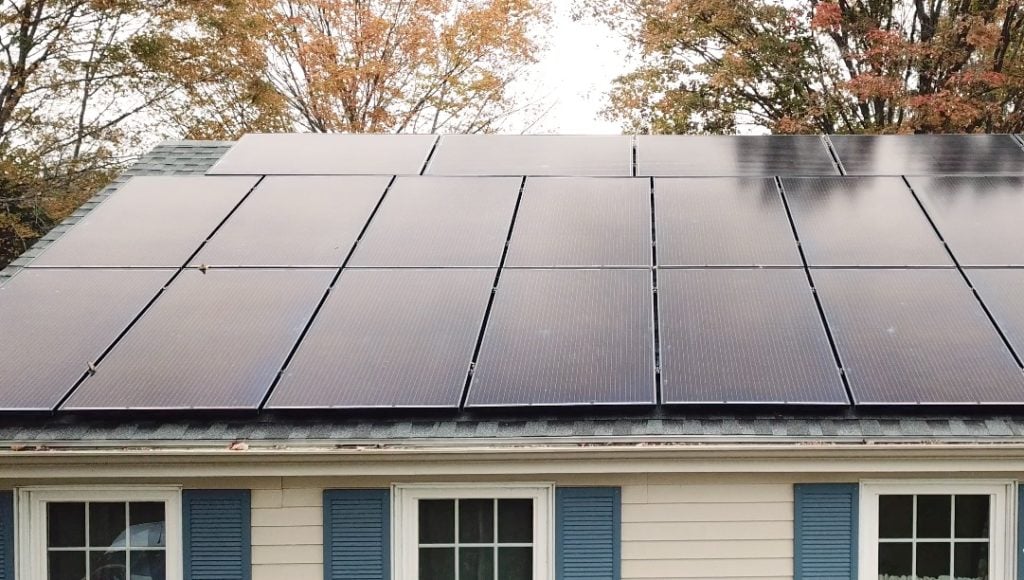
“Broadly speaking, what happens is you sign an agreement with a company and they’re the ones that own the panel on your roof,” Swim explains. “They install them, they own them and they maintain them—ostensibly anyway, as long as they don’t go out of business—then you purchase power from those solar panels at a much cheaper rate than what you’d purchase it for from the utility company.”
This system keeps capital costs down for homeowners, and gives them access to clean power at a much cheaper rate than they would otherwise pay. However, the effectiveness of this model is not owed entirely to free market dynamics; Fisher notes that it is the presence of the 48E investment tax credit (ITC), which was introduced by the Biden-era Inflation Reduction Act (IRA) and provides tax benefits for the generation of clean electricity, that facilities this model.
“The reason that this has been economical is there’s no more 25D, the direct homeowner tax credit, so the companies that are installing this are able to take the [48E] tax credit from the residences they install the solar panels on and then they sell that credit to someone else,” says Fisher.
Fisher also points to other mechanisms to facilitate residential solar, which currently exist on a smaller scale than the TPO model, but that could stand on their own feet without the support of the 48E tax credit, such as Virtual Power Plant Power Purchase Agreements (VPPPPAs).
“Instead of signing a deal with a third-party financier, you sign up to be part of a virtual power plant; I’ve seen models that are similar to a TPO model—where the utility is the owner of the infrastructure—and I’ve seen other ones where the homeowner is the owner, and then it’s more of a traditional PPA where you have a contracted rate [at which] you’re selling, as well as contracted access to batteries,” Swim explains.
Market dynamics are changing in a way that is not ‘durable’
However, as Swim says, these alternative models may have to become more popular in the future as there is uncertainty around the future of the 48E tax credit. Without policy support for this essential tax credit, this will create an environment that Swim describes as “not changing in a way that is durable.”
“The US federal government has made several changes to the way they handle solar and renewable energy installations,” explains Swim, referring to the One Big Beautiful Bill Act (OBBBA), which was passed by president Trump last year and introduced strict deadlines for a number of Biden-era policies designed to incentivise renewable energy deployment, such as the ITC.
“The 48E credit hits a cliff in 2027,” says Swim. “In order to get the 48E credit, which is really the only thing that makes these TPO systems viable, you also have to meet Foreign Entity of Concern (FEOC) requirements, which, by design, become more strict the further in time we get on.
“At the same time as the TPO financing in the US is the big thing right now, there’s a lot going on behind the scenes—a lot of companies [are] essentially taking this two-year grace window to try to figure out what’s happening next, after TPO solar is no longer viable.”

The ‘fragmented’ policy landscape
Indeed, Swim notes that not only has the Trump administration withdrawn policies that are supportive of renewable energy deployment, but is taking steps to make installation more challenging.
“The Department of the Interior put out a memo that rewired how the permitting process for larger solar and wind installations in the US worked, by making it so that instead of flowing through the standard Clean Water Act, or whatever permitting type of situation touches the Department of the Interior, those permits had to flow through the secretary of the interior, or his subordinate—so through the political appointee’s office.”
“That’s significantly slowed the process of these larger installations in the US,” Swim adds. This is borne out in other research; earlier this year, PV Tech Premium heard from Crux about how more arduous permitting requirements in the US could increase project deployment costs by tens of millions of dollars.
Far from being a sector where pure economic conditions influence the viability of solar deployments, then, US residential solar is just as affected by policy as deployments in Europe. The key difference is that Italy and France have all introduced auction programmes that developers have lauded for their role in facilitating new solar deployments.
Perhaps this is why the Aurora report calls for solar to be made “policy-proof” in the US, where the viability of a project is based on the market dynamics affecting the energy sector as a whole, and that currently favour technologies such as solar, rather than being based on the policy agenda of the current government.
“In the post-OBBBA world, the landscape for solar has become pretty fragmented,” adds Swim. “There are states and municipalities that have relatively good programmes to subsidise solar. None of them are quite as good as the subsidies that I’ve seen and read about in Europe—I have to admit I’m kind of envious—and to me it would feel a lot simpler and more efficient to do it in a European way.
Becoming more comfortable with solar-plus-storage
What the US residential sector does have in common with Europe, however, is an understanding of the crucial role of battery energy storage systems (BESS), both in terms of delivering a flexible energy supply, but also in making renewable energy generation projects more attractive investments.
“Looked at from a longer perspective, the idea that solar-only installations were financially viable has always been a transitional idea, and something for early adopters of the technology,” explains Swim, discussing the importance of co-located storage in US solar. “I don’t know of anywhere in the US where it is finally viable—unless you’re really independently wealthy—to only do solar.”
However, Swim notes that adding storage to a solar market that is already navigating fluctuations in market dynamics and the policy environment is an additional level of complexity. This is true for both investors, who have to weigh more options when making decisions, but also policymakers, who are having to adjust government support mechanisms in real-time as developers look to add ever more storage to their electricity generation assets.
“You also have to be able to calibrate incentive programmes to be able to be incentivising the right number, especially in the first couple of years of these roll-outs,” Swim explains. “I’ve seen different kinds of models that haven’t really made sense as to what they’re trying to incentivise.”
Perhaps this is why even in Europe, which has a more robust set of government auctions for renewable energy deployments, storage-specific auctions have only been introduced more recently. Germany, for example, has a strong tradition of government auctions for renewable energy, but became just the first EU member state to offer hybrid energy-plus-storage tenders last year, highlighting the expertise and experience required to effectively operate these kinds of more complex auctions.