
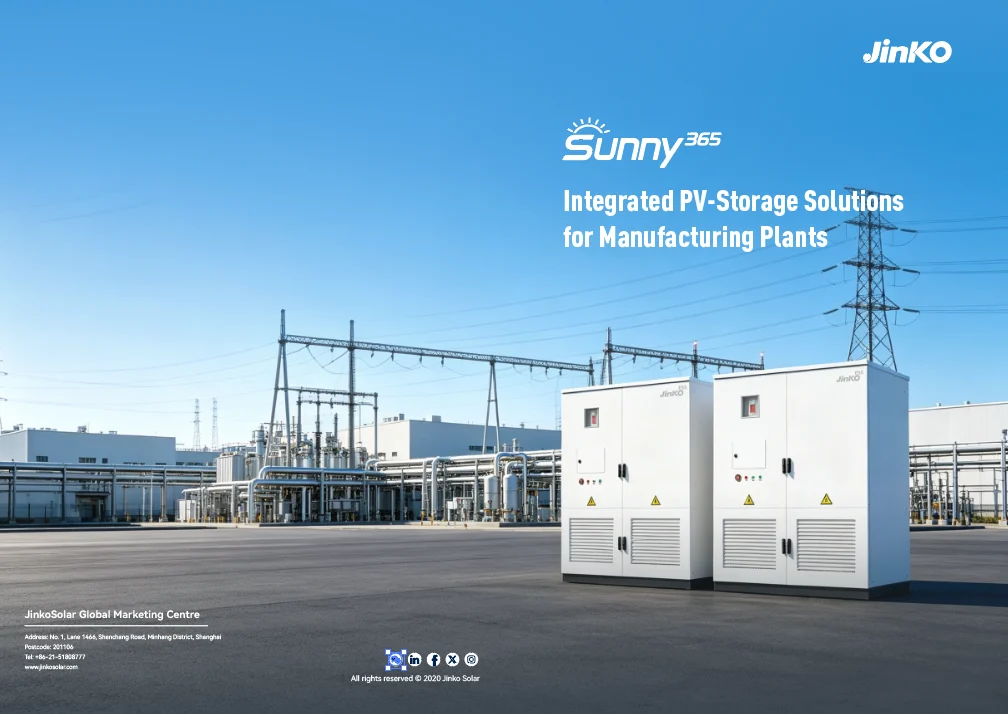
JinkoSolar has officially launched its “Sunny 365” smart PV-storage system—a solution tailored for the manufacturing industry. The solution integrates high-efficiency photovoltaics, smart energy storage and AI-driven dispatch to help manufacturing businesses in sectors including textiles, cement, steel, home appliances, home textiles, apparel, electronics, hardware, machinery and construction vehicles—a complete energy system ranging from on-site generation and self-consumption of green electricity to precise demand management and emergency backup power, thereby reshaping the energy infrastructure of industrial production.
As photovoltaic and energy storage applications become increasingly widespread, more and more manufacturing companies are utilizing idle rooftop space to build their own dedicated projects. However, they have long faced four major challenges: a lack of standardization in product selection, difficulties in matching PV and storage systems, high coordination costs and cumbersome post-installation O&M. Procuring modules, storage systems and other software and hardware separately, while integrating technical resources from multiple vendors, results in lengthy cycles and significant investment, keeping the barriers to implementing projects high for small and medium-sized manufacturers.
The “Sunny 365” smart PV-storage system series—specifically the manufacturing PV-storage solution—directly addresses these industry challenges by providing an integrated PV + energy storage + smart management solution, going beyond single-component PV or storage configurations. Centered around the Tiger Neo 3.0 high-efficiency PV modules and the SunGiga G2 C&I liquid-cooled ESS, it integrates AI-powered intelligent dispatch algorithms with the JinkoCloud platform to provide the manufacturing sector with a scenario-based, standardized and replicable one-stop energy solution.
To address core challenges faced by manufacturing plants—such as high electricity costs, stringent requirements for continuous production and significant load fluctuations—the solution offers standardized capacity configuration models covering three major industries.
The plants are high-voltage dedicated transformer users operating at 10 kV or higher, with production loads significantly higher during daytime and on weekdays than at night or on holidays. “Roof-mounted PV + consumer-side energy storage” is one of the most economically viable scenarios, featuring a high proportion of self-consumed PV power, while energy storage enables peak-valley arbitrage, demand response and distribution capacity relief.
Key challenges in electricity consumption include the high proportion of electricity costs in manufacturing expenses, as well as the significant impact of peak-hour and super-peak electricity rates on production costs. Power rationing or load shedding disrupts continuous production and production line downtime losses may far exceed the electricity costs themselves; short-term load spikes potentially leading to insufficient transformer capacity, with capacity expansion involving long lead times and high investment costs.
High-Efficiency solar-to-storage products: Reducing costs and boosting efficiency in the manufacturing industry
1. Feihu 3 Modules:
As a high-efficiency module product, the Feihu 3 features core advantages specifically designed for manufacturing rooftops – high power output, ultra-high bifaciality, excellent temperature coefficient, extremely low linear degradation and exceptional low-irradiance performance on cloudy or rainy days, and at dawn and dusk.
2. SunGiga G2 ESS: Quadruple safety protection
The ESS positions robust safety as its core competitive advantage, comprising material-level thermal isolation, electrical-level armour, multi-sensor fusion for rapid fire suppression and full-stack early warning.
One-Stop Full Lifecycle Service
Adhering to the service philosophy of “One Partnership, Complete Peace of Mind,” Jinko provides one-stop solutions covering the entire project lifecycle, including One-Stop solution design, One-Stop warranty and One-Stop service.
1. Textile Manufacturing Model
Standardized PV and Energy Storage Installation Capacity Design:
PV Capacity: 15 MWp of rooftop and carport PV, assuming full coverage at 0.12–0.16 kWp/m² on rooftops; approximately 100,000–120,000 m² of usable rooftop area is required, with an annual electricity generation of 16.5 million kWh.
Energy Storage Capacity: 1.5 MW/3 MWh (can be configured to cover 15%–30% of peak load).
Control System: An EMS is configured to integrate PV, energy storage, main transformer loads, production schedules and time-of-use electricity rates to achieve demand response.
2. Cement Plant Model
Standardized PV and Energy Storage Capacity Design:
PV Capacity: 60 MWp (ground-mounted PV project, annual electricity generation of 66 million kWh)
Energy Storage Capacity: 10 MW/20 MWh
Control System: The EMS integrates PV, energy storage, main transformer loads, production schedules and time-of-use electricity rates to achieve demand response.
3. Steel Mill Model
Standardized PV and Energy Storage Capacity Design:
PV Capacity: 100 MWp (rooftop PV; PV capacity accounts for approximately 40%–60% of the load)
Energy Storage Capacity: 150 MW/300 MWh (Energy storage capacity accounts for approximately 60%–80% of the load; it exceeds the PV installed capacity and is used to smooth load fluctuations, perform peak shaving and valley filling and support the microgrid)
Control System: The EMS integrates PV, energy storage, main transformer loads, production schedules, and time-of-use electricity rates to achieve demand response.
The “Sunny 365” manufacturing solar-storage solution provides factory owners with end-to-end standardized services—from equipment selection and system configuration to intelligent O&M. As the use of green electricity becomes a cost-saving measure across all industries and a mandatory compliance requirement, industrial and commercial organisations must keep pace with innovations in the three key areas of photovoltaics, energy storage and AI applications. The Sunny 365 system offers a one-stop solution—a self-sustaining tool that generates sustainable returns over the long term. It provides long-duration, intelligent and stable power supply, while enabling peak-valley arbitrage with surplus electricity, helping manufacturers reduce costs, improve efficiency and achieve a green transition under the electricity market mechanism.
