US solar module prices have surged in the run-up to the Section 232 polysilicon measures taking effect on 4 December, according to new data from Anza.
According to the solar and storage supply chain platform’s ‘Q4 2026 Solar & Storage Pricing, FEOC & Domestic Content Report’, the median module price jumped by 35.1% between July and October as the market absorbed a policy shift that will establish a hard floor for import pricing.
Try Premium for just $1
- Full premium access for the first month at only $1
- Converts to an annual rate after 30 days unless cancelled
- Cancel anytime during the trial period
Premium Benefits
- Expert industry analysis and interviews
- Digital access to PV Tech Power journal
- Exclusive event discounts
Or get the full Premium subscription right away
Or continue reading this article for free
The Section 232 polysilicon proclamation, signed on 6 August, establishes a minimum import price (MIP) of US$0.38/W for modules, US$0.22/W for cells, US$100/kg for wafers and $21/kg for polysilicon, plus a 15% ad valorem tariff.
The measures take effect on 4 December, but as Anza’s figures reveal, their impact on pricing has already hit the industry. After nine months holding steady in a tight US$0.275 to US$0.290/W range between November 2025 and July 2026, the overall median module price jumped to US$0.385/W by October, a 35.1% increase since July and 36.5% since November 2025.
The repricing has hit technologies and origins unevenly, Anza said. Imported modules, which make up the bulk of the exposure, climbed 43.4% since July to land at US$0.380/W, effectively right at the new MIP.
By contrast, modules using US-made cells rose a comparatively modest 7.2%, to US$0.505/W, while ‘Domestic Lite’ products, which pair imported cells with at least one qualifying US-made component, climbed 14.5% to US$0.394/W.
That divergence has narrowed the premium for domestic content considerably. Domestic Lite’s premium over imported modules shrank from 7.9 cents/W (¢/W) in July to just 1.4¢/W in October, while the premium for US-cell modules fell from 20.6¢/Wto 12.5¢/W. Anza said this narrowing made blended procurement strategies more attractive for projects chasing the Domestic Content bonus.
“Paired with other domestic equipment, Domestic Lite can now get a project to the bonus threshold for a module premium of roughly 1.4¢/W, compared with about 12.5¢/W for modules with US-made cells.”
Technology pricing – mono PERC, TOPCon and HJT
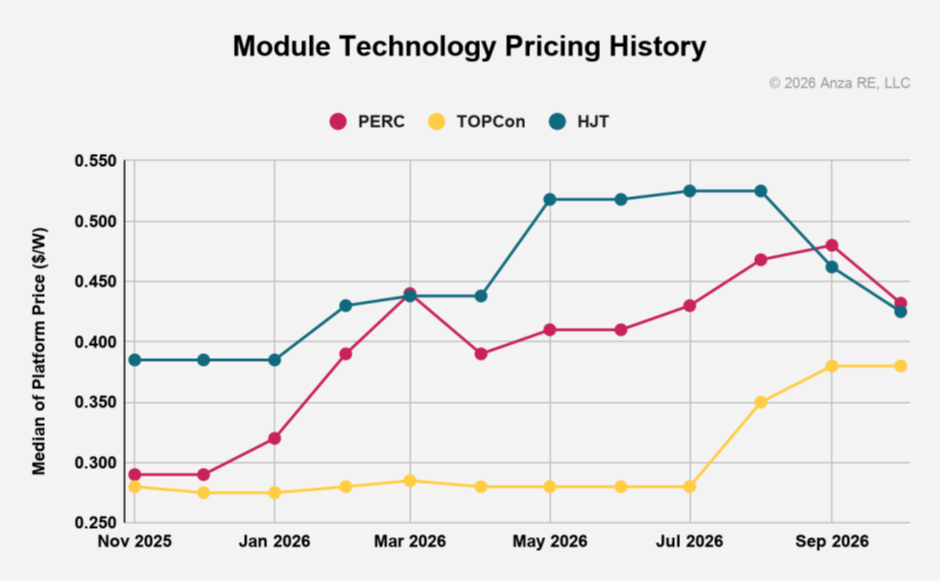
In terms of technologies, tunnel oxide passivated contact (TOPCon) modules, overwhelmingly reliant on imported cells, rose 35.7% to US$0.380/W.
The story is different for the mono PERC modules on Anza’s platform, with 55% using either US-made cells or qualifying as Domestic Lite. Anza said that domestic emphasis shaped a different price trajectory: PERC’s 49% rise since November largely predates the Section 232 proclamation, driven instead by buyers racing to secure domestic supply ahead of July’s Safe Harbour deadline. Since July, PERC has been essentially flat, up just 0.5% to US$0.432/W, after peaking at US$0.48/W in September before easing back. As a result, PERC’s premium over TOPCon has narrowed sharply, from 15 cents/W in July to roughly 5 cents/W by October.
Heterojunction technology remains a smaller, more volatile category, with pricing down 19% since July to US$0.425/W, though still up 10.4% since November. Anza attributed the recent decline to a handful of lower-priced entries from newer, not-yet-established manufacturers pricing aggressively to win financing commitments, suggesting the drop may reflect individual outliers rather than a broader shift in HJT economics.
Anza said further upward pressure remains possible. The US Department of Commerce retains discretion to adjust the MIP, and suppliers are still awaiting guidance on polysilicon onshoring exemptions. Anza noted that despite the overall jump, select suppliers on its platform continue to offer modules below the MIP even after the 4 December start date, underscoring the value of real-time pricing visibility for buyers racing to lock in supply.
Anza said that the main constraint was now availability, as about half of US-cell modules are sold out for Q4 deliveries and buyers are rushing to secure domestic supply in 2027.