US automotive and clean energy company Tesla has filed an application seeking a school property tax break to build a US$3.1 billion polysilicon facility in Nueces County, Texas, US.
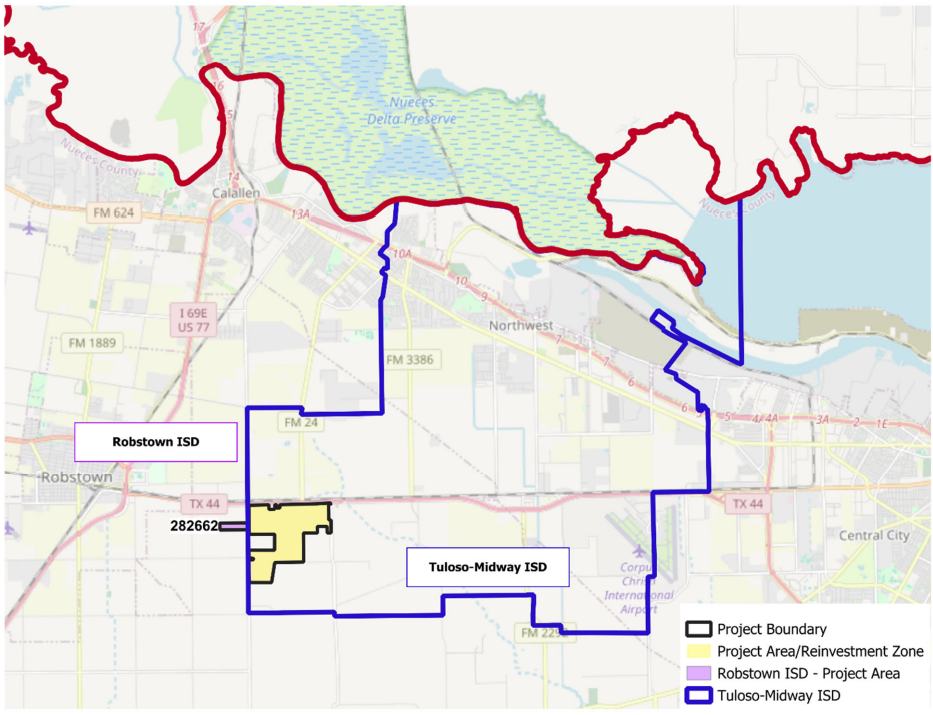
Majority-owned by Elon Musk, Tesla filed the application with the Tuloso-Midway Independent School District (ISD) under the state’s Jobs, Energy, Technology and Innovation (JETI) programme, under which it is seeking a tax break for the construction of the facility, which would otherwise be non-viable, according to the application.
Try Premium for just $1
- Full premium access for the first month at only $1
- Converts to an annual rate after 30 days unless cancelled
- Cancel anytime during the trial period
Premium Benefits
- Expert industry analysis and interviews
- Digital access to PV Tech Power journal
- Exclusive event discounts
Or get the full Premium subscription right away
Or continue reading this article for free
An analysis from accounting and consulting firm Ernst & Young (EY) included in the application mentioned that without the tax break, Tesla would not pursue the project.
“A JETI agreement is a compelling factor in the Applicant’s competitive site selection determination, and in the absence of the agreement the Applicant would not make the proposed investment in this state,” wrote EY in its analysis.
In its application form, the company is requesting a 50% abatement in property tax with the Tuloso-Midway ISD school district between 2031 and 2040. From 2041 Tesla would then pay the full value of the property’s appraised value for school operations.
Steve VanMatre, superintendent at Tuloso-Midway ISD, told local news outlet KRIS 6 News: “We were aware of the significant investment Tesla is interested in making. It is not a guarantee.”
Commercial operations in 2030
According to the economic analysis made by EY, the facility would manufacture high-purity polysilicon from ultra-pure trichlorosilane (TCS), with construction expected to begin in 2027.
Commercial operations of the facility are forecast for 2030 and would hire a total of 515 employees by 2032, with an initial 260 jobs in 2030.
The majority of the US$3.1 billion investment would be made between 2028 and 2029, with US$1.5 billion towards engineering and construction, US$1.4 billion towards equipment and US$183 million for development of utility infrastructure.
“This is another huge investment in US solar manufacturing by Tesla. It makes sense, since the scale of polysilicon needed for Project Crystal Sun would have had to be imported, adding higher costs and policy risks to the investment,” said Joe Hennessy, analyst at PV Tech Research, referring to Tesla’s proposed vertically integrated solar facility in Richmond, Texas.
Tesla to join Wacker Chemie and Hemlock Semiconductor
Across the entire solar supply chain, polysilicon remains the part with the highest concentration of capacity built in China, with only a select few companies with operational capacity across the globe. In the US, only Wacker Chemie and Corning’s Hemlock Semiconductor are currently producing polysilicon for the solar market.
This comes down to the fact that building a new facility in the US requires a significant investment. Last year Richard Rast, CEO at Highland Materials told PV Tech that to build a 20,000 metric ton polysilicon facility, using a traditional process could require an investment of US$1.5-2 billion (subscription required).
The timing of Tesla’s tax break application comes only weeks before Section 232 tariffs on polysilicon and its derivatives come into play. From 4 December, the US will introduce a 15% tariff and minimum price imports that would make the import of polysilicon much higher for Tesla, especially considering the company targets building a 100GW vertically integrated solar manufacturing facility. Given the shortages of domestic polysilicon, even with its US$3.1 billion polysilicon factory, Tesla would still for short of a local supply for its 100GW target, but Section 232 aims to stimulate domestic polysilicon, ingot and wafer production, theoretically paving the way for more US facilities such as the one proposed by Tesla
Although Tesla did not disclose how much capacity it aims to produce at the US$3.1 billion polysilicon facility, using the numbers above as a comparison for Tesla’s investment in the polysilicon factory in Texas, that could mean an annual nameplate capacity of around 40,000 metric tons.
“This announcement comes at an interesting time, as China’s Ministry of Commerce asked for comments on banning and restricting various polysilicon, ingot, wafer and cell manufacturing technologies on 16th October, public consultation closed on 15th November.
“Looking at other facilities and estimates based on the capex Tesla is spending, we expect this facility to have 30-40,000 MT of capacity, exports of machines with a single-line capacity of ≥30,000 MT are proposed to be restricted. How this will be enforced will no doubt have an effect on the facility,” explained Hennessy.
As Hennessy highlighted, it will also remain to be seen where Tesla will source the necessary equipment to build its polysilicon facility, especially given that China proposed last month imposing export controls on key solar PV components, including polysilicon. Among the proposed export prohibitions for polysilicon, China included annual limitations on TCS of at least 250,000 metric tonnes per production line.
Tesla’s solar expansion
In addition to planning a polysilicon facility in Nueces County, Tesla has also made progress on its US$10.1 billion vertically integrated solar cell plant, Project Crystal Sun, in Fort Bend County, Texas. Construction for that facility is expected to run between 2026 and 2028, while commercial production is scheduled for the first quarter of 2029.
More recently, aerospace manufacturer SpaceX, another company owned by Elon Musk, signed a supply agreement with German solar cell production equipment company Singulus Technologies for a turnkey production line for manufacturing heterojunction technology (HJT) solar cells, with further additional lines to be delivered in the future.
Singulus is expected to deliver the production line during the first half of 2027.
Tesla’s investment in the solar supply chain isn’t limited to the production of solar panels, as the company unveiled at RE+ this week a solid-state medium-voltage power electronics platform designed to integrate battery energy storage, utility-scale solar, and data centre power systems.
Called Powercore, Tesla said the platform combines the functions of a transformer, circuit breaker and inverter in a single enclosure, converting power between medium-voltage AC and low-voltage DC. The first units are expected to be delivered in 2027.