US EV, battery, AI and robotics company Tesla has unveiled Powercore, a solid-state medium-voltage power electronics platform designed to integrate battery energy storage, utility-scale solar and data centre power systems, with the first units expected to be operational in 2027.
Launching the Powercore at the RE+ trade show in Las Vegas this week, the US company said the platform combines the functions of a transformer, circuit breaker and inverter in a single enclosure, converting power between medium-voltage AC and low-voltage DC. Tesla made its announcement yesterday via the Tesla Megapack account on social media platform X, which company CEO Elon Musk owns.
Try Premium for just $1
- Full premium access for the first month at only $1
- Converts to an annual rate after 30 days unless cancelled
- Cancel anytime during the trial period
Premium Benefits
- Expert industry analysis and interviews
- Digital access to PV Tech Power journal
- Exclusive event discounts
Or get the full Premium subscription right away
Or continue reading this article for free
Powercore has a continuous power rating of up to 9MVA (7.4MW) at 34.5kVac, with peak power of 10MVA for grid-forming applications. It supports nominal AC voltages of 10kV to 34.5kV and DC voltages of 800V to 2,000V.
Tesla claims peak conversion efficiency of 98.86%, with system availability guarantees of 99.9% or higher and a warranty of up to 25 years. The platform is designed to operate at temperatures ranging from -40°C to 55°C.
The announcement places Tesla in a growing market for solid-state transformers (SSTs), as manufacturers seek to replace conventional transformer-based power architectures with more compact, efficient power electronics.
As reported on our sister website, Energy-Storage.news, competitors include Envision, which has announced the commercial deployment of an integrated 800Vdc power system at its Galaxy AI data centre campus in Ulanqab, China, and Heron Power (founded by former Tesla exec Drew Baglino), which has secured a deal with data centre operator Vantage for more than 1GW of manufacturing capacity for its Heron Link SST. Designed for hyperscale data centres, Heron Link converts medium-voltage grid power directly to 800 Vdc and integrates battery energy storage.
Powercore targets battery storage, solar and data centres
For battery energy storage systems (BESS), Powercore is designed to replace the separate inverter and medium-voltage transformer stages currently used to connect batteries to the grid.
Tesla said its existing utility-scale Megapack BESS architecture converts battery DC into 480Vac before a transformer steps the voltage up to medium voltage. Powercore instead converts battery DC directly into medium-voltage AC in a single stage.
The company said the architecture reduces conversion losses, increases site energy density and enables more energy to be delivered from the same battery capacity.
Powercore will be close-coupled with Megapack, with both products delivered pre-assembled.
Tesla also plans to integrate the platform with Powerhub, its energy management and power plant control (PPC) software, providing a standardised system backed by Tesla warranties and service.
The company said Megapack 2 XL achieved average annual availability of 99.73% across more than 50GWh of deployed capacity as of the third quarter of 2026.
Tesla added that more than 100GWh of its energy storage products are operating across 2,000 projects in 68 countries. ESN Premium took a deep dive recently into Megapack 3, the latest iteration, and Megablock, which combines multiple Megapack units into one system. In the company’s most recent financial results, Tesla reported 13.7GWh of energy storage deployments in Q2 2026, of which the vast majority comprises grid-scale Megapacks, rather than its residential Powerwall solution.
800Vdc architecture for AI data centres
Powercore is also designed to support the transition towards 800Vdc power architectures for AI data centres.
Most existing data centre equipment operates on 415-480Vac supplies, requiring multiple stages of voltage transformation and power conversion. Tesla said Powercore can convert medium-voltage grid power directly to 800Vdc, reducing the number of conversion stages and associated equipment.
The platform includes built-in redundancy, which Tesla said enables up to 99.7% product-level availability. The company claims this can reduce the additional equipment required to achieve five-nines system-level availability.
Tesla said it already has 1GWh of Megapack storage operating at data centres and is incorporating experience from those deployments into Powercore.
The company is also collaborating with AI computing giant Nvidia on engineering work to support 800Vdc architectures in next-generation data centres. Tesla’s Megapack has already qualified under Nvidia’s DSX Ready programme, with the company identifying it as one of the first battery energy storage solutions to do so.
Utility-scale solar integration
For utility-scale solar, Powercore is designed to operate as a central PV inverter, converting DC electricity generated by solar arrays directly into medium-voltage AC.
The platform supports existing 1,500Vdc solar systems and emerging 2,000Vdc architectures, according to Tesla.
The company said the integrated system could reduce reliance on separate inverters and transformers, addressing equipment supply constraints and reducing the impact of inverter downtime on plant availability.
Tesla also highlighted the platform’s modular design, which allows components to be serviced in the field without replacing the complete unit.
US manufacturing planned for 2027
Tesla said Powercore will be manufactured in the US, using US and imported components, with the first units expected to be operational in 2027. The company has not specified a manufacturing facility or production volume for the platform.
Tesla said it currently has 140GWh of annual Megapack manufacturing capacity, including 90GWh across California, Texas and Nevada.
The company also reiterated its commitment to manufacturing 100GW of solar annually in the US, although it did not provide a production timeline or further details alongside the Powercore announcement.
In August 2026, Tesla submitted plans for a US$10.1 billion vertically integrated solar manufacturing campus, dubbed Project Crystal Sun, on a 3,050-acre site in Fort Bend County, Texas.
The company said the platform will be designed, manufactured, deployed and serviced in-house, supported by a global service team of more than 900 field technicians.
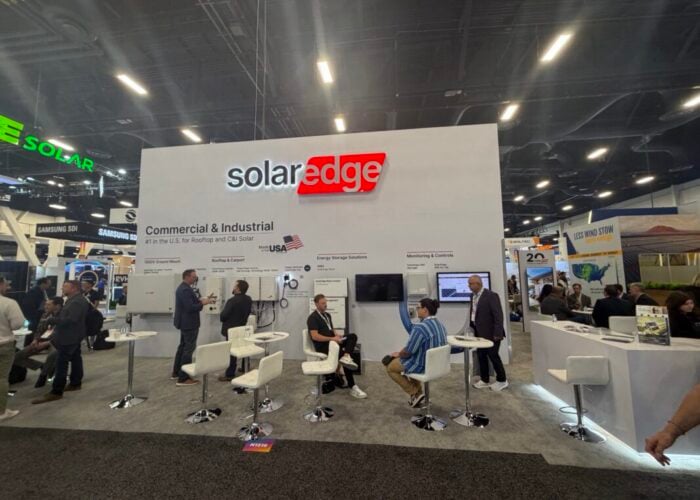
The Powercore launch follows several other product announcements at RE+ 2026, including new launches from SolarEdge, Voltage Energy, Terabase Energy and PVcase.