
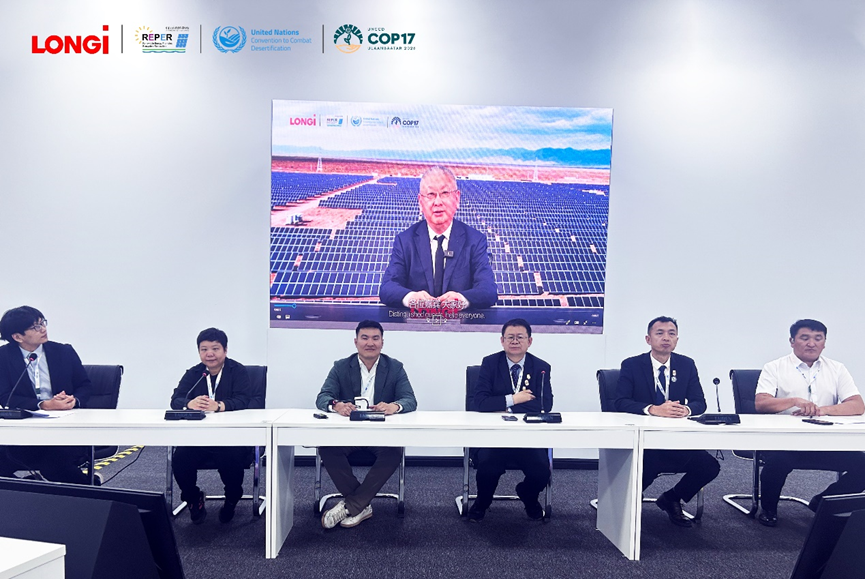
The 17th session of the Conference of the Parties to the United Nations Convention to Combat Desertification (UNCCD COP17) is currently underway in Ulaanbaatar, Mongolia, with LONGi participating in several side events, systematically presenting the enormous potential of PV technology to enhance the resilience of global food supply, and officially releasing its solutions for PV-powered food security.
At an event titled “From Desert to Asset – Comprehensive Solutions for Integrated PV-Based Ecological Restoration,” co-hosted by Tsinghua University’s School of Social Sciences and the China Green Foundation, LONGi founder and CTO Li Zhenguo joined via video link and noted that traditional food production relies heavily on natural photosynthesis and climatic conditions. Extreme weather events such as droughts and floods have severely impacted agricultural production, and global climate change is placing unprecedented pressure on an already fragile food supply system. However, as costs decline, PV technology can not only reduce carbon emissions but also offer a new solution for enhancing the resilience of global food supply.
Li recently published a forward-looking perspective article titled“Photovoltaics for food security” in the leading international academic journal Nature Sustainability, in which he systematically set out two technological pathways with prospects for practical application.
Pathway 1: PV-driven artificial synthesis of starch from carbon dioxide.
PV-generated electricity is used to electrolyze water and produce green hydrogen, which is then coupled with captured CO₂ to synthesize green methanol. The methanol is subsequently converted into starch through oxidation, polymerization and other processes. Compared with the solar energy utilization efficiency of about 2% in traditional natural photosynthesis, this pathway can raise efficiency to 7–10%. Calculations show that deploying PV on just 3.7% of the Sahara Desert could generate 26 trillion kWh of green electricity, enough to synthesize 3 billion tonnes of food and meet current global food demand.
Pathway 2: PV-driven “energy-water-food” nexus system.
By building PV power plants in desert areas, the shading effect of PV modules reduces soil moisture evaporation, improves the soil microclimate and lowers irrigation requirements. Combined with PV-powered seawater desalination and inter-regional water transfer projects, this approach can gradually transform desert land that was previously unsuitable for cultivation into arable farmland.
In fact, LONGi has already been actively exploring this approach in the Kubuqi Desert in Inner Mongolia, generating electricity from panels, planting crops under the panels and raising livestock between the panel rows. Below the panels, the once barren land is being revitalized. This practice verifies the feasibility of integrated PV-ecology-agriculture development and provides a replicable solution for the coordinated development of ecological restoration and food production in desertification-prone areas.
Under the theme of this year’s COP17 of “Restoring Land, Restoring Hope,”LONGi has actively participated in multiple side events, engaging in in-depth exchanges with government agencies, scientists and corporate representatives from around the world, sharing Chinese experience in the integration of PV with desertification control and ecological restoration.
