

LONGi has unveiled its comprehensive “Full-Stack LONGi ONE” strategy at the recently concluded SNEC 2026 in Shanghai, presenting a deliverable, verifiable and responsibility-closed-loop solar-storage integration solution.
LONGi founder and CTO Li Zhenguo stated in his opening address that, over the past two decades, the PV industry has made solar power sufficiently cheap. However, as the share of PV generation increases, grid stability, dispatchability and energy storage coordination have become new bottlenecks.
Li stated: “Cheap electricity that cannot be stably fed into the grid or flexibly used has a ceiling on its value. This is not a technical detail but a hurdle that energy transition must overcome.” Li believes that overcoming this hurdle requires more than just a module, an inverter or a storage cabinet—it demands a complete technological system and ecosystem capability. This insight forms the logical starting point for LONGi’s transformation from a single-component supplier to a solar-storage integrated solutions company.
This judgment was quickly translated into an industrial solution in the subsequent keynote speech, with VP Dennis She pointing out that, although solar-storage integration is a clear path, solar and storage systems often come from different suppliers, relying on heterogeneous communication protocols for interconnection. This leads to loss stacking, inefficient joint debugging and blurred lines of responsibility. Customers not only suffer efficiency losses but also bear the hidden costs arising from lack of system integration. This is precisely the industrial manifestation of the “systemic bottleneck” described by Li.
On the first day of the exhibition, LONGi introduced a series of solutions for GWh-level power stations and industrial/commercial grid sectors. The core is to reconstruct the solar-storage coordination mechanism from the ground up, achieving native integration from high-efficiency BC PV technology to the full 5S (BMS, iCCS, EMS, TMS, PCS) of energy storage systems, breaking the silo effect of PV and storage from the source.
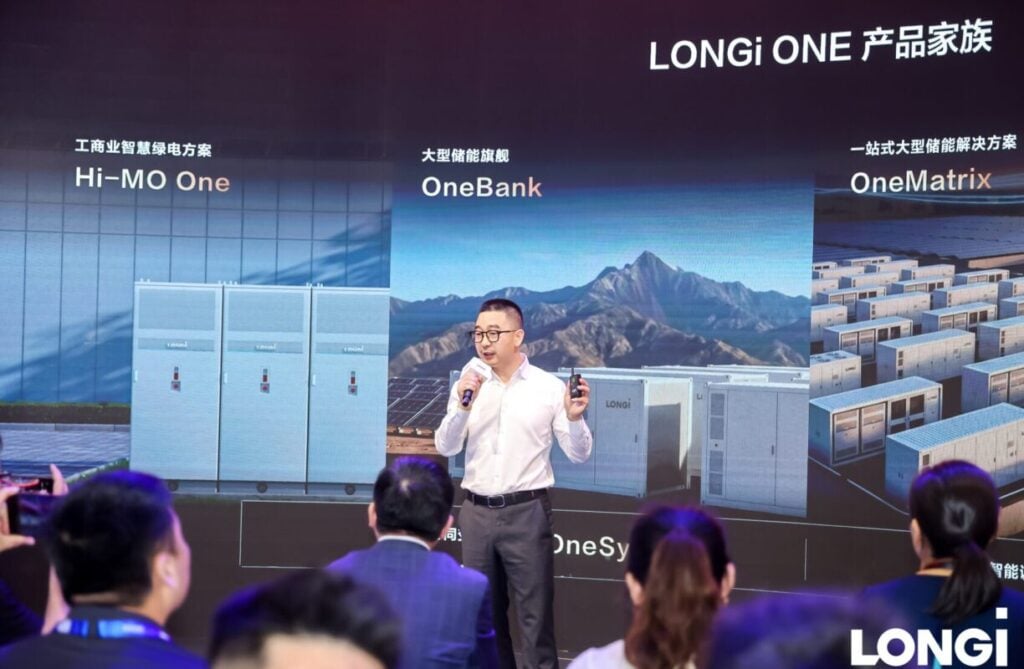
From the OneBank 2.0 and OneMatrix 2.0 for GWh-level large-scale power stations, to the Hi-MO ONE smart green power solution for industrial and commercial users, the OneNexus off-grid microgrid storage flagship, the global collaborative power conversion core OneSync, and the OneOS cloud-based intelligent dispatch platform, LONGi’s full-stack approach builds a product matrix covering all scenarios on a unified technical foundation, providing customers with complete solutions from centralized power stations to distributed parks. Ending the era of patchwork means customers no longer need to coordinate multiple suppliers themselves or bear the hidden costs of system fragmentation.
In terms of quantifiable system-level gains, the round-trip efficiency of the OneBank 2.0 and OneMatrix 2.0 systems reaches 93%, about 4 percentage points higher than similar discrete solutions. Cluster-level management technology increases the total power generation over the storage lifecycle by 8%. Together, these improve project ROI by 2 to 4 percentage points. On safety, OneBank extends the thermal runaway prediction window to over three months for the first time. On service, a single-responsibility model supports a 99% system availability rate.
Li described this full-stack capability as a “capability extension”: LONGi is extending its breakthroughs in monocrystalline silicon, diamond wire and BC technology over the past 26 years from the power generation end to the storage, dispatch and operation ends. “This is not a cross-border move, but an extension of capability—and also a responsibility.”
Li emphasized that LONGi’s foray into solar-storage integration is not to build a closed ecosystem. “On the contrary, it is to open up better. Only with system-level capabilities can we truly understand the pain points of our partners and co-build an efficient, trustworthy solar-storage ecosystem.”
The advantages of the full-stack self-developed architecture are not limited to the energy conversion process but extend throughout the entire project lifecycle. LONGi is promoting the global implementation of its “2830 Plan,” aiming to build 30 versatile local service centres in major solar-storage integrated markets worldwide by 2028, covering the entire value chain from early planning and solution design to full-process delivery and implementation, and then to lifecycle operation management.
Last month, the first overseas service centre was established in Madrid, Spain. No matter which time zone the customer is in or which language they use, they can receive localized, rapid response and professional support—no longer lagging responses from remote coordination, but proactive, localized assurance; no longer fragmented, reactive answers, but end-to-end solution delivery. Service has been upgraded from a single delivery action to a systemic commitment that runs through the entire project.
If Full-Stack LONGi is the system-level answer to solar-storage integration, BC technology is the foundational cornerstone. Charles Jiang, LONGi VP and President of the PV Product Management Centre, demonstrated the irreplaceability of BC technology from the perspective of the core PV device.
He outlined the full picture of BC technology’s journey from lab to mass production with a set of data: From 2023 to the end of 2026, LONGi’s cumulative global shipments of BC modules are expected to approach 100GW, with a leapfrog increase from 6GW in 2023, 17GW in 2024, 23GW in 2025, to an estimated over 50GW in 2026. “BC is no longer a niche technology; it has fully entered the era of mass production and scaling.”
Jiang analyzed the inevitability of BC from first principles. Solar efficiency is determined by open-circuit voltage, short-circuit current and fill factor, which form an “impossible triangle” of mutual constraints. Traditional front-griddle batteries increase grid line area to improve fill factor, inevitably leading to increased shading, reducing open-circuit voltage and short-circuit current, and preventing the process from reaching its maximum potential. “BC technology, through its all-back-contact structure with 100% no metal shading on the front, simultaneously addresses shading and recombination issues, perfectly balancing the triangle. This is the first principle for choosing BC.” As a platform technology, BC can be combined with HJT, TOPCon and other routes. HPBC offers a 20-30W lifecycle power advantage over existing technologies.
In mass production validation, LONGi’s HPBC modules achieve 670W power with a 99% yield. The company has consecutively broken multiple world records: 28.13% for single-crystalline silicon cells, 34.1% for commercial-size tandem cells, 35.2% for crystalline silicon-perovskite tandem cells and 26.4% for BC cell modules—making it the only solar company in the world to hold world records in both major cell technology camps.
“BC’s advantages go far beyond efficiency.” In terms of safety, BC’s weak conduction design reduces hot-spot local temperature by over 28% compared to conventional cells—equivalent to buying a 30-year “fire insurance policy” for a power station. For anti-microcrack performance, BC uses a “one-stroke” welding structure instead of the traditional “Z-shaped” welding, in principle reducing stress concentration. Combined with LONGi’s Tairay silicon wafers, which are 10μm thicker than ordinary wafers, microcrack risk is reduced by approximately 87%. Local precision welding and 0BB design further reduce product risk. For anti-shading performance, when a BC cell is shaded, it can self-bypass, resulting in 70% less power loss than TOPCon. Combining all characteristics, BC modules achieve an 8.81% increase in power generation per unit area.
On the commercial implementation front, signing ceremonies at the exhibition booth made LONGi’s full-stack ecosystem more tangible, the company successively reaching strategic cooperation agreements with Generali China Insurance, Shenzhen Fengshi Algorithm Technology, Xi’an Fengpin Energy Technology and Xi’an Zhongchuang Xinneng Network Technology, covering key nodes of the full solar-storage stack from storage safety insurance and algorithm optimization to energy operations and digital networks.
Li placed this progress in a longer-term perspective: “If we call the past two decades the first half of ‘making solar cheap,’ then the next decade is the second half of ‘making solar-storage a major power source.’ LONGi is willing to be the pioneer, using action to blaze a verifiable trail.”
