The US has become a unique market when it comes to the technology choice for solar PV. The majority of the manufacturing announcements made until late 2025 had PERC as the technology of choice for module or solar cells, but more recently, several manufacturers have either brought online or announced plans to build heterojunction (HJT) manufacturing capacity for solar cells and/or modules.
One of the main reasons for the rise of HJT as the n-type technology of choice in US solar manufacturing is the history of intellectual property issues surrounding TOPCon technology. Over the past couple of years, there has been a flurry of patent infringement cases not only in the US but also in Europe. This was further escalated earlier this year when the US International Trade Commission (ITC) began a Section 337 investigation into TOPCon solar products in the US, following a complaint by US thin-film module manufacturer First Solar.
Try Premium for just $1
- Full premium access for the first month at only $1
- Converts to an annual rate after 30 days unless cancelled
- Cancel anytime during the trial period
Premium Benefits
- Expert industry analysis and interviews
- Digital access to PV Tech Power journal
- Exclusive event discounts
Or get the full Premium subscription right away
Or continue reading this article for free
However, this year has seen several new announcements focused on heterojunction, with Canadian Solar and SEG Solar among the first to bring online either cell or module capacity for that technology.
This is despite the fact that even in China, the number of companies making HJT has decreased over the years in favour of TOPCon or back contact, as shown earlier this year by Kiwa PVEL’s PV Module Reliability Scorecard. Tristan Erion-Lorico, vice president of sales and marketing at Kiwa PVEL, told PV Tech at the time that there were fewer HJT testings than in previous years.
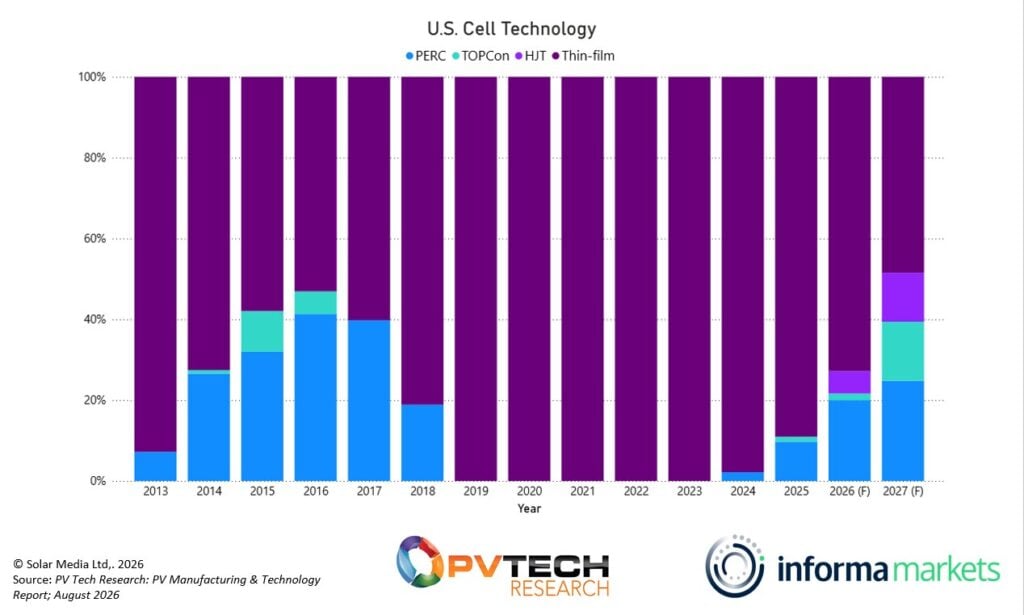
In the US, the trend is going the opposite direction, as shown from the conversations held at PV ModuleTech USA earlier this year and from recent data from PV Tech Research, which forecasts that HJT cell production capacity could account for around 10% of total US cell production capacity in 2027, as shown in the chart below.
Amongst the companies planning to build new solar cell capacity in the US is Japanese solar cell and module manufacturer Toyo. The company recently announced plans to build HJT capacity in the US with a 1.5GW solar cell nameplate production capacity at its Houston, Texas, manufacturing facility, where it is already producing TOPCon modules with a 1GW annual nameplate capacity that will increase to 2GW in the coming weeks. Another is California-based module manufacturer DYCM, which expects to begin commercial shipments of its first HJT line in Q4 2026.
Rhone Resch, chief strategy officer at Toyo, explains that the HJT solar cell expansion factors in the recent Section 232 tariffs on polysilicon and its derivatives.
“What that proclamation really does is it allows you to bring product in at a reduced tariff level, or maybe tariff-free, if you’re building out capacity in the United States,” says Resch.
Certainly, having an import tariff not only on polysilicon but also on its derivatives helps balance the price of foreign-made cells and modules compared to domestic ones, making HJT technology more financially viable.
Both Resch and DYCM explain that the capital expenditure required for HJT manufacturing is higher, with Resch saying that “we fully expect that to come down”.
The more, the better
For Resch, Section 232 tariffs on polysilicon and its derivatives create a structure that “does support investment into advanced solar technologies”.
He also adds that one of the benefits of having more companies manufacturing HJT cells is improved equipment scalability: “The benefit of having more companies manufacture HJT cells is that the equipment that’s used to produce the cells is going to be manufactured at a much greater scale, and subsequently at a much lower cost.”
However, equipment procurement has been highlighted as one of the main challenges for HJT technology by both SEG Solar and DYCM.
SEG Solar’s CEO Jim Wood highlighted the difficulty of procuring equipment for HJT lines from Chinese suppliers in an interview with PV Tech in July. “I could definitely see companies that didn’t already secure their HJT equipment having issues,” said Wood at the time.
“Securing specialised overseas production gear is increasingly tight as Chinese policymakers weigh advanced technology export curbs on key suppliers such as Suzhou Maxwell Technologies, compounding US customs reviews. The US policy regarding tariffs on imports from China has compounded the issue,” Ravindra Nuggehalli, CTO at DYCM Power, further explains to PV Tech.
Nuggehalli adds that “its historic relationship with European equipment manufacturers has secured excellent cooperation in addressing its requirements of turnkey production line”, and that the entire production line will be set up by DYCM in collaboration with European manufacturers.
HJT vs TOPCon
Ascribing the move by many US manufacturers from PERC to HJT in preference to TOPCon purely to the latter’s IP risk would be to oversimplify. After all, several of the companies that are manufacturing HJT also have TOPCon manufacturing in the US.
“First and foremost, HJT has the highest commercially available efficient solar cell on the marketplace. When we talk to our customers, who are primarily utility-scale developers or asset owners, they are looking to generate greater output from a similar footprint, and that means higher efficiency,” explains Resch regarding the advantages of HJT technology.
Another advantage for HJT technology over TOPCon or IBC (interdigitated back-contact) is its better energy yield over the lifetime of a solar system. Nuggehalli adds that HJT offers “outstanding low-light performance, minimal heat-related power loss and very low annual degradation”.
Resch adds that the lower-temperature coefficient for HJT is really important for utility-scale developers, especially in projects built in the Southwest Texas desert areas and other similar areas. “If you use typical solar panels, obviously, they’re going to overheat, and the efficiency drops off. HJT doesn’t have that same type of drop-off in performance,” says Resch, adding that HJT also has better bifaciality than a TOPCon module.
Reducing silver consumption
Another key challenge that solar cell manufacturing faces is the high silver consumption for metallisation. The latest edition of the International Technology Roadmap for Photovoltaics (ITRPV) highlighted that slightly more than a fifth (21.4%) of the entire silver supply was consumed in solar PV modules shipped in 2025.
In that same report, the silver consumption in 2025 for HJT cells was higher than for TOPCon bifacial cells, at 12mg/W versus 10 mg/W, respectively. The ITRPV roadmap projects a drastic reduction in silver consumption for both technologies over the coming decade, with HJT cells set to be lower at 4.3 mg/W compared to 6.3 mg/W for TOPCon cells.
“Silver is an increasingly expensive part of a solar cell, and if you can move towards technologies that reduce it, in the long run, you are going to have a potentially more competitive product from a manufacturing perspective,” says Resch.
He adds that the higher silver consumption in HJT cells, which in itself increased manufacturing costs, was also one of the reasons why companies shifted to TOPCon years ago.
“The reality is today the silver gap has narrowed dramatically, and frankly, HJT is moving away from silver entirely,” says Resch, adding that “cell manufacturers have reduced the silver consumption for HJT through finer screen printing, multi busbar and zero busbar designs, better paste formulations, copper-assisted metallisation.”
Resch adds that Toyo’s target is to reach single-digit use of silver per watt for when its HJT solar cell processing line comes online and that the company has a technology roadmap that uses even less silver through copper metallisation.
Indeed, last year, scientists at the Fraunhofer Institute for Solar Energy Systems (ISE) developed a new HJT solar cell that used 1.4mg/W of silver. The scientists replaced the silver with copper in the new HJT cell, replacing it entirely on the rear side.
“The industry is rapidly transitioning towards copper-based metallisation, and so we believe that the silver usage is going to continue to decline, while HJT retains these fundamental advantages in efficiency, energy yield, degradation and, clearly, compatibility with perovskite tandem cells,” explains Resch.
Tandem HJT-perovskite
Looking further ahead, HJT can also offer a bridge towards tandem-perovskite technology, as shown by perovskite-silicon tandem cell manufacturer Swift Solar earlier this year when it acquired Meyer Burger’s manufacturing assets and patents.
“For us, thinking about how to progress a two-terminal architecture for tandems, it comes down to picking the right bottom cell. And for us, the bottom cell choice was heterojunction, so that’s been on our roadmap,” explains Geoff Dunican, VP, commercial strategy & partnerships at Swift Solar. “We can code on both TOPCon and heterojunction, but heterojunction for us provides better cost efficiency, better process efficiency, as well as a bump in overall power efficiency.”
Dunican adds that HJT ended up being a better bottom-cell technology choice for Swift Solar, which is why the company jumped at the opportunity to acquire Meyer Burger’s assets.
“It’s just a way for us to go bigger and faster sooner, as opposed to just focusing on perovskites as a standalone, which would not get to the scale as quickly as having a heterojunction backbone behind it,” he adds.
Dunican says that both HJT and tandem-perovskite solar cell and module production will be brought online in parallel during the second half of 2028 in the same facility. And this is because, for Dunican, scale is currently one of the main gaps towards commercially manufactured perovskites.
“The pathway to scaling up is really important, and the pathway that we’re going down, which is using the heterojunction as our foundation for tandems, is something that is important for the market.”
Resch adds that HJT technology is “widely recognised as the preferred base technology for perovskite tandem solar cells”, which helps make the bridge between the technologies that are currently in the market and what will be the next technological solar PV jump in the coming years.
“We don’t want to do mono-PERC. It’s last year’s technology. TOPCon’s great for this year’s technology, but we want to be shooting out into the future, and HJT certainly provides that long-term manufacturing platform that can evolve as the industry advances,” concludes Resch.
The technology trends shaping US PV manufacturing will be under discussion at our PV CellTech USA event in California on 13-14 October. For full details, click here.