India’s Central Electricity Authority (CEA), a statutory body under the Ministry of Power, has proposed mandatory grid-forming inverter capability and co-located energy storage for new renewable energy projects, with the requirements applying to projects commissioned from 1 July 2027.
Under the draft Central Electricity Authority (Technical Standards for Construction of Electric Plants and Electric Lines) 2nd Amendment Regulations, 2026, renewable energy power plants commissioned after that time would be required to have at least 15% of their inverters equipped with grid-forming control.
Try Premium for just $1
- Full premium access for the first month at only $1
- Converts to an annual rate after 30 days unless cancelled
- Cancel anytime during the trial period
Premium Benefits
- Expert industry analysis and interviews
- Digital access to PV Tech Power journal
- Exclusive event discounts
Or get the full Premium subscription right away
Or continue reading this article for free
The draft also proposes that all power conversion systems (PCS) of battery energy storage systems (BESS) have grid-forming control to meet the technical requirements specified under the CEA’s grid connectivity regulations.
For ground-mounted solar and onshore wind projects commissioned after 1 July 2027, the CEA has proposed mandatory co-located energy storage systems (ESS) with a minimum storage duration of two hours and capacity equivalent to at least 10% of the plant’s installed capacity.
A 100MW solar or wind project, for example, would therefore require at least 10MW of co-located ESS with two hours of storage, equivalent to 20MWh.
ESS duration to rise to four hours from July 2029
The proposed storage requirement would become more stringent for ground-mounted solar and onshore wind projects commissioned after 1 July 2029 and up to 30 June 2031.
Projects commissioned during this period would be required to have co-located ESS with a minimum storage duration of four hours, while the storage capacity requirement would remain at 10% of the plant’s installed capacity.
A 100MW project would therefore require at least 10MW/40MWh of co-located storage under the proposed second phase.
The draft allows the CEA to modify the percentage requirement for grid-forming capability or ESS capacity from time to time.
Comments invited
The CEA issued the draft notification on 3 September 2026, under Section 177 of the Electricity Act, 2003. Stakeholders and members of the public have been invited to submit suggestions, comments and objections to the CEA by October 4, 2026.
The draft regulations will be considered after the expiry of 30 days from the date on which the notification is made available to the public. The proposed grid-forming requirement comes as India’s renewable build-out places increasing pressure on its power infrastructure.
PV Tech Premium reported in March that transmission bottlenecks were emerging as a key constraint [subscription required], necessitating the country’s grid infrastructure to expand alongside new renewable capacity.
A November 2025 analysis by PV Tech Premium also highlighted grid gaps and tender complexity as challenges to India’s 500GW renewable energy roadmap [subscription required].
At the same time, storage is becoming increasingly prominent in India’s renewable procurement. PV Tech Premium reported in May that the role of standalone solar was being challenged by projects offering greater dispatchability [subscription required].
Meanwhile a June Solar Energy Corporation of India (SECI) tender sought 1,200MW of firm and dispatchable renewable energy capacity backed by 4,800MWh of co-located storage.
SECI subsequently awarded a 1GW round-the-clock renewable energy tender in August, further demonstrating the emergence of storage-backed renewable procurement.
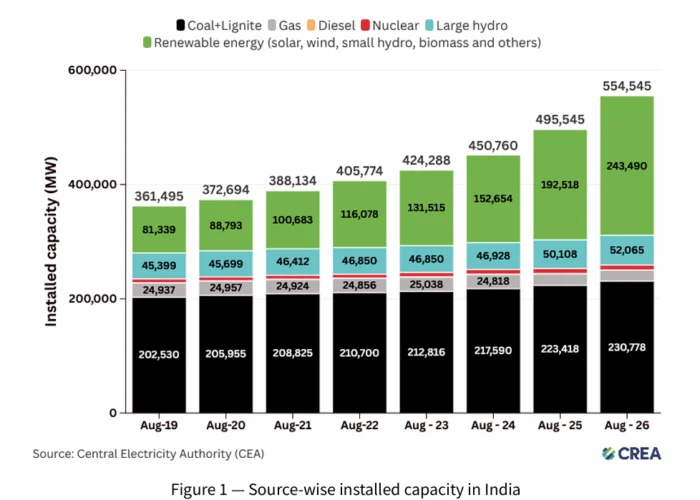
The developments come as India’s renewable fleet continues to expand. The country had 288GW of renewable energy capacity as of June 30, 2026, including 162GW of solar and 57GW of wind, according to figures reported by JMK Research & Analytics’ Q2 2026 India RE Update. A further 149GW of solar, wind, hybrid and storage projects was in the pipeline at the time, underscoring the scale of new capacity that will need to integrate with the power system.