
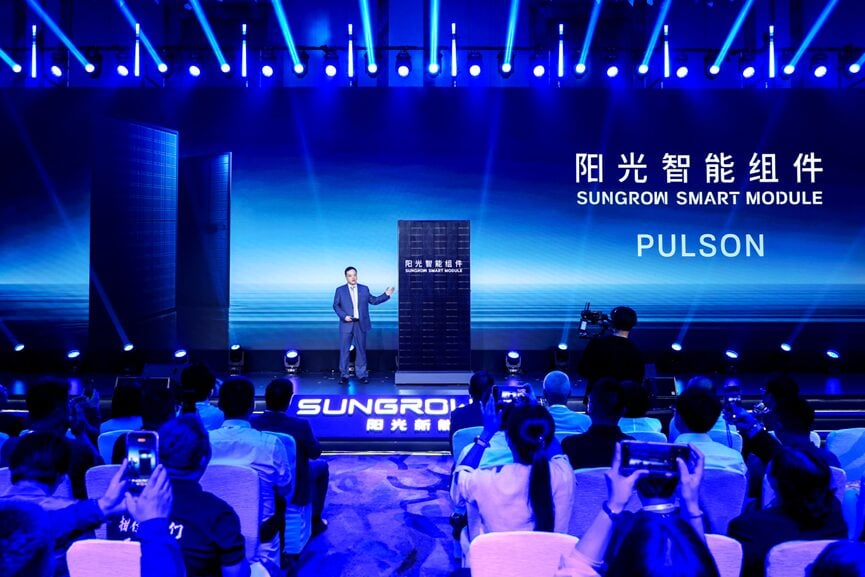
At the 2026 edition of its Intelligent Technology Conference in Shanghai, Sungrow Renewables unveiled its new iBuilding BIPV 2.0 power plant solution, officially introducing the world’s first self-developed high-efficiency smart module. The Sungrow smart module is no longer a merely passive power generation device — it has evolved into the “strongest heart” of power plants, capable of perception, intelligent analysis and autonomous decision-making.
At the same time, the company released a White Paper on smart PV module technologies, introducing the industry’s first smart module classification standard and opening a new chapter in the intelligent evolution of the PV industry.
Global Debut of Sungrow Smart Module: Building the “Strongest Heart” of Power Plants
Built on the design philosophy of “More Power, More Protection”, the smart module integrates power electronics, materials science and AI algorithms. Featuring five intelligent capabilities — self-diagnosis, self-RSD, self-cleaning, self-cooling and self-logging — it represents a transformative leap from passive power generation units to active intelligent terminals.
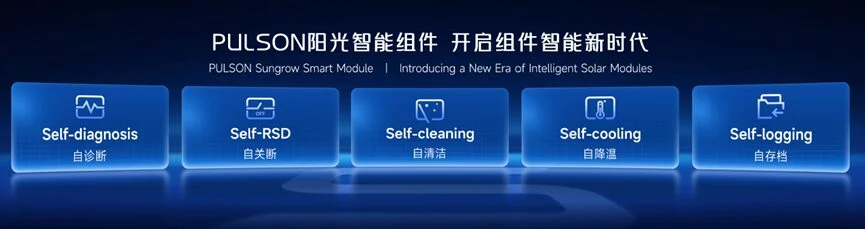
The self-diagnosis capability utilizes high-precision chips embedded within the company’s brand new self-developed module controller to collect real-time multi-dimensional data including voltage, current and temperature from every module. AI-powered analytics enable precise diagnostics and fault localization, allowing anomalies to be captured within milliseconds.
The self-RSD capability delivers industry-leading dual-layer safety protection at both module and plant levels. It fundamentally mitigates electrical fire risks before they escalate. During module failures, faulty modules autonomously disconnect while ensuring normal power generation for the remaining modules within the string, preserving energy yield that would otherwise be lost. Under extreme scenarios, total plant voltage can be reduced to human-safe voltage levels within 25 seconds — significantly outperforming international standards.
Self-logging creates an independent digital identity for each module through an electronic passport system, automatically recording carbon footprint data, health metrics, operational logs and lifecycle information, these trusted datasets providing strong support for refined plant operation and asset valuation.
Self-cleaning and self-cooling technologies combine nano-scale hydrophilic surface treatment with the world’s first “SilverAnt” cooling technology, delivering a comprehensive power generation improvement of approximately 6%.
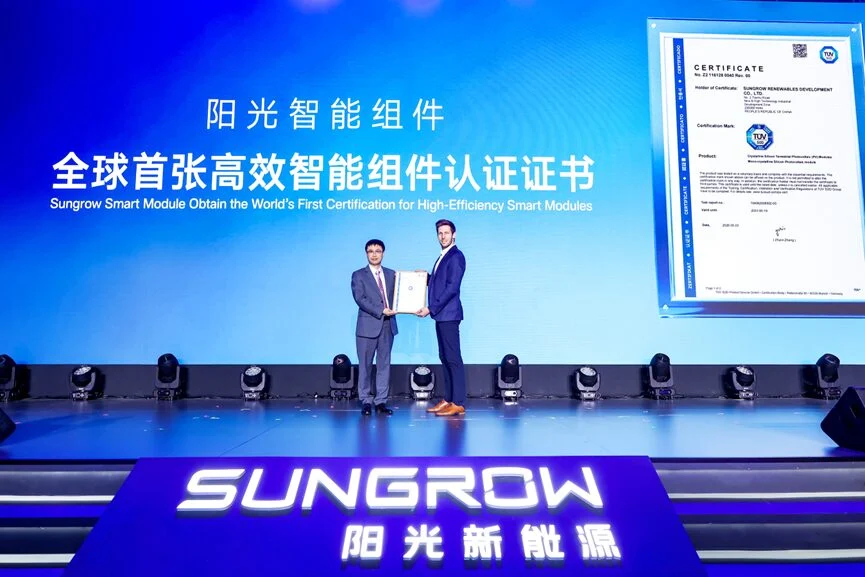
International certification organization TÜV SÜD awarded Sungrow Renewables the world’s first certification for high-efficiency smart modules during the event. TÜV SÜD VP for Greater China Hurry Xu commented: “Sungrow’s smart module demonstrates unique technological advantages and delivers systematic breakthroughs spanning precise diagnostics, proactive safety and lifecycle-data-driven optimized value creation. It fully embodies the philosophy of ‘More Power, More Protection’ and marks the beginning of a new era of smart modules.”
Released alongside the smart module, the new iBuilding BIPV 2.0 power plant solution delivers a 20% increase in installed capacity under the same rooftop area, while balancing extreme safety with higher energy yields. Together with smart modules, it creates a more efficient and safer clean energy experience for commercial and industrial users.
During the conference, Sungrow Renewables jointly released a White Paper on Smart PV Module Technologies with TÜV SÜD and the Shanghai Artificial Intelligence Institute, proposing the industry’s first smart module classification standard, providing a clear framework for the development and application of smart modules.
The classification standard evaluates modules across dimensions including intelligence level, functional completeness, technology maturity and application adaptability, categorizing smart modules into four levels from L1 to L4. It clearly defines capability boundaries and value propositions for each level while filling a long-standing gap in smart module evaluation standards.
L1 —Perceptive Intelligence: Module-level monitoring with self-cooling and self-cleaning capabilities.
L2 — Active safety intelligence: Active protection with diagnostics, shutdown and traceability.
L3 — Collaborative Intelligence: Collaborative optimization across generation and maintenance.
L4 —Autonomous Intelligence: Autonomous decision-making across PV, storage and loads.
The newly released smart module is the world’s first product to achieve the L2 Proactive Safety Intelligence standard. Xu Chun, General Secretary of the Shanghai Artificial Intelligence Institute and the Global Industrial AI Alliance Centre of Excellence, stated: “The L1-L4 classification standards establish a clear technology roadmap that will guide collaborative innovation across the industry chain, transforming isolated corporate breakthroughs into industry-wide consensus and accelerating intelligent transformation throughout the PV sector.”
Unlike conventional module innovation, which often focuses on isolated hardware optimization, Sungrow Renewables starts from the plant itself and works systematically to define module capabilities. This represents not merely product innovation, but a shift from physical integration toward system value creation.
For years, the PV industry has pursued maximum power output and larger form factors, often overlooking lifecycle value and plant-level collaboration within power plants. The traditional mindset of optimizing modules in isolation has frequently led to gaps between laboratory performance and real-world plant operation, while challenges in safety, O&M efficiency and asset preservation continue to emerge.
Sungrow Renewables’ answer is to transform modules from passive adapters into active enablers — defining module capabilities based on real-world plant requirements. Supported by its dedicated PV technology team and the Cube Technology Platform, the company translates power plant pain points into module innovation targets, creating a smart module aligned with plant requirements. Driven by full-lifecycle thinking, the smart module evolves beyond passive hardware into intelligent terminals capable of actively enhancing system value — ensuring “More Power, More Protection” throughout the plant lifecycle.
Sungrow Renewables chairman Zhang Xucheng added: “We have always adhered to ‘user mindset, systematic thinking’. We build better plants with modules that understand plants better, realizing our core value of ‘empowering customers’.The Sungrow smart module is first deployed within self-developed projects, creating a closed-loop ecosystem of plant application, pain-point identification, technology accumulation, hardware iteration and continuous feedback into plant optimization.”
According to Shen Wenzhong, Honorary Chairman of the Shanghai Solar Energy Society, Sungrow Renewables’ new paradigm of “power plants defining modules” breaks away from the traditional one-way model of “manufacturers build modules, and plants adapt to them.” Instead, it shifts industry competition from hardware specifications toward system intelligence and full-lifecycle value creation, providing a new path for scenario-driven and system-integrated innovation.
As PV value shifts from physical integration towardsystem value creation, the industry’s value framework is being fundamentally redefined.
