In recent years, supply chain traceability has become a key topic for PV producers, as the net has tightened in some parts of the world on solar products allegedly made with forced labour. Now, PV manufacturers are facing two further challenges on the environmental, social and governance (ESG) front: how to reduce the carbon intensity of their products and how to address end-of-life management as a surge of retired PV modules gathers force worldwide.
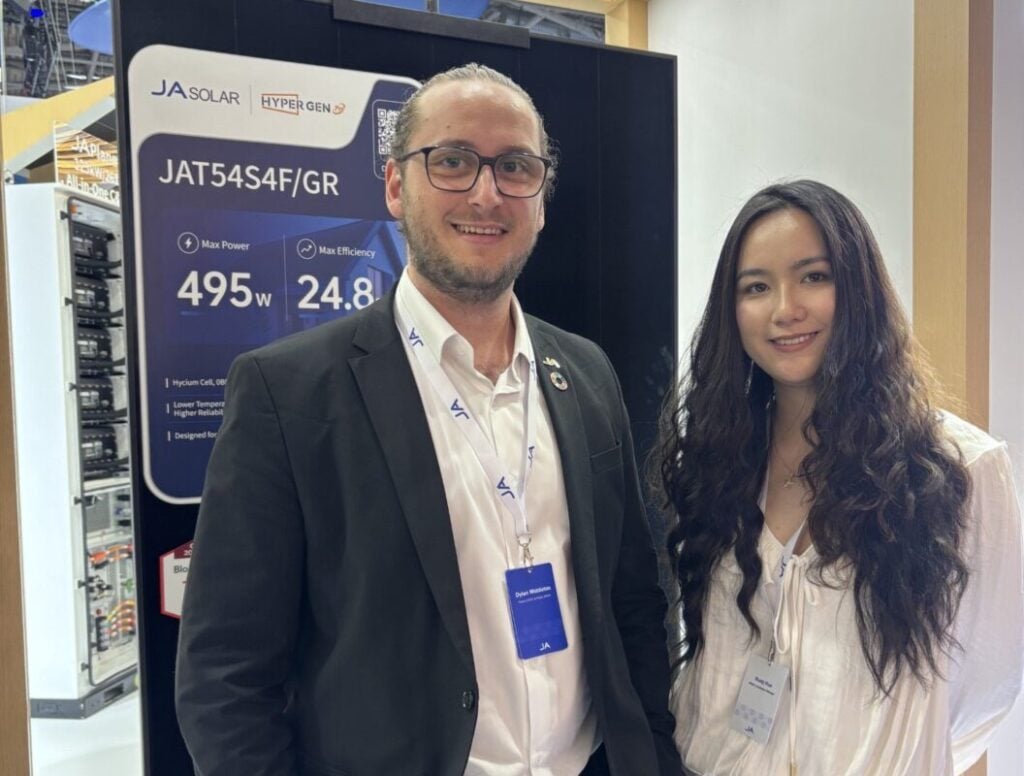
On the fringes of Intersolar Europe in Munich last month, PV Tech spoke with Dylan Middleton, head of ESG and Public Affairs in Europe at the recently rebranded JA, and Ruiqi Hua, JA’s WEEE (waste electrical and electronic equipment) compliance manager in Europe. Under discussion was how one of the world’s largest module manufacturers is using traceability, decarbonisation and circularity to future‑proof its business – and what it will take for the industry to cope with an impending wave of decommissioned PV modules.
Try Premium for just $1
- Full premium access for the first month at only $1
- Converts to an annual rate after 30 days unless cancelled
- Cancel anytime during the trial period
Premium Benefits
- Expert industry analysis and interviews
- Digital access to PV Tech Power journal
- Exclusive event discounts
Or get the full Premium subscription right away
Or continue reading this article for free
PV Tech: You have recently rebranded from JA Solar to JA. What’s behind that shift and what does it say about where the company is going?
Dylan Middleton (DM): It’s a natural evolution of the business. JA started as a solar manufacturer. We specialised in cell manufacturing in the early days, and now rebranding to JA takes us to where the business is today. It’s got four very distinct areas underneath it: JA Solar, which is the core module business, and JA ESS, which is the energy storage arm – those are the two manufacturing‑heavy parts. But alongside that there is JA Green and JA Capital, which look at financing and more integrated renewable energy solutions.
ESG has become central to how module manufacturers present themselves and operate. How do you define ESG within JA, and where is the main focus today?
DM: It depends on how you look at ESG. From a compliance perspective, ESG is about meeting regulatory requirements around due diligence, carbon, waste and so on. From a commercial and marketing standpoint, it’s increasingly a differentiator in competitive tenders. But ultimately, it’s cross‑cutting; it touches pretty much every part of the business.
Over the last five or six years, the first big focus has been supply chain due diligence and traceability – understanding where raw materials are coming from and how they move across the supply chain. We’ve built what I would say is an industry-leading traceability platform, which we call ITS – an integrated traceability system that allows us to track the flow of raw materials across the supply chain from where they come out of the ground into the final module.
Another key environmental focus area for us is decarbonisation. On top of ITS, we’ve developed a low‑carbon solar offering that maintains all the technical attributes customers expect – performance, reliability, warranties, bankability – but at significantly lower embodied carbon. We’re able to manufacture those modules using around only 58% of the carbon footprint of the mainstream modules you see coming out of China. We are, I would say, at this point the only manufacturer who’s doing it at any real commercial scale.
How do you achieve that reduction in carbon intensity while keeping performance and bankability on par with standard products?
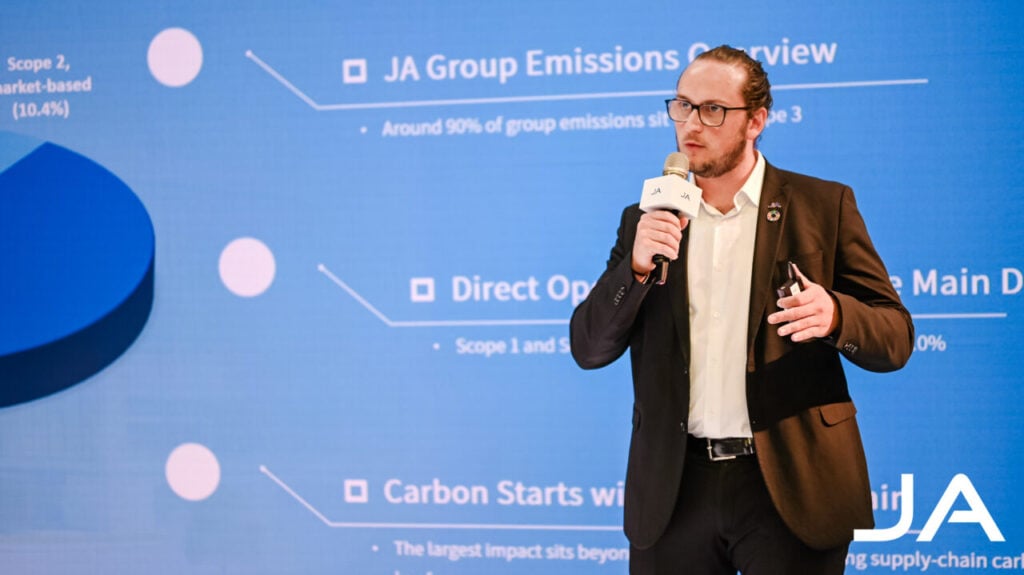
DM: The gains come primarily from material selection and process optimisation upstream.
On the silicon side, we’re using advances in FBR (fluidised bed reactor) polysilicon production, which has lower energy intensity, and we’re blending that with recycled polysilicon at the ingot stage. That heavily brings down the carbon footprint of the modules, and then now building off of that, when we talk about sustainability within module manufacturing, we’re looking at it from a circularity perspective, and that then cascades to the downstream as well. So we’re doing a lot of circularity upstream with recycled content on the polysilicon side, on the aluminium side, on the glass side, finding ways to minimise the resource inputs, and also we’re looking at the downstream, which is the recycling side of things.
Let’s turn to the end of the lifecycle. Ruiqi, you manage WEEE compliance in Europe. How does JA approach PV waste and recycling under the European framework?
Ruiqi Hua (RH): Compliance with local requirements is absolutely our fundamental approach in the European market. In Europe, that begins with joining Producer Responsibility Organisations (PROs) in European countries where we have the obligation as a WEEE Producer.
A PRO is essentially a collective system for managing e‑waste obligations. It is designated or approved by national authorities. Producers of electrical and electronic equipment – including PV modules – join these schemes, pay fees based on the weight of products they put on market and, in return, the PRO organises collection infrastructure (both public and private collection points), sets up logistics and transport networks in the country to recyclers and coordinates with local authorities on reporting and policy feedback.
We are members of PROs in more than 20 European countries. If a commercial customer has defective or end‑of‑life panels, there are dedicated collection points where they can deliver them or request an on-site pick up. For residential systems, there are municipal collection points. In both cases, the funding ultimately comes from producer contributions under the WEEE framework.
As a manufacturer, our role is not only to participate in existing systems, but also to help support the development of future solutions. This includes monitoring evolving regulatory requirements, working closely with recycling partners and ensuring the recyclability of our products to ensure their performance from a circularity perspective.
When you pay into these schemes, is that essentially the financing mechanism for the entire PV waste system in those countries?
RH: Yes. Our contributions – calculated by weight of products placed on the market – help finance the collection, transportation and recycling of end-of-life PV modules through national Producer Responsibility schemes. That’s one of the core elements of Extended Producer Responsibility (EPR): the producers collectively fund and support the management of the waste generated by the product category they place on the market.
The phrase “PV waste tsunami” is often used to refer to the solar industry’s pending waste issue. How close are we to that, and what does it mean from a manufacturer’s perspective?
RH: We are at the beginning of that process. Many of the panels that entered Europe 15-20 years ago are now being retired. That’s what we mean when we say a PV waste wave is coming. It’s an important long-term industry responsibility rather than an immediate challenge. Under the WEEE directive, producers are not only responsible for their own branded waste. We share responsibility for managing the entire category of PV waste generated on the market, which is why collaboration across the industry, recyclers and policymakers is so important.
How do we deal with it? It’s not only about end-of-life treatment. It actually starts at the beginning when we design and produce the panels so they’re easier to disassemble, and the materials are easier to treat. Also, a priority for JA is preventing waste by prolonging the lifetime of products. We also conduct recyclability assessments to see how recyclable our panels are. And so far, our result is over 90% – so, 90% of our panel is recyclable, and that’s something that all the manufacturers should consider when putting products on the market.
As one of the leading manufacturers in Europe, we see circularity as a long-term responsibility. For 2025, in the UK, Belgium, Italy, Germany and Spain alone, we have already fulfilled responsibility for around 6,700 tonnes of end-of-life PV modules through established recycling systems.
Looking further ahead, is a genuinely circular business model for PV realistic – where materials from end‑of‑life modules loop back into new ones?
DM: There are certain gains that can be made, but a fully closed loop – where recycled PV materials systematically go back into new modules – is a much bigger question.
One is supply chain geography. In Europe, PV deployment is growing, but if you look at the global picture, a very large share of new capacity is still being installed in China. That will affect where investment at scale into PV‑specific recycling will need to occur, and where recovered materials would ultimately be used.
Another challenge is material purity and performance. For PV glass, for example, how much recycled content can you introduce before it affects light transmission and module performance? With silicon, can recycling technologies reach the purity levels required for solar‑grade feedstock at scale and at a reasonable cost?
There is a strong case for cross‑sector circularity: using recovered PV materials as input into other industries – construction, chemicals, other manufacturing segments – where specifications might be less exacting, but the carbon and resource benefits are still very real.
As an industry, we should absolutely be working towards more closed material loops, but how we get there is something that needs to be examined further. What we can say is that we see this wave of PV panels that will need to be recycled. This is something that’s gaining a lot of attention within the market from our customers; previously, it was about manufacturing, quality, cost, deployment and getting the solar out there. Now the industry is really maturing to think about the full life cycle of these modules, and that’s a very, very good thing.
The European framework is relatively advanced. How do you see things evolving globally on EPR, waste and ESG more broadly?
DM: Europe has a very clear regulatory framework, but the question is, how do we scale something like this globally? You see growing EPR regulation in South Africa, for example; they’re developing something similar to the WEEE Directive that’s mandating us as a producer to not only design and manufacture these products to be recyclable, but also finance recycling at end-of-life. You’re seeing some of that EPR legislation in other jurisdictions, but it’s not a globally harmonised framework.
A global harmonised framework would be a gold standard benchmark, but that’s a much bigger, more challenging topic to implement in practice. Here, independent standards bodies and industry associations can play an important role, possibly in incorporating standards around carbon footprint and obligations on manufacturers for global recycling into an overall ESG standard for assessment. That’s one potential mechanism.
You mentioned that JA has strong upstream traceability. Is there also a move to trace materials downstream, beyond the point of recycling?
DM: Yes, that’s the next frontier. As a sector we’ve made big strides in upstream traceability – to a level that many other industries haven’t yet reached, and in a relatively short period of time.
The next stage is how do we build the downstream traceability to understand when a solar module is recycled, exactly where is that silicon going, where is that glass going and how can we verify that at each step in the downstream supply chain. This is something we are starting to see become increasingly of interest to customers in certain markets.
If we can do that, we move towards a genuinely end‑to‑end traceability model, from raw material extraction through many years of operation, all the way to final reuse of recovered materials. The win is that we’ve then achieved a completely closed-loop traceability system, knowing where it comes out and where it ends up. That’s not only knowing it, but being able to verify, to be able to see each step in that upstream and downstream supply chain.