Correction: An earlier version of this article did not specify the currency of the cost figures referenced from ARENA’s report. This has been updated to clarify that they are understood to be in Australian dollars (AU$).
Australia’s installed cost of utility-scale solar has not fallen at the pace required to reach the country’s “ultra-low-cost solar” (UCLS) ambitions, despite continued progress in cell and module efficiency.
Try Premium for just $1
- Full premium access for the first month at only $1
- Converts to an annual rate after 30 days unless cancelled
- Cancel anytime during the trial period
Premium Benefits
- Expert industry analysis and interviews
- Digital access to PV Tech Power journal
- Exclusive event discounts
Or get the full Premium subscription right away
Or continue reading this article for free
This is according to an updated white paper published by the Australian Renewable Energy Agency (ARENA) yesterday (30 July).
The ‘ULCS White Paper Update 2026’ finds that Australia’s weighted-average installed cost for utility-scale solar is AU$1.52 per watt, compared with AU$1.71 per watt in the US and AU$0.95 per watt in China.
It should be noted that ARENA’s report labels the chart “c/W (2026$, weighted average)” without specifying whether the figures are in Australian or US dollars, though the values are consistent with an AUD basis when checked against the underlying IRENA data it cites.
Balance-of-system costs, covering labour, civil works, grid connection and project delivery, now represent the dominant component of total project costs and have been largely resistant to reductions, even as module prices have continued to fall.
ARENA CEO Darren Miller said the focus needed to shift.
“Australia needs a shift in focus towards how solar projects are delivered, not just what is installed,” he said.
“Without a change to the approach in how large-scale solar is built, financed and integrated, we risk missing the opportunity to bring costs down fast enough to support the next phase of the energy transition.”
The update is the first revision to ARENA’s 2023 Ultra Low-Cost Solar White Paper, which set out the agency’s 30-30-30 vision: 30% module efficiency, an installed cost of AU$0.30 per watt, and a levelised cost of electricity (LCOE) below AU$20/MWh, all by 2030.
On the technology side, the update records genuine progress. Laboratory cell efficiencies have reached 27.9%, with commercially available modules now hitting 26.2% in 2025, up from 22% in 2022.
However, overall project costs have not followed the same trajectory, and the white paper describes a growing divergence between technology improvements and system-level outcomes.
The gap between module cost progress and total project cost is the defining tension in the 2026 update. Module prices have continued to decline amid global oversupply, and efficiency improvements have, in some cases, exceeded earlier industry projections.
But these gains have been offset at the project level. Civil works, labour, grid connection and financing costs have risen in real terms, and projects are increasingly being developed in more complex environments, reflecting growing grid connection queues, evolving regulatory requirements and more challenging site and delivery conditions.
In some cases, cost pressures in balance-of-system categories have fully erased the savings delivered by cheaper and more efficient modules.
The white paper notes that the Australian context is particularly challenging. A 10% improvement in module efficiency means 10% less concrete, steel, labour and land is required for the same energy output, a meaningful benefit at the system level.
However, ARENA notes that saving can only translate into lower project costs if the rest of the delivery chain moves in the same direction. At present, it is not doing so at a sufficient pace.
Three interlocking barriers
The update identifies three interconnected barriers holding back cost reduction at the project level.
Labour availability and productivity are tightening as regional workforce shortages emerge across Australia’s construction sector. The scale of deployment required over the coming decade is expected to place increasing pressure on regional workforces where competition for skilled labour and existing shortages are already evident.
Current construction approaches remain relatively labour-intensive, and the white paper is direct in stating that changes to how projects are delivered will be required to meet Australia’s renewable energy deployment targets.
Grid connection processes represent the second constraint. Growing connection queues are adding cost and timeline risk across the project pipeline, and the white paper highlights that grid connection requirements are contributing to more complex project environments, pushing costs higher.
Addressing this, the document argues, will require more streamlined grid-connection processes, improved project planning, and better integration of system requirements into early project design. These are all reforms that fall outside ARENA’s direct control but are central to the ULCS ambition of achievability.
The third barrier is market dynamics. Revenue certainty has become more challenging for standalone solar projects under certain market conditions, as rising rooftop solar penetration has suppressed daytime wholesale prices and reduced revenue available from solar generation alone.
Investors have responded by shifting clearly toward hybrid solar-plus-storage projects, which offer more diversified revenue streams but also introduce additional complexity and cost.
The white paper notes that while hybrid projects address some of the standalone solar challenges, they do not resolve the underlying cost-reduction problem and may, in some cases, exacerbate it.
Together, these three pressures reinforce the white paper’s central finding: that the path to ultra-low-cost solar now depends more on construction methods and system integration than on module pricing.
“Cost reduction now depends more on construction methods and system integration than module pricing,” the document states directly.
Innovation in the field, not just the lab
A key shift in ARENA’s approach since 2023 has been moving away from isolated technology development toward testing multiple innovations within a single, large-scale real-world deployment environment.
This shift reflects a recognition that meaningful cost reductions are unlikely to be achieved through incremental improvements and instead require a coordinated system of changes across the full delivery model.
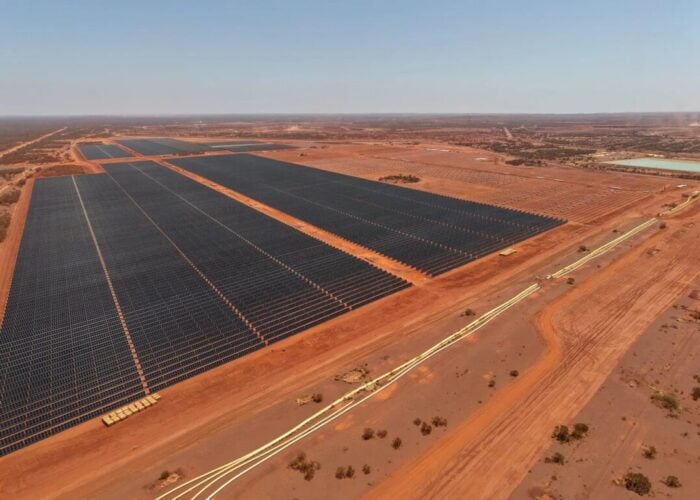
The Fortescue Solar Innovation Hub in the Pilbara region of Western Australia is referenced as the most advanced example of this approach, designed to test construction, automation and deployment technologies together on a site that reflects the conditions that much of Australia’s future solar buildout will face.
The white paper describes the test-bed model as enabling multiple technologies to be deployed, assessed and refined under consistent site conditions, providing a clearer understanding of their individual and combined impact on project cost, construction timelines and operational performance.
ARENA-funded projects at the forefront of this effort include 5B, which produces prefabricated modular solar systems designed to cut on-site labour and build time; Built Robotics, which has developed autonomous piling equipment that reduces dependence on manual labour and improves consistency across projects.
Other referenced companies include Nextpower, which is testing advanced piling and tracking solutions for challenging ground conditions and Luminous Robotics, whose LUMI robot installs panels at utility-scale projects using AI-guided systems.
Operations and maintenance are also emerging as a source of value alongside construction innovation. The white paper highlights UNSW spin-out company Lab360, which is developing advanced diagnostic tools to identify faults and improve asset performance, and notes that digital and AI-enabled tools are being applied more broadly to optimise operations and reduce downtime.
ARENA frames these operational innovations as important contributors to whole-of-life cost reduction, recognising that the levelised cost of electricity is determined by performance over decades rather than by construction outlay alone.
On the cell technology side, ARENA’s funding of SunDrive is progressing copper-based metallisation technology and high-efficiency cell designs with the potential to reduce both module costs and overall system costs.
ARENA has separately extended funding for the Australian Centre for Advanced Photovoltaics (ACAP) to support research into next-generation cell technologies through to the early 2030s, recognising that breakthroughs in cell architecture and materials can take a decade or more to progress from laboratory research to commercial deployment.
As previously reported by PV Tech, ARENA has committed AU$60 million to ultra-low-cost solar research and development in Australia to support this pipeline.
ACAP modelling published in March 2026 showed that achieving the 30-30-30 target could unlock a 2,000GW-scale solar PV market in Australia, capable of supplying 1,000TWh per year for domestic use and 2,600TWh annually for export as green metals and fuels.
That modelling, led by researchers at the Australian National University and UNSW, described ultra-low-cost solar as a potential foundation for green aluminium, ammonia and steel production to reach cost parity with conventional methods, and for electro-fuels for aviation to move closer to commercial viability.
On the manufacturing side, ARENA committed US$98 million to SunMan’s 500MW PV module manufacturing hub as part of its strategy to build domestic production capacity alongside driving down costs through innovation.
ARENA has previously targeted sub-AU$30/MWh solar to unlock a 10GW annual deployment pipeline, a threshold that the white paper implies remains out of reach under current delivery models.
The white paper closes by framing the remainder of the decade as a period of decision.
Achieving the 30-30-30 vision by 2030 will depend on how effectively the sector translates innovation into consistent, scalable deployment, moving from demonstration to repeatable, scalable delivery.
ARENA says it will continue targeting investments toward innovations that can deliver step-change reductions in total system cost and encourages proponents with novel approaches to construction, system integration and solar-storage deployment to engage with the agency directly.
“The progress we’re seeing today gives us confidence in what’s possible, but the next few years will be critical to turning this potential into reality,” Miller said.