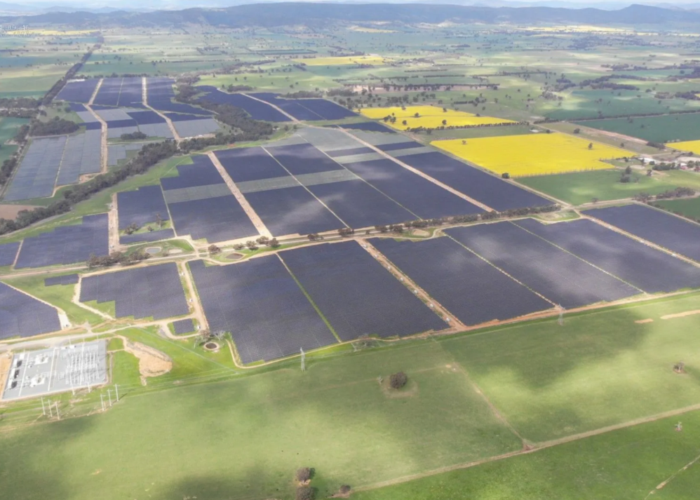
Preliminary financial results from three Chinese manufacturers show a downward trend in the fortunes of the solar manufacturing industry over 2024.
Publications from polysilicon producer Daqo New Energy and solar manufacturers JinkoSolar and LONGi all show steep declines year over year (YoY) compared with 2023. LONGi founder and chairman, Li Zhenguo, pointed to “The imbalance between output and demand” across the solar supply chain which has been affecting industry players over the last 12 months.
Try Premium for just $1
- Full premium access for the first month at only $1
- Converts to an annual rate after 30 days unless cancelled
- Cancel anytime during the trial period
Premium Benefits
- Expert industry analysis and interviews
- Digital access to PV Tech Power journal
- Exclusive event discounts
Or get the full Premium subscription right away
Or continue reading this article for free
Daqo posts losses
Daqo New Energy’s subsidiary, Xinjiang Daqo, published preliminary findings for the Shanghai Stock Exchange which estimated losses between RMB2.6 billion (US$355.5 million) and RMB3.1 billion (US$424 million) for the financial year 2024. This compares with net profits of RMB5.8 billion (US$793 million) in 2023.
In its Q3 2024 results, Daqo revealed it had slashed its polysilicon production and sales volumes. This corresponded with fewer financial losses compared with the previous quarter.
The price of polysilicon has plummeted over the last 12-to-18 months, largely driven by an excess of production capacity in China. Daqo CEO Xiang Xu blamed “the overall oversupply in the industry” for the challenging market conditions, dynamics which saw polysilicon market analyst Bernreuter Research predict an industry “shakeout” in 2024 as production volumes and low prices make things difficult for smaller players.
Jinko profits crash
In its preliminary results for the full year 2024, JinkoSolar – the world’s largest solar manufacturer by volume – predicted net income between RMB80 million (US$10.9 million) and RMB120 million (US$16.4 million) for its subsidiary, Jiangxi Jinko. This constitutes a decline of over 98% compared with 2023 profits.
The company also predicted preliminary net losses “excluding extraordinary gains and losses” of RMB750 million to RMB1,050 million.
Over the course of 2024, JinkoSolar’s results exhibited a broader trend among major solar manufacturers. In consecutive quarterly reports, the company simultaneously posted growing solar module shipments and flat or declining revenues, primarily as a result of falling prices across the industry.
The Q4 2024 PV ModuleTech Bankability Ratings report predicted a “tsunami” of Chinese solar manufacturer insolvencies in 2025, citing what our head of research, Finlay Colville, called “chronic overinvestment,” which has left the Chinese sector with the capacity to produce around three times the global annual demand for solar modules.
LONGi looks past losses
Fellow manufacturing giant LONGi expects to post losses between RMB8.2 billion (US$1.1 billion) and RMB 8.8 billion (US$1.2 billion) in 2024.
The company posted US$1.26 billion in losses in its Q1-3 2024 financial results and expects those figures to continue.
LONGi has been the leading voice in the Chinese PV manufacturing space calling for controls and measures to control falling prices and overcapacity; back in March its chairman, Zhong Baoshen, petitioned the Chinese government to introduce bidding rules to control prices.
Now, in a statement, the company has said it plans to “strategically contract” and focus on technology and research & development (R&D), forecasting that “In the next two to three years, many photovoltaic manufacturers might be forced to exit the industry” – a period it called a “cold winter” for the PV industry.
As part of this strategic contraction, Baoshen said: “The company is accelerating the construction of back contact (BC) production capacity through various models such as technology licensing and equity cooperation.”
The company claimed that its plan to license the rights to BC technology could “avoid the industry following the disorderly expansion of TOPCon” and allow a “breakthrough” in the technology cycle. PV Tech Premium covered the LONGi’s plans for BC technology in 2025 last week.