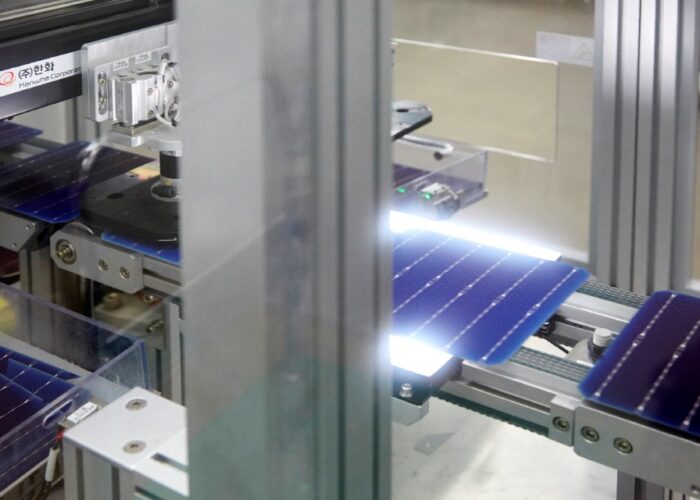
The rapid growth of the PV market during the last five to seven years entailed a considerable expansion of the encapsulation material market, which temporarily led to shortages in the supply chain. Simultaneously, module prices decreased significantly, which resulted in intense pressure on production costs and the cost of PV module components, inducing changes in the encapsulation material market towards new materials and suppliers. This pressure – together with the huge impact of the encapsulation material on module efficiency, stability and reliability – makes the selection of encapsulation technologies and materials a very important and critical decision in the module design process. This paper presents an overview of the different materials currently on the market, the general requirements of PV module encapsulation materials, and the interactions of these materials with other module components.
ASP declines in 2012, driven by industry overcapacity throughout the PV supply chain, forced over 350 companies in China, from equipment suppliers, polysilicon producers to module manufacturers, to stop operations entirely, according to market research firm ENF.
Our focus here at Photovoltaics International has always been on efficiency improvement and driving down the cost per watt of modules. In this issue we take a look at some of the market dynamics driving prices in the supply chain so that you can make better decisions to help reduce your overall cost per watt and increase your efficiency at the same time.
Overcapacity in the c-Si ingot/wafer supply chain has forced materials specialist, Cookson to close one of its two ingot crucible production plants in China, with immediate effect. The company had closed a similar plant in the Czech Republic in July 2012, which has supplied crucibles, primarily to the European market. Major European-based ingot/wafer producers such as PV Crystalox are down below 30% capacity utilization on the back of weak demand.
In releasing its latest Polysilicon and Wafer Supply chain Quarterly Report for Q3 2012, NPD Solarbuzz is predicting that polysilicon capacity will grow 22% in 2012 and another 18% in 2013. According to the report, the industry’s polysilicon processes for PV applications are anticipated to drop 52% this year while plant utilization will decline from to 63%, from 77% in 2011. Total polysilicon capacity will be in excess of 385,000 tons this year, of which 70% will be held by a small group of tier 1 producers.
Dealing with the acute lack of capital spending across the PV supply chain, major equipment supplier Meyer Burger is consolidating its production and technology operations after several years of leading an acquisition trail. The company said it would focus operations at four main production locations and two solar technology centres worldwide.
The seventeenth edition of Photovoltaics International applauds new markets emerging to plug the deployment gaps left by countries such as Spain, the Czech Republic and Italy. Profitless prosperity is the way Mark Osborne, Senior News Editor at PV-Tech.org characterises the PV manufacturing supply chain at the moment. In this issue the Fraunhofer ISE presents an overview of MWT technologies and calls on manufacturers to “quickly bring these techniques to industrialisationâ€. Additionally back contact cells and modules are featured extensively with valuable contributions from IMEC/ECN and the ISFH.
The latest global PV inverter market report from IMS Research paints a mixed business environment for the sector that has more than 150 active suppliers. Although having defended reasonably well against price declines, compared to the rest of the supply chain, the market research firm is forecasting inverter sector revenues to only increase by 3% in 2012, while shipments increased nearly 25%.
According to Solarbuzz’s “Polysilicon and Wafer Supply Chain Quarterly Report,” polysilicon prices are expected to fall 48% while wafer prices drop 56% year-over-year in 2012; results which have so far led to only 12 Chinese PV polysilicon manufactures still producing, and of those, more than half running at reduced utilization rates.
As the largest merchant solar cell producer, JA Solar continues to be impacted by rapidly declining prices as overcapacity continues thought the supply chain. Emphasis has therefore shifted to module production and shipments, though a return to profitability remains a distant goal. First quarter shipments which included cells and modules that exceeded guidance at 366MW, while revenue reached US$254.4 million, down 17.7% from the prior quarter and 56%, year-on-year. Net loss for the quarter was US$39.8 million.