In releasing its latest Polysilicon and Wafer Supply chain Quarterly Report for Q3 2012, NPD Solarbuzz is predicting that polysilicon capacity will grow 22% in 2012 and another 18% in 2013. According to the report, the industry’s polysilicon processes for PV applications are anticipated to drop 52% this year while plant utilization will decline from to 63%, from 77% in 2011. Total polysilicon capacity will be in excess of 385,000 tons this year, of which 70% will be held by a small group of tier 1 producers.
Dealing with the acute lack of capital spending across the PV supply chain, major equipment supplier Meyer Burger is consolidating its production and technology operations after several years of leading an acquisition trail. The company said it would focus operations at four main production locations and two solar technology centres worldwide.
The seventeenth edition of Photovoltaics International applauds new markets emerging to plug the deployment gaps left by countries such as Spain, the Czech Republic and Italy. Profitless prosperity is the way Mark Osborne, Senior News Editor at PV-Tech.org characterises the PV manufacturing supply chain at the moment. In this issue the Fraunhofer ISE presents an overview of MWT technologies and calls on manufacturers to “quickly bring these techniques to industrialisationâ€. Additionally back contact cells and modules are featured extensively with valuable contributions from IMEC/ECN and the ISFH.
The latest global PV inverter market report from IMS Research paints a mixed business environment for the sector that has more than 150 active suppliers. Although having defended reasonably well against price declines, compared to the rest of the supply chain, the market research firm is forecasting inverter sector revenues to only increase by 3% in 2012, while shipments increased nearly 25%.
According to Solarbuzz’s “Polysilicon and Wafer Supply Chain Quarterly Report,” polysilicon prices are expected to fall 48% while wafer prices drop 56% year-over-year in 2012; results which have so far led to only 12 Chinese PV polysilicon manufactures still producing, and of those, more than half running at reduced utilization rates.
As the largest merchant solar cell producer, JA Solar continues to be impacted by rapidly declining prices as overcapacity continues thought the supply chain. Emphasis has therefore shifted to module production and shipments, though a return to profitability remains a distant goal. First quarter shipments which included cells and modules that exceeded guidance at 366MW, while revenue reached US$254.4 million, down 17.7% from the prior quarter and 56%, year-on-year. Net loss for the quarter was US$39.8 million.
What does an industry need for sustainable, long-term success? A market, customers and suppliers, and – most certainly – excellent products that can be sold. When looking at various different mature industries there is one thing they all have in common – they have industry-initiated roadmaps! With SEMI’s experience in the semiconductor industry over the last 40 years, the example of the International Technology Roadmap for Semiconductors (ITRS) has proved that pre-competitive industry collaboration among the supply chain and among competitors leads to a reduction in costs, a better time to market and an increased efficiency. Moreover, it helps all players to benefit from jointly solved manufacturing challenges.
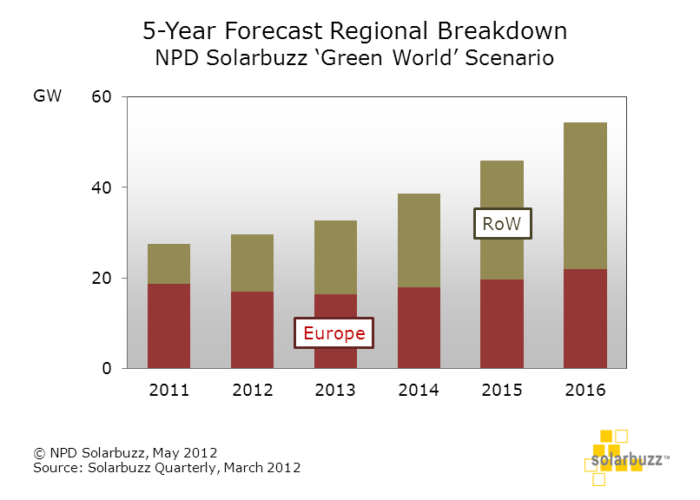
Recently, PV demand forecasting has seen greater contributions from countries that had previously been lumped together in the rest-of-world (RoW) bucket – a category previously reserved for the collective PV demand from countries or regions outside of major (FiT-stimulated) European PV markets. Research has shown that PV adoption outside Europe will not simply increase overall PV demand levels, but will assist in smoothing out erratic demand cyclicality. At first glance, the increased gigawattage of demand being added from the RoW grouping provides an essential component in driving long-term industry growth scenarios. Non-European PV demand is forecast to increase from approximately 30% to 60% of global PV demand between 2011 and 2016. However, more tangible benefits of having an increased number of countries feeding into the global demand mix extend beyond just the significant ‘growth’ potential this situation offers to the PV supply chain. Of these various benefits, perhaps the one that will provide the greatest level of comfort to the PV supply chain will be a collective ‘smoothing’ effect in quarterly demand swings. This should have a positive effect on factory shipment schedules and hopefully provide an end to some of the boom-and-bust cycles that have negatively impacted the fortunes of the PV supply chain during 2010 and 2011.
The PV industry is undergoing dramatic changes. Like a carnival ride gone dreadfully wrong, exhilaration has been supplanted by dread; joy has been replaced by fear. Just look around you – provided you are able to turn your head to defy the g-forces acting upon you as we bank and turn wildly along. You will see PV companies closing their doors for good. You will see extraordinarily talented people throughout the supply chain, shifting positions everywhere and looking for safe-haven jobs. And you will also see once-leading PV companies burning cash and losing their status as ‘bankable’. Everywhere we turn, we see companies in the supply chain shuttering production as if to balance markets.
Silver paste is a key component of the design of nearly all silicon wafer solar cells manufactured in 2011. The high cost of the precious metal in the paste formulation means that silver paste is also the second-highest component of the total cost of materials. This article reviews the silver paste supply chain and the challenges in silver paste formulation and manufacture, and discusses some of the approaches for reducing or removing entirely the use of silver in crystalline silicon cell manufacture.