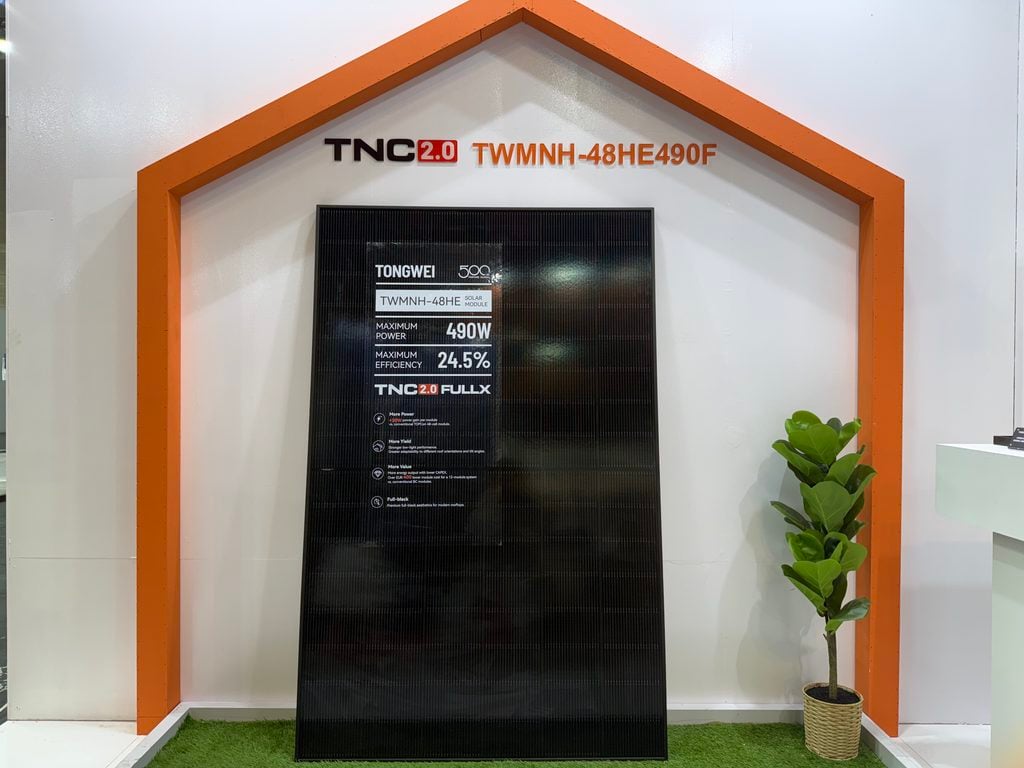
Tongwei Solar has launched TNC 2.0 FULLX G12R-48, a new 48-cell module adopting a mainstream format of 1762x1134x30mm, designed for rooftop applications where available space, installation conditions and aesthetic requirements can vary significantly.
Built on Tongwei’s TNC technology platform, TNC 2.0 FULLX G12R-48 combines high power output, strong energy yield and broad adaptability in a compact format. The product is available in two design options, Full Black and Black Frame, offering customers greater flexibility in both system design and appearance.
Try Premium for just $1
- Full premium access for the first month at only $1
- Converts to an annual rate after 30 days unless cancelled
- Cancel anytime during the trial period
Premium Benefits
- Expert industry analysis and interviews
- Digital access to PV Tech Power journal
- Exclusive event discounts
Or get the full Premium subscription right away
Or continue reading this article for free
The product delivers up to 490W with an efficiency of 24.5%, helping rooftop systems achieve higher installed capacity while maintaining strong energy performance under varying operating conditions.
More power, more returns from the same rooftop
For rooftop solar, higher module power is only part of the equation. What matters ultimately is how much energy the system can generate from limited roof space and how much value that energy can create.
With up to 490W of power, TNC 2.0 FULLX G12R-48 provides a 30W power gain per module compared to conventional TOPCon modules, enabling higher installed capacity on the same roof area and helping make better use of limited rooftop space.
Its power advantage is further supported by the proven energy performance of TNC technology. Field testing showed an average 3.3% gain in per-watt generation compared with conventional BC modules under the tested conditions (Figure 1). During the low-light periods of early morning and late afternoon, the generation gain reached up to 12.32%, demonstrating stronger energy capture under weak irradiance conditions (Figure 2). This capability is especially valuable in the early morning and late afternoon, when irradiance is low but electricity prices may be higher under time-of-use tariffs. Generating more power during these high-value periods can help improve the overall value of rooftop solar generation.
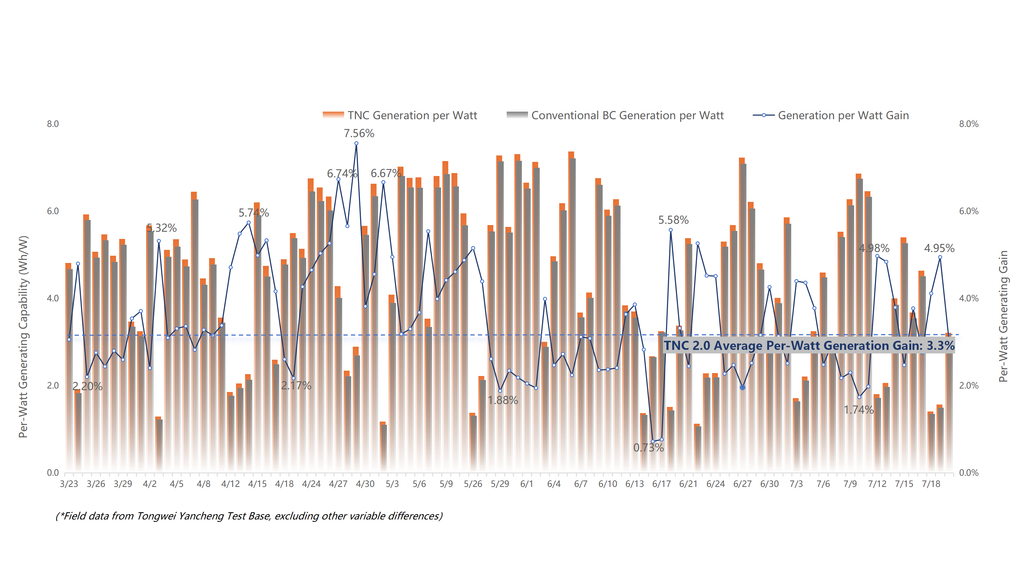
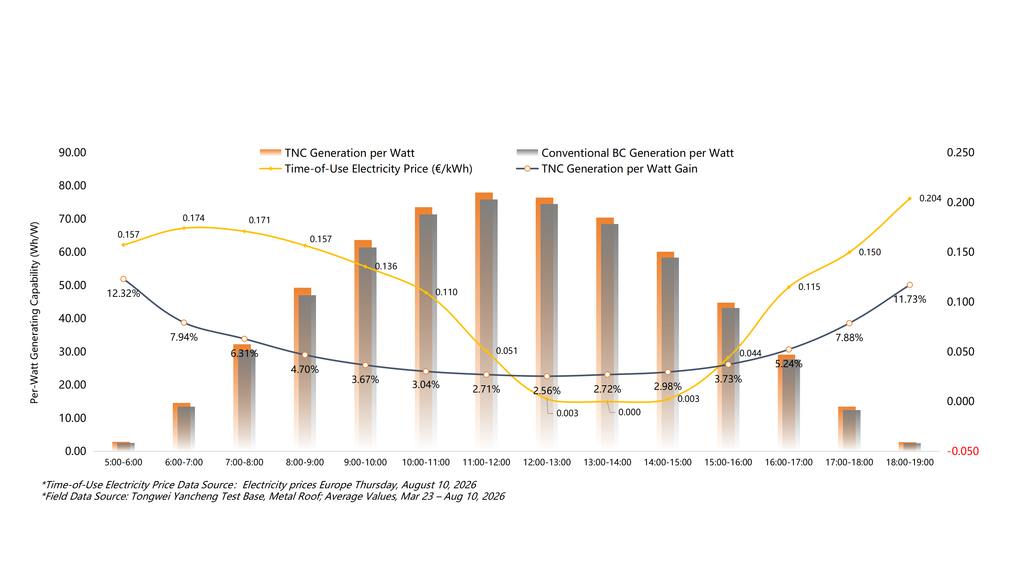
The higher energy yield can translate into greater returns over the operating period. In the tested scenario, TNC achieved 447.56 equivalent full-load hours, compared with 433.27 hours for conventional BC modules, representing approximately 3.3% higher generation capability. The time-of-use electricity calculation showed an additional revenue of around €0.03 per day under the tested conditions.
TNC 2.0 FULLX G12R-48 can also offer a competitive upfront cost by delivering more energy output with lower CAPEX, saving over €400 in initial module investment for a standard 12-module system compared to conventional BC modules.
Adaptability for real-world conditions
Not every rooftop can offer the ideal orientation, tilt angle or operating conditions. TNC 2.0 FULLX G12R-48 is built on TNC technology designed to maintain energy performance across a broader range of real-world conditions.
In Germany-based simulations, TNC showed only 0.38% energy loss related to roof tilt under low-light conditions, compared with 0.96% for conventional BC modules. This means conventional BC modules were more than 2.5 times more sensitive to tilt in the tested scenario.
The technology also showed greater adaptability to different roof orientations. At a fixed 40° tilt, TNC recorded approximately 1.02%–1.11% low-light generation loss across different orientations, compared with 3.53%–3.72% for conventional BC modules.
This adaptability can help reduce the impact of non-ideal roof layouts, giving installers greater flexibility when designing rooftop systems.
TNC technology also maintains a lower power-loss ratio under different soiling conditions. Compared with conventional BC modules, the reduction in fractional power loss reached 0.40 percentage points under light soiling, 0.73 percentage points under moderate soiling and 0.99 percentage points under heavy soiling.
This helps reduce the impact of dust accumulation when cleaning cannot be carried out frequently, supporting more stable energy generation under real-world operating conditions.
Designed for modern aesthetics
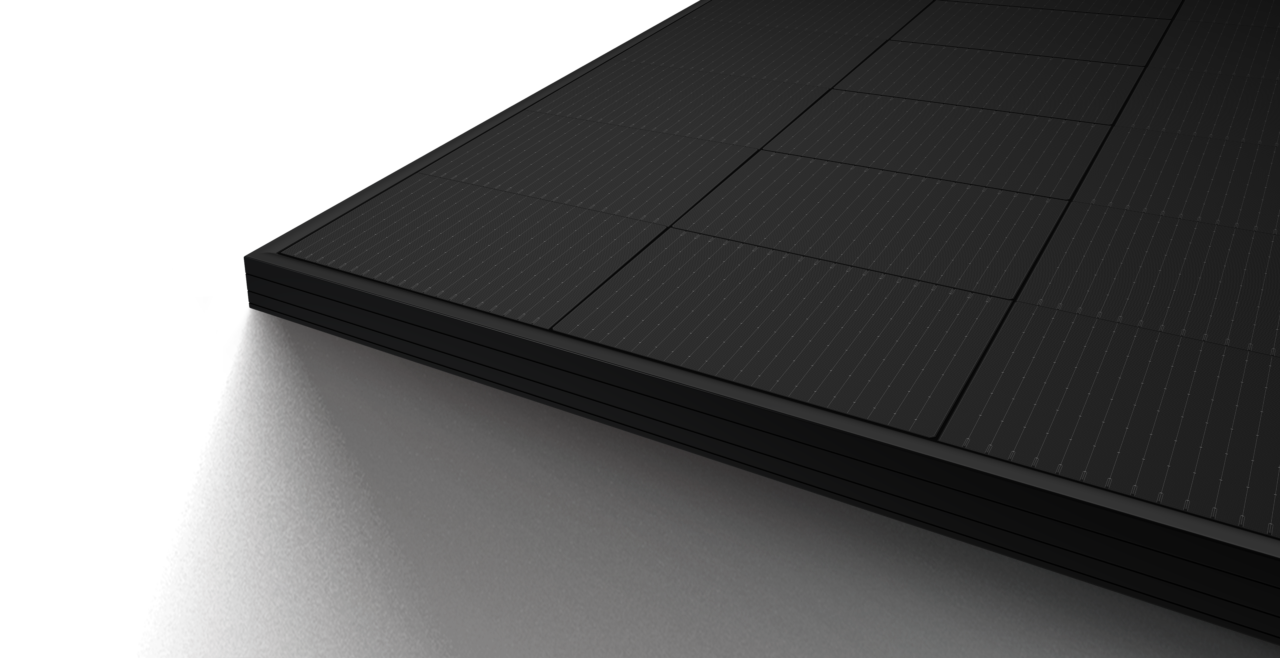
Beyond performance adaptability, TNC 2.0 FULLX G12R-48 is offered in a full black option designed for premium rooftop applications. Its clean and uniform look integrates naturally with modern buildings and residential rooftops, where module aesthetics can be an important part of the overall architectural design.
By combining a high-power 48-cell format with the proven energy performance and adaptability of TNC technology, TNC 2.0 FULLX G12R-48 is designed to meet the realities of modern rooftop solar.
With Full Black and Black Frame options, it gives customers more freedom in system configuration, operating conditions and rooftop aesthetics, while delivering more energy from limited roof space.
TNC 2.0 FULLX G12R-48. More powerful. More adaptable.