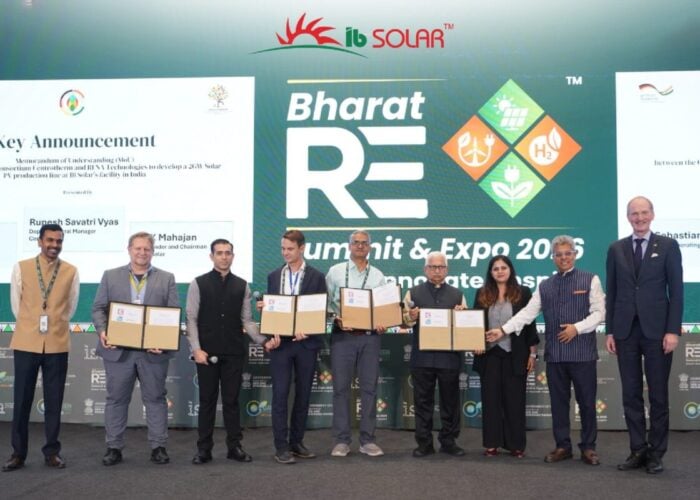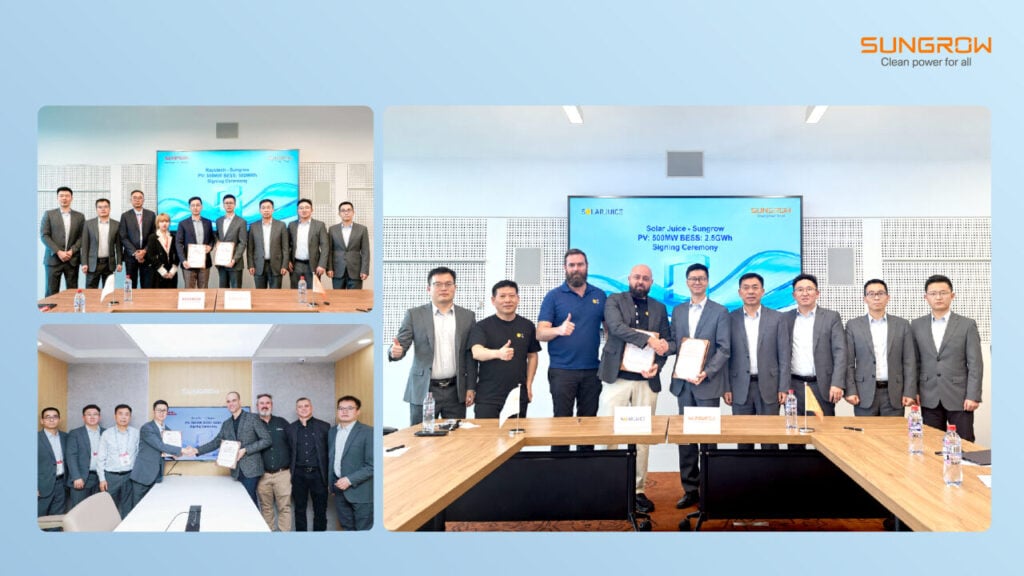
Chinese inverter and energy storage specialist Sungrow has signed three distribution agreements in Australia covering 1.5GW of solar PV and 4GWh of battery storage, with Solar Juice, Supply Partners and Raystech Group.
The deals were signed at All-Energy Australia 2026 in Melbourne. Three-quarters of the storage volume is for residential customers, a segment supported by a federal subsidy for home battery storage.
Try Premium for just $1
- Full premium access for the first month at only $1
- Converts to an annual rate after 30 days unless cancelled
- Cancel anytime during the trial period
Premium Benefits
- Expert industry analysis and interviews
- Digital access to PV Tech Power journal
- Exclusive event discounts
Or get the full Premium subscription right away
Or continue reading this article for free
Each partner takes 500MW of PV. The storage split is uneven and Solar Juice accounts for the largest share.
Solar Juice is an Australian wholesale distributor of solar and storage equipment. It will take 2.5GWh of battery storage, made up of 2GWh for residential customers and 500MWh for commercial and industrial (C&I) customers.
The company has distributed Sungrow products for several years, having signed a 2GW distribution deal with Sungrow in 2022 covering PV inverters and battery storage, followed by a 500MWh storage agreement in 2023.
The second partner is Supply Partners. The distributor, which has worked with Sungrow since 2012 and offers technical support, system design and installer training, has expanded its arrangement to include 1GWh of battery storage, split evenly between residential and C&I.
Raystech Group, a Brisbane-based renewable energy wholesaler operating in Australia and New Zealand, renewed its agreement for 500MW of PV and 500MWh of residential battery storage. The renewal also covers joint marketing, technical training and installer engagement.
The storage volumes are larger than those in the previous agreements the same three distributors signed at All-Energy Australia 2024. That year, Raystech took 800MW of PV inverters and 500MWh of battery storage, Solar Juice 500MW and 300MWh, and Supply Partners 200MW and 100MWh, around 900MWh of storage in total.
Sungrow did not disclose the period the new agreements cover, their financial value or delivery schedules.
“Our longstanding relationships with Solar Juice, Raystech Group and Supply Partners reflect the importance of mutual trust,” said Steven Zhu, vice president of Sungrow APAC. The company said it would continue to pair its products with local service in the Australian market.
The residential focus of the deals sits alongside federal support for home storage. The Cheaper Home Batteries Program, which cuts upfront costs by 30% and launched in July 2025, has now passed 500,000 installations, according to figures released by prime minister Anthony Albanese and energy minister Chris Bowen.
Around half of those home battery storage systems were installed alongside new or upgraded solar PV systems.
Other All-Energy Australia announcements
Raystech also features in another supplier’s plans. At the same event, Chinese PV manufacturer LONGi signed a memorandum of understanding with Raystech, its exclusive Australian distribution partner, setting a combined module delivery target of 2GW for 2027 to 2029 as it launched two new modules for the Australian and New Zealand markets.
Other manufacturers used All-Energy Australia to target the utility-scale end of the market. CATL held the global launch of its 9MWh TENER+ system at the show and agreed to combine its battery storage products with Hitachi Energy’s power conversion systems.
SMA also used the event to launch its DC-coupled, grid-forming solar-plus-storage solution in Australia, one of three initial markets for the product alongside Germany and the UK.
The Australian deals come as Sungrow’s financial results soften. The company’s operating revenue fell 28.99% year on year to RMB30.9 billion (US$4.6 billion) in the first half of 2026, while net profit attributable to shareholders dropped 32.01% to RMB5.26 billion.
Even so, Sungrow remained one of three Chinese inverter makers, with Deye and Sigenergy, that together accounted for more than 95% of the sector’s net profit, as PV Tech reported in an analysis of first-half results in which four rivals posted losses.