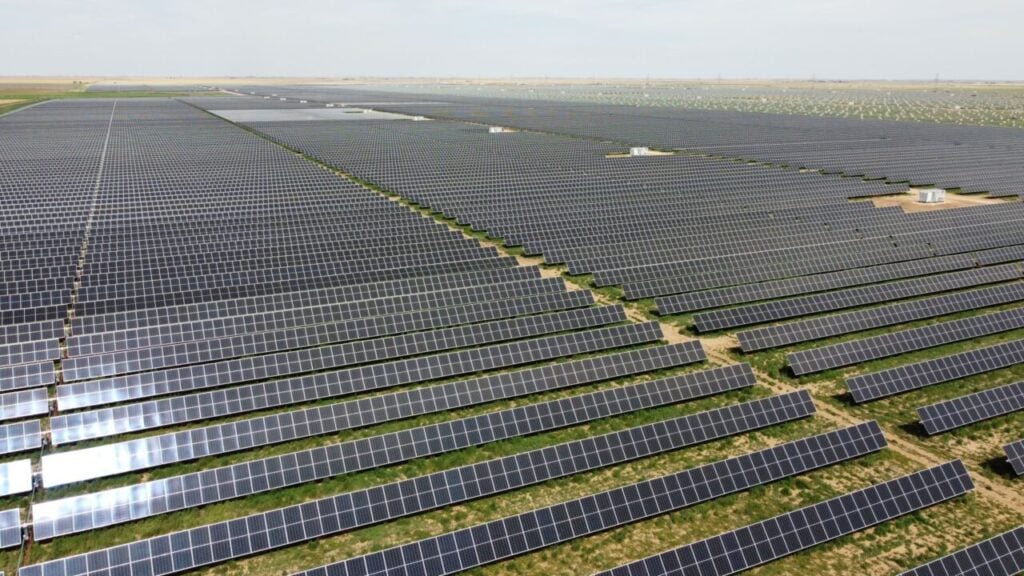
Despite the many policy barriers created by the Trump administration over the past year, new figures reveal that solar and storage continue to dominate new power additions to the US grid.
According to the latest quarterly US solar market report published today by trade body the Solar Energy Industries Association and analysts Wood Mackenzie, solar and storage accounted for 91% of new power generation capacity installed in the first quarter of 2026.
Try Premium for just $1
- Full premium access for the first month at only $1
- Converts to an annual rate after 30 days unless cancelled
- Cancel anytime during the trial period
Premium Benefits
- Expert industry analysis and interviews
- Digital access to PV Tech Power journal
- Exclusive event discounts
Or get the full Premium subscription right away
Or continue reading this article for free
Solar specifically saw 7.8GW of new capacity additions in the quarter, ensuring it retained its position as the leading source of new power added to the grid.
It performed particularly strongly in Republican areas, with states that voted for President Trump in the last election accounting for 74% of all new solar capacity installed in Q1. Texas, Florida, Ohio, Indiana, Michigan, Arizona, and Mississippi ranked among the top 10 states for new solar installations.
SEIA and Wood Mackenzie noted that, amid surging electricity demand and rising geopolitical instability, solar and storage offered energy security because they can be deployed quickly and operate without exposure to fuel price volatility.
Annual growth stagnates
Yet the positive quarterly figures for solar represented a decline of 27% on Q1 2025 and 42% on Q1 2024.
Furthermore, no additional solar module manufacturing capacity was added in Q1 2026 despite strong growth in recent years. Although several new cell and wafer facilities are in development, SEIA and Wood Mackenzie said the US solar manufacturing industry remains “gripped by uncertainty” relating to new foreign entity of concern (FEOC) requirements and ongoing trade cases that have stymied new development.
“In a world of fluctuating fuel prices, energy buyers have made it clear that they want the security, low cost and speed of solar and storage, which commanded a massive 91% of all new capacity built in Q1,” said Darren Van’t Hof, interim president and CEO of the Solar Energy Industries Association. “Yet, as power demand skyrockets, political and regulatory attacks are slowing down the exact resources we rely on. Impeding the only sector that is actively building new power is a reckless gamble that will only drive electricity bills higher. The stakes are simply too high for Washington’s permitting gridlock to continue.”
Balancing the strength of underlying demand against the various political headwinds the sector faces, the report said its outlook for the US solar industry for 2026 to 2030 had changed only minimally, with a small 1.4% increase coming mostly from the utility-scale sector.
Although this will amount to a doubling of the US solar fleet over the next five years, the report noted that the last such doubling occurred in only three years.
“We are forecasting that US solar additions will be flat over the next five years despite the need for more power supply in the US,” said Michelle Davis, head of solar at Wood Mackenzie. “We’ve seen a notable increase in solar procurements in utility resource planning, but current permitting bottlenecks continue to serve as near-term headwinds.”
The opportunities and challenges for US solar manufacturing will be under discussion at our annual PV CellTech USA conference in San Francisco on 13-14 October 2026. For details and booking, click here.