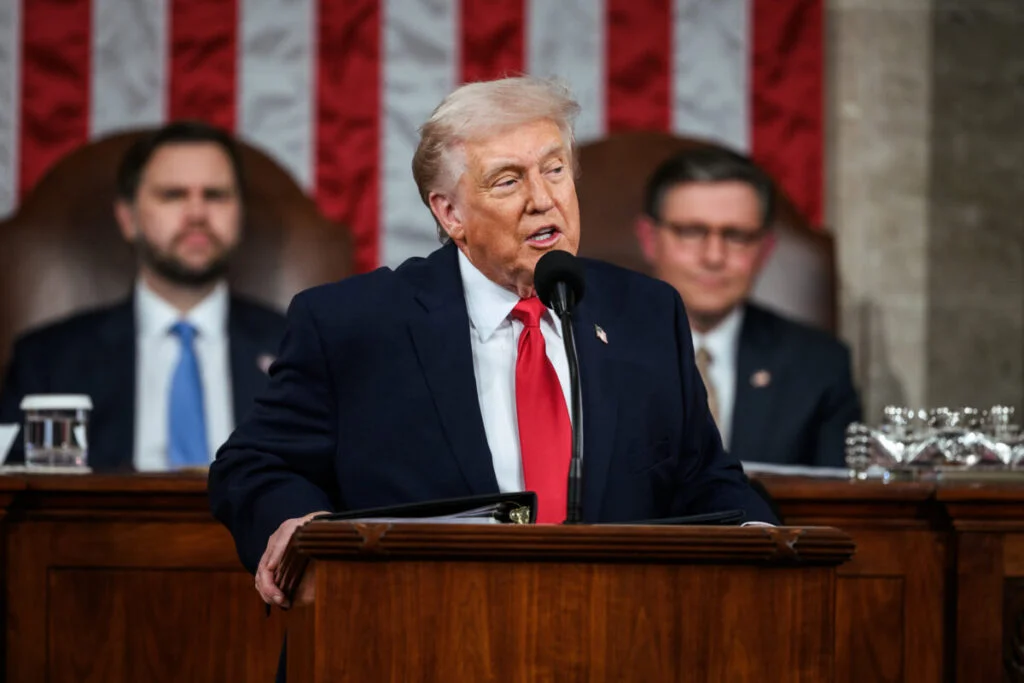
US President Donald Trump has introduced a 15% tariff on imports of products using polysilicon, and set minimum prices for polysilicon and its derivatives, under Section 232 of the Trade Expansion Act of 1962.
The new rules will come into force on 4 December 2026, and were described as “one of the biggest events in the US solar landscape” by Moustafa Ramadan, head of market research at PV Tech Research, who spoke exclusively to PV Tech today.
Try Premium for just $1
- Full premium access for the first month at only $1
- Converts to an annual rate after 30 days unless cancelled
- Cancel anytime during the trial period
Premium Benefits
- Expert industry analysis and interviews
- Digital access to PV Tech Power journal
- Exclusive event discounts
Or get the full Premium subscription right away
Or continue reading this article for free
“It will change how module procurement works in the US entirely,” he continued. “Some projections of Section 232 had differentiations by country of polysilicon source. The difference between this and an anti-dumping and countervailing duty (AD/CVD) is that this applies to all imports into the US, not just from certain countries.”
While the 15% tariff will be applied to all polysilicon and its derivatives, the interaction of this tariff with other regulations means that not every polysilicon producer will be exposed to the same tariffs. For instance, the White House notes that these duties “shall be connected in addition to any special rate of duty otherwise applicable”, meaning that companies looking to import to the US from countries already facing existing tariffs will have to pay total tariffs in excess of 15%.
The White House also namechecks “anti-dumping” and “countervailing” duties as an example of these additional tariffs, which have seen the Department of Commerce investigate Ethiopia, South Korea and India, among other countries, for alleged violations of anti-dumping and countervailing duty (AD/CVD) rules.
While none of these countries are significant players in the global polysilicon trade, the White House’s explicit addition of the new 15% tariffs to existing tariffs highlights the increasingly hostile approach to overseas imports of the Trump administration.
However, there are exceptions in place. EU members, alongside Japan, Liechtenstein, Switzerland, Taiwan and South Korea, one of the countries under AD/CVD investigation, would have their total tariffs imposed under these rules capped at 15%. Meanwhile, the UK has its tariffs capped at 10%.
Thomas Beline, partner at law firm Cassidy Levy Kent, told PV Tech exclusively that these details and differences “will matter” as solar products often include components that are built in different countries, where they will be exposed to different tariff environments ahead of import to the US.
“To be sure, the details here will matter as some derivative articles are further manufactured in the US and for that policy to work, it will need to ensure that price erosion does not happen for the further manufactured downstream article that includes an upstream article at a lower minimum import price,” he said.
The second part of the new legislation—the minimum import prices—sets a price floor for polysilicon, and its derivatives, to be imported into the US. US buyers will have to purchase polysilicon for US$21 per kilogram and ingots and wafers for US$100 per kilogram, while the minimum price of imported solar cells is set at US$0.22/W and imported solar modules at US$0.38/W.
“This is good news for US manufacturers, which now have a significant level of price protection against imported products,” explained Ramadan. “US-made modules are currently sold at around US$0.3/W. The more domestic your supply chain is, the more competitive you have potentially become.”
A more resilient supply chain
The establishment of minimum prices mirrors efforts made in China to curb the ‘race to the bottom’ in cell and module prices that have seen manufacturers slash prices to compete with one another, but to the detriment of the industry as a whole. Earlier this year, the China Photovoltaic Industry Association (CPIA) announced plans to slow new capacity additions in order to move away from an era of “competing on scale and price,” and Beline said that the latest Section 232 regulations would aim to introduce a similar level of stability.
“The hope is that having minimum import prices provide stability in the market for derivative products such that the business case can be made by companies in the supply chain to create a more durable and predictable supply chain,” said Beline who, when asked if the new rules could create a more resilient supply chain, was optimistic.
“I believe that it will,” he said. “The minimum import pricing allows for investors to know that prices will have some durability to them and price erosion will not be as significant in this industry.”
PV Tech also spoke to Hasan Nazar, head of government affairs and policy at Crux Climate, about the US policy landscape more broadly. Speaking ahead of the updates to the Section 232 tariffs, he said that the US renewable energy manufacturing sector has benefitted from policy support from multiple administrations, as the government has sought to close the “cost gap” with China.
“There is an argument to be made that all of these policies, in many ways, fit together, even if they’ve been created by different administrations,” said Nazar. “It is worth noting that it was the first Trump administration that imposed polysilicon tariffs; it was the Biden administration that created 45X and the expanded tech-neutral credits; and both of those administrations subsequently preserved both of those policies.”
“It says that there is a clear bipartisan interest in onshoring strategic assets, including energy supply chains and, in this case, solar supply chains. In this regard, these policies are trying to tackle the same problem, which is that China has a long head start and a nationally-sanctioned industrial strategic plan to build cheap supply chains. And the US is in a position of catching up.”
“This is all in pursuit of closing that cost gap such that the offtakers of these technologies are able to choose cost-competitive alternatives to what was previously a Chinese-dominated market.”
Encouraging domestic manufacturing
A key component of narrowing the cost gap between Chinese manufacturers and those based elsewhere will be to expand manufacturing capacity outside of China, and PV Tech has heard that the updates to the Section 232 rules amount to an effort to further incentivise domestic manufacturing of polysilicon and components of the upstream solar supply chain.
This is not out of character for the Trump administration—the president said last night that reliance on overseas imports has been “eroding our economic and national security”—and Aaron Hall, president of Anza, told PV Tech exclusively that the new rules constitute both a “stick and a carrot” approach to incentivising domestic manufacturing.
“Section 232 is a very strong domestic manufacturing policy,” Hall said. “Beyond raising the cost of imports, it also creates meaningful incentives for companies willing to invest in US manufacturing capacity. We see this as more than just a tariff policy. It’s both a stick and a carrot.
“The biggest story is wafers, because that’s where the domestic supply chain remains the least developed today. We expect this policy to accelerate investment across the manufacturing ecosystem, particularly upstream.”
Hall’s point about the difference in maturity of different parts of the US domestic manufacturing space is notable, as the US has been significantly more successful in adding new downstream manufacturing capacity than upstream manufacturing capacity. Figures from PV Tech Research estimate that, by the end of next year, the US will have close to 100GW of module manufacturing capacity in operation, around double that of predicted operational cell manufacturing capacity, and there is even less manufacturing capacity in operation for more upstream products.
The US, for instance, has just two operational polysilicon facilities, owned by US-based Corning, which sold out 80% of its available capacity for the next five years late last year, and Germany-headquartered Wacker Chemie, which reported a 67.6% year-on-year decline in its polysilicon earnings in the second quarter of this year due to “lower demand and lower prices” in the sector.
This compares to China, which has long dominated global polysilicon production—figures from the China Photovoltaic Industry Association (CPIA) and Bernreuter Research estimate that China accounted for between 93.2% and 95% of global polysilicon output in 2024—and the use of polysilicon in solar manufacturing has left countries outside of China at a significant trade disadvantage as solar PV has become more widespread.
“Given the current domestic cell supply gap, in the near term, cells will still be imported into the US, which will increase costs for domestic module manufacturers, while improving the economics for companies that supply the US market,” added Ramadan, speaking to PV Tech about this disparity between US cell and module manufacturing capacity and the questions this poses.
“However, as the domestic supply chain starts building up, this gap will narrow, and manufacturers will increasingly need to consider how much of their supply chain they bring onshore to remain competitive,” he continued. “The key question coming out of this policy is whether the new pricing environment will provide sufficient incentive to accelerate investment across the US solar supply chain.
“The impact on developers and project economics will also be important, but the immediate effect will be felt by manufacturers and module buyers as they reassess sourcing strategies and the relative competitiveness of domestic and imported supply.”
Industry response
Perhaps unsurprisingly, companies with a manufacturing footprint in the US have voiced their support for the new rules, such as US module manufacturer First Solar, which reported over US$1 billion in net sales in the second quarter of this year.
“First Solar strongly commends the Trump Administration’s Section 232 national security action on polysilicon and its derivatives, one of the most strategically significant trade measures in decades,” said First Solar CEO Mark Widmar.
“For years, China-linked supply chains dumped below cost and circumvented US laws to undercut American workers and their livelihoods, while creating a strategic vulnerability. This action closes that loophole, and it is built to be enforced, with a minimum import price, an ad valorem tariff behind it, and real consequences for violators.”
Meanwhile, South Korea-headquartered company Hanwha Qcells, which started cell production at a facility in Georgia earlier this year, praised the new rules for adding stability to the sector.
“Today’s decision from the White House balances the reality of where America’s solar energy manufacturing is today while advancing our collective ambition to onshore the entire supply chain from polysilicon to finished panels in the US,” said Hanwha Qcells CEO Andy Park. “It also helps lay the groundwork for more investments, more jobs, and more innovation to come.”
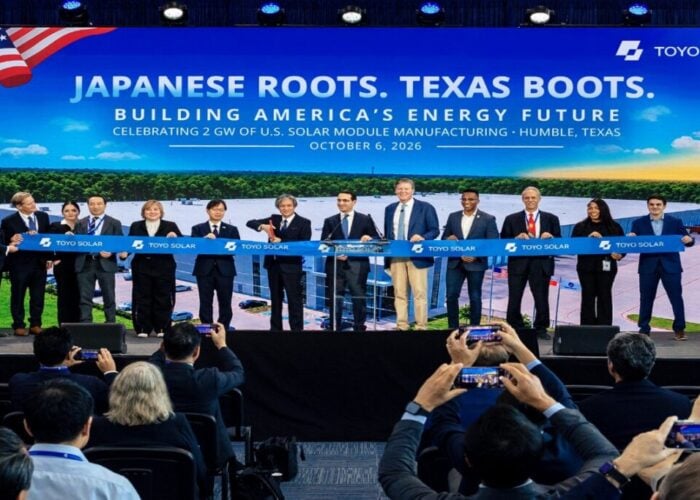
Japanese firm Toyo Solar has also experienced the full breadth of US policy with regard to overseas companies, having both filed AD/CVD complaints and been on the receiving end of duty investigations for its work in Ethiopia. Its chief strategy officer, Rhone Resch, praised the Trump administration’s “leadership” with regard to its latest Section 232 ruling.
“The proclamation reflects the administration’s leadership in making national security, American energy dominance and domestic manufacturing central to US solar policy,” said Resch. “It recognises that the United States must develop commercially scaled production of polysilicon, ingots, wafers and cells to reduce its dependence on China and other foreign entities of concern (FEOC).”
Ramadan, meanwhile, highlighted the importance of policy clarity, telling PV Tech that “having clarity on this policy will help developers and manufacturers assess which projects and investments can be viable.”
This week’s Section 232 update will have a significant impact on the US solar supply chain, which will be discussed in more detail at the PV CellTech USA conference on 13-14 October 2026. The event will address the policy and investment landscape for US solar manufacturing, across the supply chain, and include speakers such as Solar Energy Manufacturers for America (SEMA) Coalition executive director Mike Carr. Read the full agenda here and book tickets on the event website.