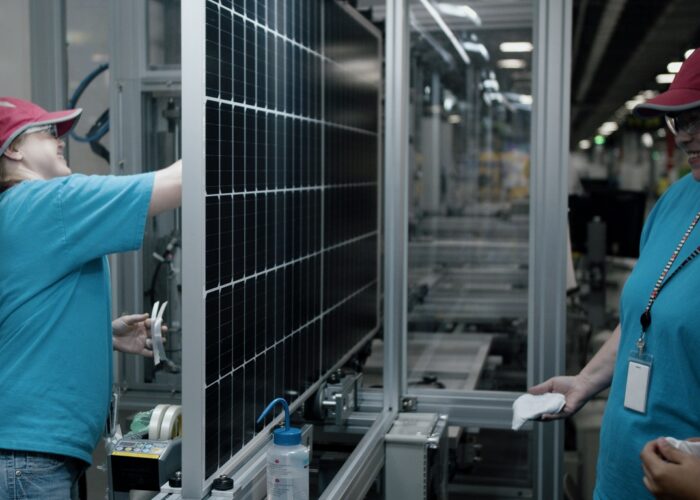
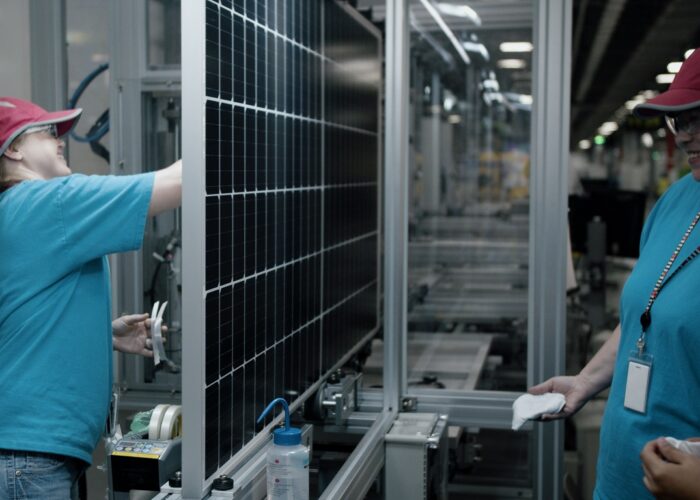
The first roll-to-roll flexible OPV thin-film plant using vacuum deposition of oligomers (a molecule that consists of a few monomer units) has been officially opened by Heliatek. The €14 million facility in Dresden, Germany, has one pilot/production line initially, with the expectation to launch commercial product offerings in around the third quarter of 2012. The first key market Heliatek is addressing is BIPV and has plans to raise a further €50 million for a full-scale production line. An opening ceremony was attended by the Prime Minister of Saxony, Stanislaw Tillich.
“After a construction period of less than six months of this proof-of-concept production line, we have achieved an important milestone on our way to the commercialization of organic solar films based on small molecules,” commented Thibaud Le Séguillon, CEO of Heliatek GmbH. “Now comes process integration. Heliatek will roll out its organic solar film for “Energy-2-Go” applications in the fall of 2012. Key product features will allow us to take truly green solar power everywhere it’s needed. At the next step, the first volume market will be BIPV.”
Try Premium for just $1
- Full premium access for the first month at only $1
- Converts to an annual rate after 30 days unless cancelled
- Cancel anytime during the trial period
Premium Benefits
- Expert industry analysis and interviews
- Digital access to PV Tech Power journal
- Exclusive event discounts
Or get the full Premium subscription right away
Or continue reading this article for free
“Organic photovoltaic is an important next generation technology for BASF,” added Dirk Nachtigal, managing director of BASF Venture Capital. “In order to fully exploit the potential of this innovative technology, our collaboration with partners like Heliatek is of strategic importance.”
Investors include, BASF Venture Capital, Bosch, Innogy Venture Capital (RWE) and Wellington Partners.
Heliatek announced late last year that it had set another new world record for organic solar cells after Fraunhofer ISE CalLab certified a cell efficiency of 9.8 % for a 1.1 cm² tandem cell.
Employing a vacuum deposition process using oligomers on a flexible substrate is claimed to achieve improved process control, leading to longer life expectancy and higher initial conversion efficiencies than other process techniques currently used for OPV and other thin-film technologies using flexible substrates.