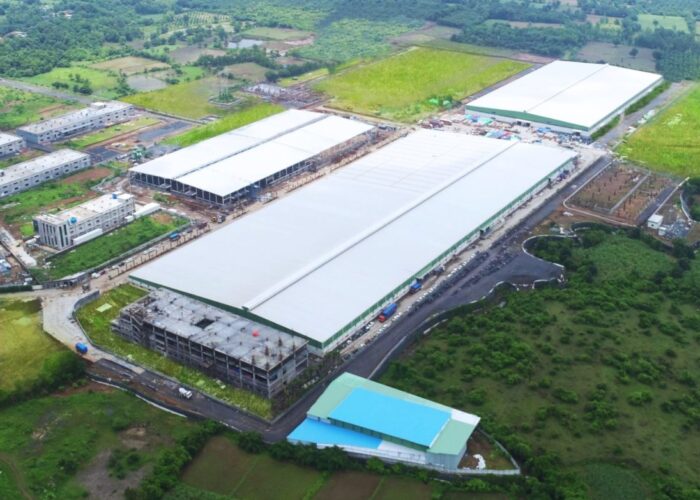
On August 23, workers from Siliken’s centre in Rafelbunyol, Valencia, Spain, are today protesting after the solar company presented an ERE (Expediente de Regulación de Empleo) — a Spanish administrative redundancy procedure which employers must comply with — to 100 employees, the CCOO Industry Federation has revealed.
The demonstration is the first of several planned protests. As part of the protest, workers began a march at 10.30a.m., starting from San Agustín Square.
Unlock unlimited access for 12 whole months of distinctive global analysis
Photovoltaics International is now included.
- Regular insight and analysis of the industry’s biggest developments
- In-depth interviews with the industry’s leading figures
- Unlimited digital access to the PV Tech Power journal catalogue
- Unlimited digital access to the Photovoltaics International journal catalogue
- Access to more than 1,000 technical papers
- Discounts on Solar Media’s portfolio of events, in-person and virtual
Or continue reading this article for free
On the morning of September 4, the workers led a second protest. Since the first demonstration, Siliken has made a total of 14 terminations, the majority of which are on maternity leave or on short-term contracts.
This was also backed up by one of the demonstrators who contacted PV-Tech to confirm that the company had started laying off a number of workers with the majority being pregnant women on maternity leave and mothers who work reduced hours.
This has led to banners being held outside the gates of Siliken’s headquarters in Valencia claiming that Siliken is discriminating against working mothers.
In response to such claims, a spokesperson for Siliken issued a statement to PV-Tech confirming that “the company is implementing a Labour Force Adjustment Plan in our factory in Rafelbuñol, Valencia (Spain), which reaches 90 of our employees including the 14 lay-offs made last week. These layoffs mainly affect the manual manufacturing process in Valencia, where Siliken is not economically profitable.
“The people affected in this process are those employees assigned to the non-automated production, and in Siliken this has represented around 80% women-20% men from 2001 till now. This means that Siliken has been and continue being a women employer.
“Moreover, Siliken is characterized by following work-life balance policies, supporting and growing with their employees. The current situation responds to ensure the viability of the company, and to preserve the security of other mothers and fathers job.”
It is believed that Silken has until December 31 to make the remainder of the lay-offs.
Earlier this year, Siliken reduced its workforce by 40 members in May at its Windsor, Ontario solar panel manufacturing plant.
Siliken has been suffering with a debt of €111.4 million. However, in July it managed to re-gain the bank’s trust and signed an agreement to refinance its debt as part of its Strategic Plan 2012-2015. Despite the negative backdrop of lay-offs and being in the red, the company has remained positive and foresees a 20% growth in 2012.