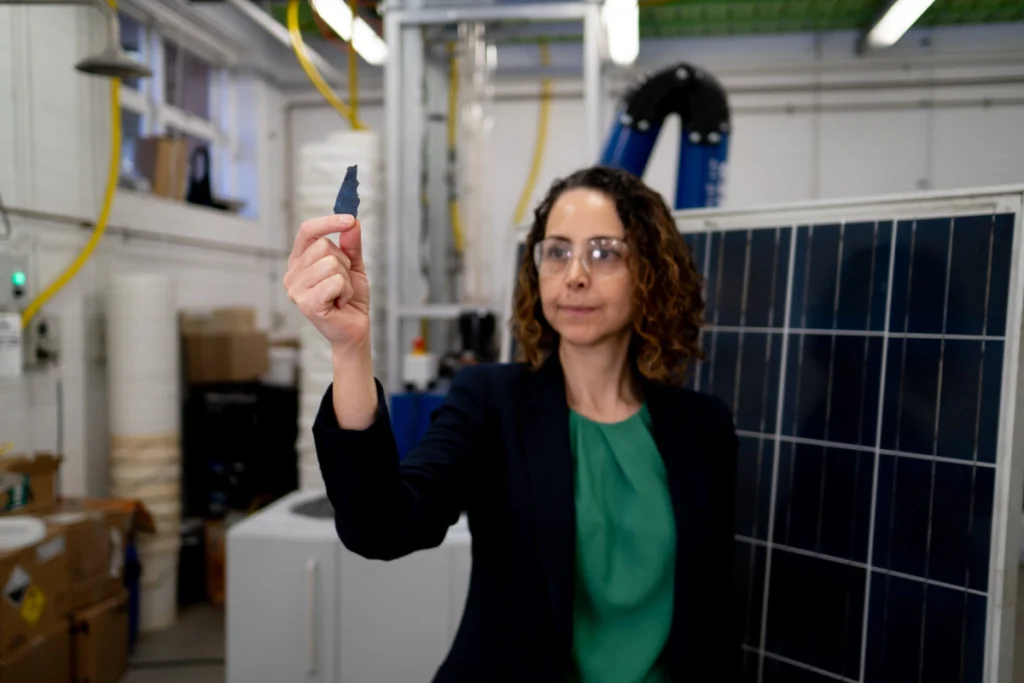
Researchers in Australia have heralded a potential breakthrough in recovering valuable silver from decommissioned PV modules.
Scientists from the University of Newcastle recovered nearly 100% recovery of the silver from half a tonne of end-of-life PV modules using a mineral processing technique called froth flotation, which is commonly used in mining.
Try Premium for just $1
- Full premium access for the first month at only $1
- Converts to an annual rate after 30 days unless cancelled
- Cancel anytime during the trial period
Premium Benefits
- Expert industry analysis and interviews
- Digital access to PV Tech Power journal
- Exclusive event discounts
Or get the full Premium subscription right away
Or continue reading this article for free
In previous trials, the team had demonstrated this method could extract silver from old modules without the need for costly and potentially hazardous acid, but the latest effort involved what they said was the world’s first continuous pilot-scale trial of the process.
“Our earlier small-scale batch research proved flotation could recover silver from solar panels,” said associate professor Mahshi Firouzi, deputy director of the University of Newcastle’s Centre for Critical Minerals and Urban Mining.
Firouzi said the challenge was no longer whether silver could be recovered from solar panels, but whether it could be recovered at a scale and cost that made recycling commercially viable.
“This latest work demonstrates that the process can operate continuously at a much larger scale with nearly 100% silver recovery, bringing us closer to commercial implementation.”
The trial processed 22kg of solar cell material extracted from around 460kg of end-of-life solar panels, equivalent to around 23 residential solar panels.
The researchers recovered almost 100% of the silver from the modules, and concentrated it into a product with around 80 times the silver concentration of the original cell material.
According to their preliminary calculations, the researchers said the flotation method could be three to five times more cost-effective than conventional acid-leaching, which also comes with the added complexity of hazardous waste management.
In Australia, they said modules cost around AU$10-15 (US$7.06-10.60) each to recycle, compared with only a few dollars to send to landfill, an equation that could be shifted if more of their silver can be recovered.
“At the moment, recycling often costs more than landfill. But if recyclers can efficiently recover and sell the silver contained within solar panels, that changes the economics completely,” Firouzi said. “Silver is the highest-value material in a solar cell. Recovering it has the potential to make solar-panel recycling far more financially attractive.”
Firouzi added that material recovery was a critical step in building a circular economy: “If we’re serious about building a circular economy, we need to think not only about how we generate clean energy, but also how we recover the materials that make those technologies possible. We’re effectively burying silver in landfill when we have the ability to recover it and return it to the economy.”
Full findings of the pilot trial been released as a preprint in the ChemRxiv.
The latest edition of PV Tech Power contains a special report on the solar industry’s efforts to manage the growing volumes of waste modules. To read in full, click here (subscription required).