Renewable energy supplied 42.1% of electricity generated across Australia’s National Electricity Market (NEM) in the three months to June 2026, a new quarterly high for the second quarter of the year, according to the Australian Energy Market Operator’s (AEMO) Quarterly Energy Dynamics report for Q2 2026.
NEM-wide wholesale spot prices averaged AU$74/MWh (US$51.50/MWh) across the quarter, down 47% from Q2 2025 and the lowest Q2 average since 2020.
Try Premium for just $1
- Full premium access for the first month at only $1
- Converts to an annual rate after 30 days unless cancelled
- Cancel anytime during the trial period
Premium Benefits
- Expert industry analysis and interviews
- Digital access to PV Tech Power journal
- Exclusive event discounts
Or get the full Premium subscription right away
Or continue reading this article for free
AEMO attributed the decline to three factors: higher renewable energy generation, rising battery storage system discharge during evening peak periods and reduced evening demand as home battery storage systems increasingly supply households after sunset.
The NEM’s daily price profile flattened materially, with evening peak prices well below Q2 2025 levels, while daytime prices remained broadly unchanged as rising battery charging and data centre loads absorbed the midday solar surplus.
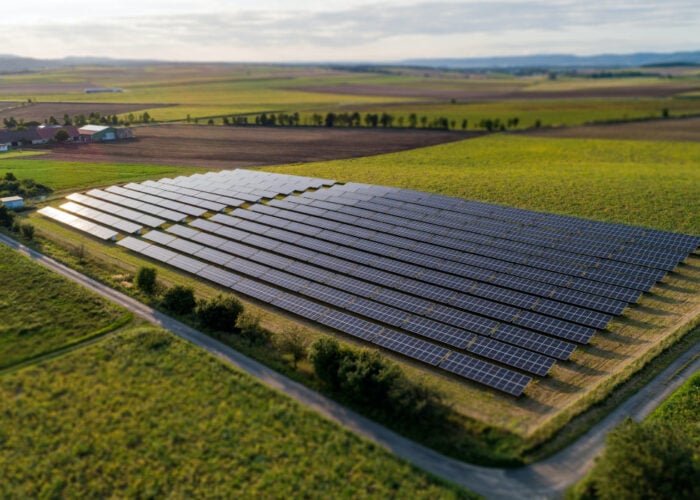
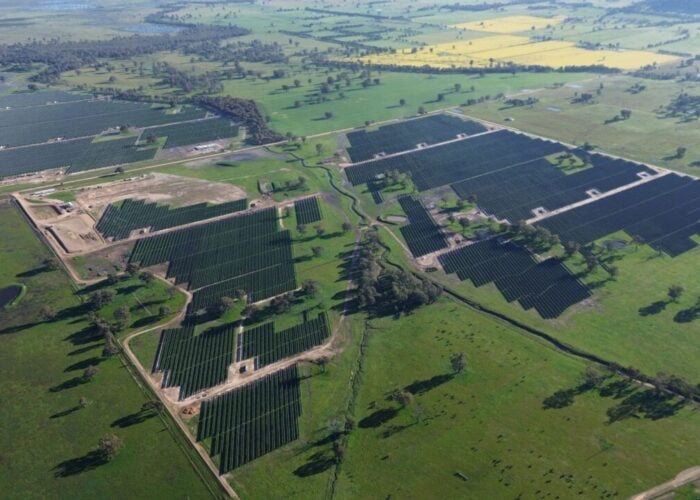
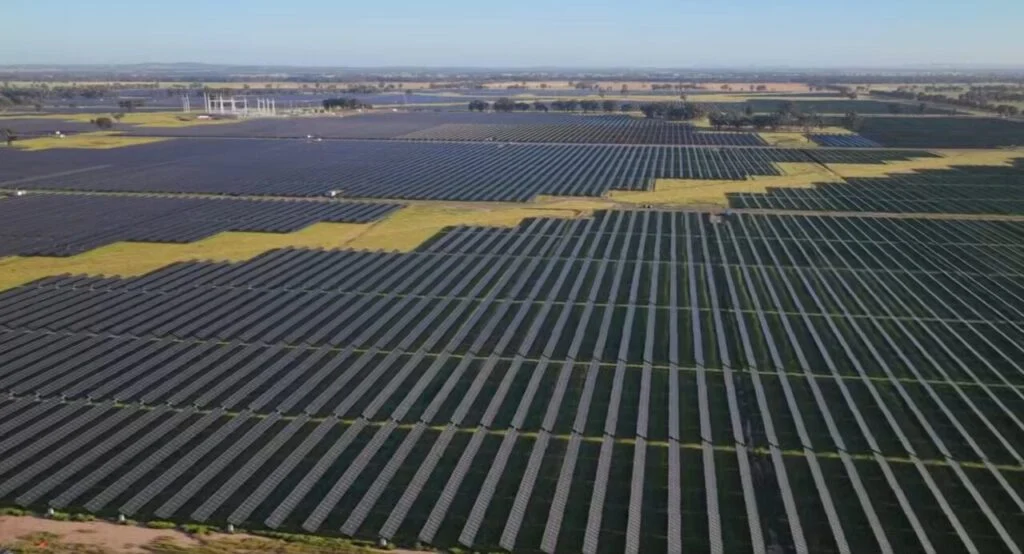
Grid-scale solar set a new Q2 record, averaging 1,860MW, up 12% from Q2 2025, with new capacity from Aldoga in Queensland, Culcairn in New South Wales, and Goorambat East in Victoria leading the additions.
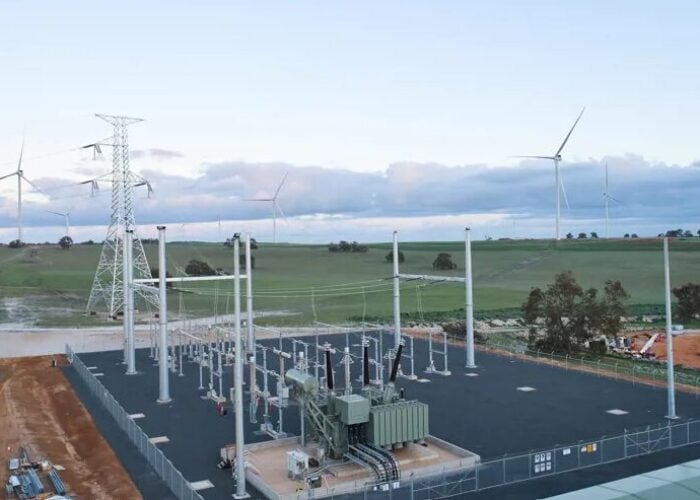
However, wind generation led the renewable energy growth, reaching a new Q2 average of 4,198MW, up 20% year-on-year. Queensland was the standout, recording a new all-time high of 842MW, up 80%, driven by the commissioning of new wind farms including Clarke Creek, MacIntyre and Wambo and stronger wind conditions across the state.
Output also increased in Victoria, up 177MW, and South Australia, up 102MW, with capacity additions from Golden Plains East, Golden Plains West and Goyder South contributing across those two states.
The NEM-wide volume-weighted wind capacity factor rose to 33%, up 3 percentage points from Q2 2025, with Queensland’s factor reaching 41%.
Variable renewable energy output across wind and grid-scale solar combined reached a new Q2 high of 6,058MW, up 903MW or 18% year-on-year.
Total coal-fired generation fell to a new Q2 low of 13,158MW, down 5% from Q2 2025, while gas-fired output averaged just 1,050MW, the lowest Q2 figure since 2003. NEM total emissions fell to a new Q2 low of 27.1 million tonnes of CO2 equivalent, down 6.4% from Q2 2025, with the grid’s emissions intensity falling to 0.57 tonnes of CO2 equivalent per MWh, down 6% year-on-year.
Regional wholesale price outcomes diverged across the quarter. Victoria recorded the lowest average at AU$56/MWh, down 60% year-on-year, while South Australia averaged AU$86/MWh, down 38% year-on-year. New South Wales fell 53% to AU$75/MWh and Queensland declined 44% to AU$67/MWh.
The cap return component of the NEM average price, which reflects spot prices above AU$300/MWh, fell to just AU$3/MWh from AU$37/MWh in Q2 2025, with South Australia responsible for almost the entire total following a price event in late June.
The quarter’s generation figures come as the Clean Energy Investor Group reported in July that 65% of its members believe Australia will not meet its 82% renewables by 2030 target under current settings, with lack of investor confidence in the delivery of transmission and grid connection infrastructure cited as the primary constraint.
The midday solar surplus was visible in wholesale price patterns and demand behaviour. Distributed rooftop solar output reached a new Q2 record of 2,520MW, up 6.9% year-on-year, while cumulative rooftop capacity across the NEM reached 26.4GW across 3.9 million installations by the end of June.
Victoria and South Australia set new Q2 minimums for operational demand, with South Australia’s minimum falling to just 57MW for a half-hour interval on 18 April, down 64% from the prior Q2 record.
The growing surplus during peak solar hours prompted the Australian government to launch the Solar Sharer Offer from 1 July 2026, a regulated initiative giving eligible households in New South Wales, South Australia and South East Queensland three hours of free electricity daily during peak solar generation.
Households do not need rooftop solar to participate and can access up to 24kWh of free electricity during the designated window each day.
Home battery storage adoption also accelerated through the quarter, supported by the federal government’s Cheaper Home Batteries Program. Cumulative household battery capacity under the scheme reached 11,321MWh across 389,137 installations by the end of June, up 41% from the end of Q1 2026, with growth recorded in every NEM region.
AEMO found that households with both solar and battery systems reduced their evening peak grid imports by an average of 0.7kW per household compared to solar-only households, equivalent to a 73% reduction in net imports during the 1600 to 2100 hour window.
Battery storage set prices in 36% of dispatch intervals as revenue compresses
As detailed in Energy-Storage.news’ energy storage focused analysis of the same report, grid-scale battery storage more than doubled its installed capacity in the NEM over the year, with 4,640MW/12,353MWh beginning commissioning between Q2 2025 and Q2 2026.
Projects reaching full output during Q2 2026 alone included the 300MW/1,200MWh Stanwell BESS and 222MW/593MWh Woolooga BESS in Queensland, the 240MW/590MWh Mornington BESS in Victoria and the 180MW/360MWh Broadsound Energy Park in Queensland.
Total installed capacity, including projects in commissioning, exceeded 9,000MW by the end of June.
Average battery storage discharge reached a quarterly record of 476MW, almost triple the 162MW recorded in Q2 2025, while average charging rose 182% to 574MW, concentrated in daytime hours when solar output and battery storage economics align.
Daytime charging increased by 1,009MW, up 211% year-on-year, with that stored energy supporting a 1,066MW, or 228%, increase in evening discharge.
Peak battery storage charging set a new record of 3,653MW on 7 June, surpassing the previous record set in Q4 2025 by 819MW. Peak battery discharge also set a record at 3,759MW on 26 June, 203MW above the prior record set in Q1 2026.
As Energy-Storage.news reported, NEM-wide battery price spreads collapsed 85% in a single year, falling from AU$342/MWh in Q2 2025 to AU$51/MWh in Q2 2026, compressing arbitrage margins sharply as the installed fleet scaled.
The decline was consistent across all mainland NEM regions. New South Wales recorded the steepest fall, with spreads declining 90% to AU$41/MWh, followed by Victoria at 88% to AU$50/MWh, South Australia at 80% to AU$59/MWh and Queensland at 79% to AU$57/MWh.
Total estimated net battery storage revenue fell to AU$57.5 million in Q2 2026, down from AU$130.5 million in Q2 2025. Net arbitrage revenue dropped 56% to AU$52.8 million, driven by a AU$44.5 million fall in gross energy revenues to AU$106.2 million and a AU$23.6 million rise in charging costs to AU$53.4 million.
FCAS revenue declined 51% to AU$4.8 million, though it accounted for a slightly larger share of total battery storage revenue at 8.3%, up from 7.5% in Q2 2025.
Volume-weighted average battery storage discharge prices fell from AU$427/MWh in Q2 2025 to AU$101/MWh in Q2 2026, a decline of AU$326/MWh in a single year, illustrating how quickly the economics of arbitrage-focused battery operation shift as capacity scales rapidly.
The connection pipeline continued to expand through Q2 2026, with a record 6.9GW of new generation and storage applications approved across 32 projects.
Battery storage projects accounted for 3.6GW of that total, followed by 1.8GW of solar-plus-storage hybrids, 1.3GW of wind and 0.2GW of solar.
Total capacity working through the end-to-end connection process grew 42% over the year to 75.4GW, with battery storage systems comprising 53% of the pipeline at 39.6GW. Of that battery storage pipeline, 32.9GW features grid-forming inverters, which provide synthetic inertia and system strength services as coal-fired generation exits the market.
The application pipeline more than doubled across FY26, from 17.5GW to 35.3GW, though AEMO flagged a throughput challenge in the developer-led proponent implementation stage, where the median project duration increased from 14 months to 18 months over the year, and nearly one-third of projects have been in that stage for more than two years.
A further 17 data centre load connection projects with a combined maximum capacity of 9GW are separately working through the transmission network connection process, with 52% of that capacity in New South Wales, 31% in Victoria and 17% in South Australia.
Parts of this article first appeared on Energy-Storage.news as the item ‘NEM battery price spreads fall 85% in a year as Australia’s grid-scale BESS fleet passes 9,000MW‘.