The Australian government has officially launched the Solar Sharer Offer, a regulated energy initiative that gives eligible households three hours of free electricity every day during peak solar generation.
The new initiative was made available to residential customers in New South Wales, South Australia and South East Queensland from 1 July 2026.
Try Premium for just $1
- Full premium access for the first month at only $1
- Converts to an annual rate after 30 days unless cancelled
- Cancel anytime during the trial period
Premium Benefits
- Expert industry analysis and interviews
- Digital access to PV Tech Power journal
- Exclusive event discounts
Or get the full Premium subscription right away
Or continue reading this article for free
The scheme requires energy retailers with more than 1,000 customers in Default Market Offer areas to make the Solar Sharer Offer available to eligible households.
It is delivered as an opt-in plan through electricity retailers rather than as a rebate or cash payment and is open to both renters and homeowners.
Crucially, households do not need rooftop solar modules to participate. Instead, the offer is designed to share the benefits of the country’s growing solar generation with customers who have been unable to access it directly.
The free electricity window is timed to coincide with peak solar output and varies by network. In New South Wales and South East Queensland, the free period runs from 11:00 to 14:00, on the Ausgrid, Endeavour, Essential and Energex networks.
In South Australia, the SA Power Networks system runs from 12:00 to 15:00. Households can access up to 24kWh of free electricity during the three-hour window each day.
Electricity used outside the window and the daily supply charge still apply, and charges may apply if consumption during the free period exceeds the 24kWh cap. Participants need a smart meter to access time-based billing.
The 24kWh daily cap was added to the scheme’s design following consultation. As PV Tech reported when the scheme was first announced in November 2025, the Australian government mandated that energy retailers provide a free solar electricity window for households from 2026, with the scheme framed as a way to reduce the waste of abundant midday solar generation and redistribute its benefits to a wider population.
The cap, equivalent to the total daily electricity use of an average five-person household according to Australian Energy Regulator (AER) benchmarks, was introduced to keep the offer financially sustainable for retailers.
The solar surplus problem that the scheme addresses
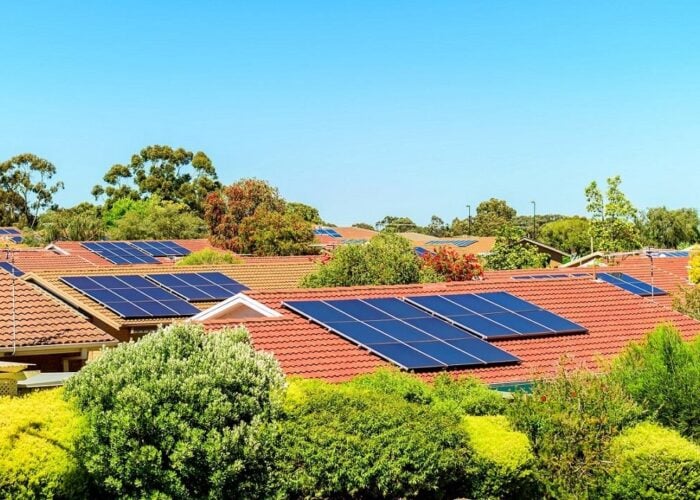
Australia now has more than 4.3 million rooftop solar installations. On clear, midday days, those systems push electricity into the grid at a rate that exceeds demand, causing wholesale electricity prices to fall sharply or even turn negative.
That dynamic has intensified as large-scale solar capacity has grown alongside the rooftop fleet.
The Solar Sharer Offer is structured to shift household demand into the midday window, absorbing that surplus at the consumer level rather than relying entirely on grid-scale batteries and curtailment.
The scheme sits within a broader set of reforms to how the Default Market Offer operates, which is the regulated price cap that protects households that do not actively shop around for a better electricity deal.
The Solar Sharer Offer is one component of those DMO reforms, which also aim to ensure that standing offer customers pay prices that reflect the efficient cost of supply.
According to the government, the scheme is expected to deliver the greatest savings for households that can practically shift energy-intensive tasks such as running washing machines, dishwashers, clothes dryers, hot water systems, heating and cooling, or electric vehicle (EV) charging into the free window.
Consumer advocacy group CHOICE has estimated that running a dishwasher during the free period rather than at a peak evening rate of around 35 cents per kilowatt-hour could save a household approximately AU$127 annually.
Households with home batteries can also maximise the scheme’s value by charging during the free period and drawing on stored electricity through the evening peak.
The Solar Sharer Offer is currently limited to the three Default Market Offer jurisdictions. Victoria, the Australian Capital Territory and other states are not included at launch, though the government has indicated it is considering introducing the scheme or a similar mechanism in other regions.