China’s ‘Top Runner’ solar program becomes dominated by P-type mono PERC modules

May 25, 2018
Facebook
Twitter
LinkedIn
Reddit
Email
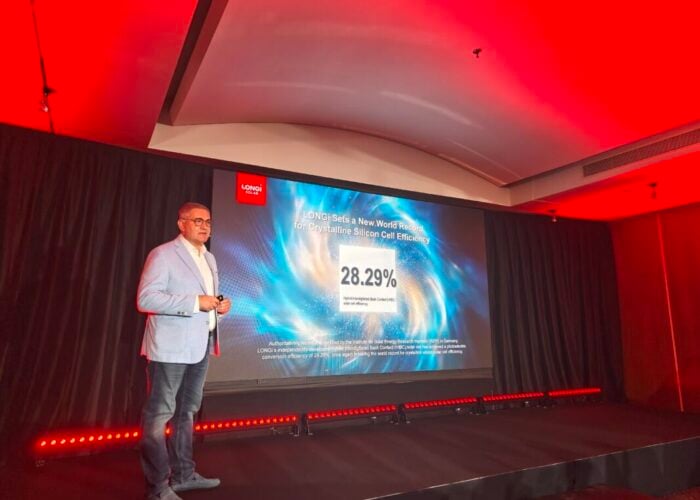
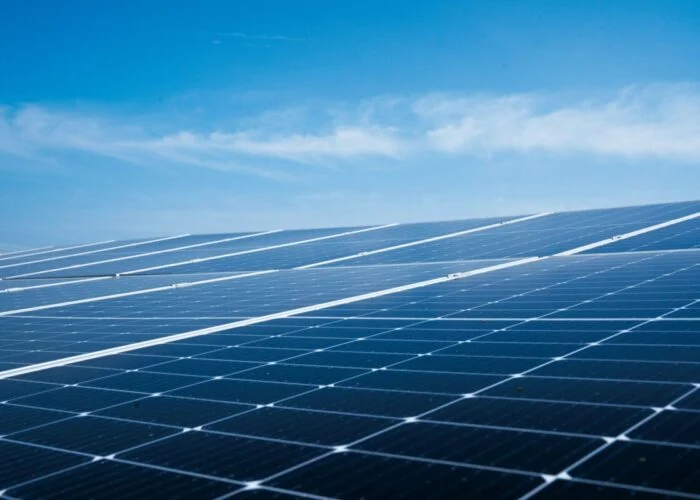
Although bifacial modules seem to be a key performance upgrade, EnergyTrend said that there are more uncertainties for bifacial modules in respect to evaluating the performance gains. Image: LONGi Solar

According to analysis by Taiwan-based market research firm, EnergyTrend, around 67% of Top Runner program bids in 2017 were won with P-type mono PERC modules and it expects an increasing percentage of project bids in 2018 will be secured by using P-type mono PERC bifacial modules.

This article requires Premium SubscriptionBasic (FREE) Subscription

Try Premium for just $1

  • Full premium access for the first month at only $1
  • Converts to an annual rate after 30 days unless cancelled
  • Cancel anytime during the trial period

Premium Benefits

  • Expert industry analysis and interviews
  • Digital access to PV Tech Power journal
  • Exclusive event discounts

Or get the full Premium subscription right away

Or continue reading this article for free
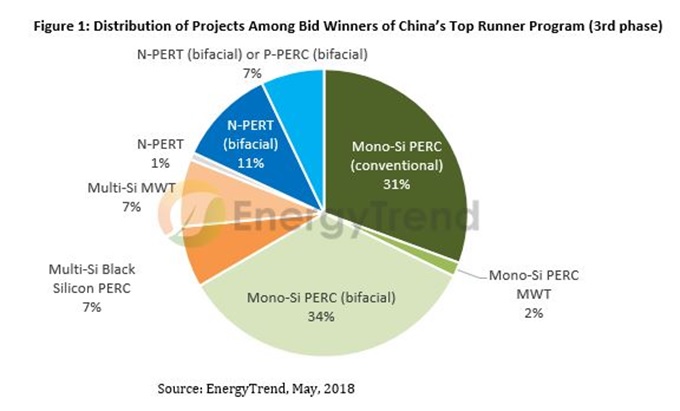
According to analysis by Taiwan-based market research firm, EnergyTrend, around 67% of Top Runner program bids in 2017 were won with P-type mono PERC modules. Image: EnergyTrend

“Mono-Si PERC accounted for the majority (67%) of all the bid-winning projects,” says Lions Shih, EnergyTrend’s analyst, “including conventional mono-Si PERC, bifacial mono-Si PERC, and mono-Si PERC MWT”. Other projects mostly use multi-Si P-PERC and bifacial N-PERT. For P-type products, black silicon and PERC technologies are applied to improve the performances.”

However, although bifacial modules seem to be a key performance upgrade, EnergyTrend said that there are more uncertainties for bifacial modules in respect to evaluating the performance gains claimed. Therefore P-type mono PERC modules are expected to remain the dominant choice of module for project developers in the Top Runner bidding in 2018. 
Read Next

Premium
April 2, 2026
Analysis: Some in the US solar industry are positioning tariffs as a silver bullet for manufacturers, but it may not be as straightforward as that.
March 30, 2026
The scope of supply chain diligence for PV projects in the US seeking tax credits has expanded, requiring greater vigilance in procurement, writes Intertek CEA's Paul Wormser.
March 27, 2026
The US International Trade Commission (ITC) has begun an investigation into tunnel oxide passivated contact (TOPCon) solar products in the US, following a complaint by US thin-film module manufacturer First Solar.
March 27, 2026
Two module production facilities in China have been awarded the first Supply Traceability Standard certifications by Europe’s Solar Stewardship Initiative (SSI).
March 26, 2026
More than 70% of global solar manufacturing facilities exhibited “major” or “critical” defects in 2025, according to a new report from Intertek CEA.
March 25, 2026
The global annual capital expenditure on PV manufacturing equipment is expected to more than double to US$43.8 billion over the next decade, according to a report from VDMA.

Upcoming Events

Solar Media Events
April 15, 2026
Milan, Italy
Solar Media Events
June 16, 2026
Napa, USA
Solar Media Events
October 13, 2026
San Francisco Bay Area, USA
Solar Media Events
November 3, 2026
Málaga, Spain
Solar Media Events
November 24, 2026
Warsaw, Poland