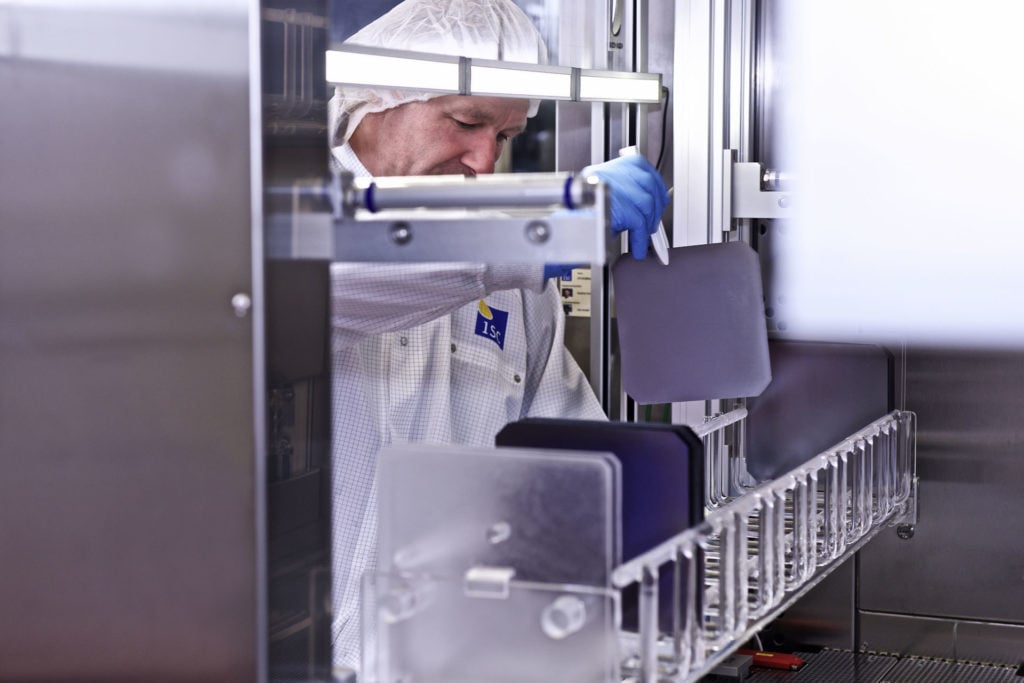
The global annual capital expenditure on PV manufacturing equipment is expected to more than double to US$43.8 billion over the next decade, according to a report from German industrial body VDMA Services.
The study, undertaken by leading PV research bodies Fraunhofer ISE and ISC Konstanz, highlights opportunities for high-quality European PV equipment in markets such as India and the US, despite the lack of a strong home market for their tools.
Try Premium for just $1
- Full premium access for the first month at only $1
- Converts to an annual rate after 30 days unless cancelled
- Cancel anytime during the trial period
Premium Benefits
- Expert industry analysis and interviews
- Digital access to PV Tech Power journal
- Exclusive event discounts
Or get the full Premium subscription right away
Or continue reading this article for free
The study said the global market for PV manufacturing equipment is entering a period of unprecedented growth as solar deployment continues to accelerate, rising from around US$16.6 billion in 2025 to approximately US$43.8 billion by 2035, with total investment of US$250-300 billion during that decade.
Although China dominates PV manufacturing, with a number of other hubs such as the US, India and the Middle East emerging, driven by strong industrial policies, the report said Europe continued to play a critical role in developing high-tech manufacturing equipment.
“European equipment manufacturers remain recognised for their technological excellence, reliability, long service lifetimes, and close integration with research institutes. Their machines are valued for precision, durability, and advanced process control,” the study authors said.
However, they suffer from structural disadvantages that hinder their competitiveness. “European tools often involve higher up‑front capital costs, longer delivery times and greater operational complexity compared to Asian alternatives. Moreover, Europe lacks a functioning domestic market for PV manufacturing, which deprives equipment makers of local reference factories, economies of scale, and continuous industrial learning,” the report said.
This is borne out by interviews the authors carried out with international factory operators, who confirmed that although European tools are valued for their quality, precision and reliability, factors such as speed of delivery and cost-efficiency on which Chinese producers excel mean they struggle to compete.
ISC Konstanz co-founder Radovan Kopecek said: “European machinery already demonstrated its strength in current TOPCon technology. The technological shift to back contact, HJT and tandem cells creates significant opportunities for European equipment suppliers. But speed matters; customers increasingly prioritise short payback cycles, integrated solutions, and fast response times.”
To capitalise on the opportunities emerging over the coming decade, the study said that European companies should expand turnkey capabilities, develop risk‑sharing business models, strengthen after‑sales service structures and improve local presence in key markets.
It also stressed the need for more coordinated and effective industrial strategies at the European level. These include targeted investment support, procurement programmes and closer alignment between national and EU‑level measures.
The study concluded that Europe remains a global leader in PV equipment technology, yet its future competitiveness depends on “translating engineering excellence into industrial scale and commercial agility”.
Peter Fath, chair, VDMA Photovoltaic Equipment, and CEO of RCT Solutions, said: “We are proud to have the results of the important study that puts the current situation of the European PV machinery industry in perspective. For us, it is clear that the expertise to build a competitive European solar manufacturing industry is possible with competencies of our machinery segment and research.
“The absence of global level playing field in the current market situation makes it necessary to introduce clever industrial policy measures and effective financing tools for the domestic EU market and the export-relevant regions like India and USA. Europe must act now to secure its share.”
‘European photovoltaics machinery and equipment study for the growing global photovoltaics market’ is available here.