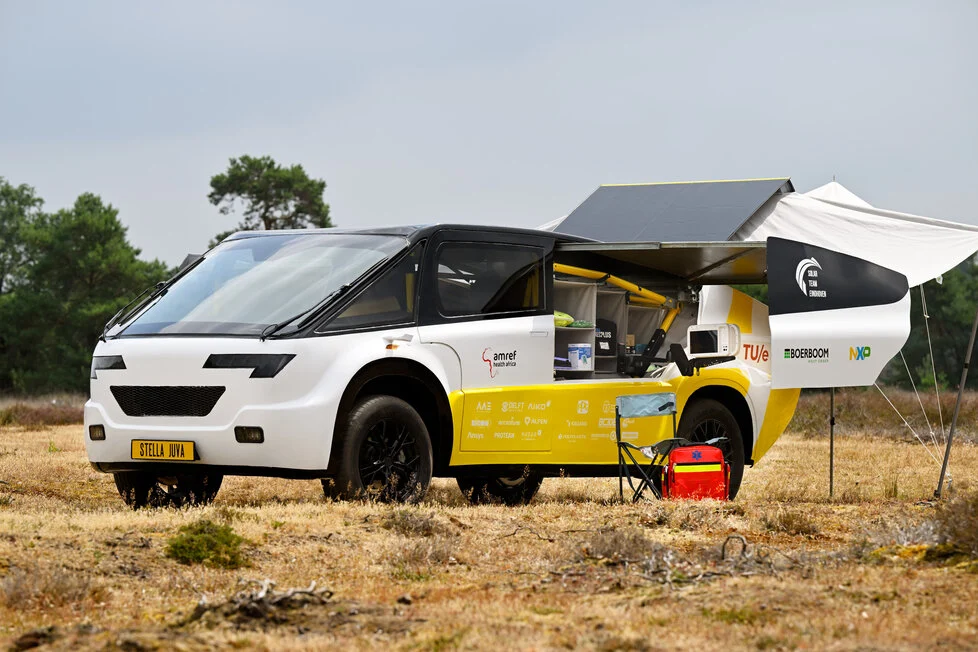
The Eindhoven University of Technology announced ‘Stella Juva’, a prototype of the world’s first solar-powered ambulance, which uses all back contact (ABC) solar cells from leading Chinese manufacturer Aiko.
Unveiled in the Netherlands, the vehicle has been developed by the Eindhoven University of Technology Solar Team and uses Aiko’s cells to generate electricity that powers both the vehicle and the medical equipment onboard.
Try Premium for just $1
- Full premium access for the first month at only $1
- Converts to an annual rate after 30 days unless cancelled
- Cancel anytime during the trial period
Premium Benefits
- Expert industry analysis and interviews
- Digital access to PV Tech Power journal
- Exclusive event discounts
Or get the full Premium subscription right away
Or continue reading this article for free
The vehicle can purportedly travel up to 715km under favourable solar conditions and reaches top speeds of 120km/h. An integrated battery system ensures continuous operation during periods of low solar irradiance and at night.
Vehicle-integrated solar presents a challenge because of the limited roof space and the potential added weight meaning the vehicle requires more power. The Eindhoven Solar Team said it selected Aiko’s ABC technology because of its high conversion efficiencies, long term efficiency and stable performance.
Aiko’s cells also incorporate copper interconnection technology to reduce the risk of cracks caused by the near-constant vibrations of off-road travel.

In the UK, an R&D project called the Smart Use of Integrated Technology for EV (SUITE) project sees a consortium including Nissan Technical Centre UK explore how solar can provide supplementary electricity for vehicles.
For that, UK-based perovskite solar company Oxford PV is providing its perovskite-on-silicon tandem solar cell technology, also known as thin-film, which is a more lightweight option, for the trial.
Read the full version of this story on our sister site EV Infrastructure News.