The widespread deployment of renewable energy capacity in Spain has driven a decoupling of energy prices from volatile global gas prices, resulting in a 19% reduction in consumer electricity bills.
This is a key takeaway from a report, published today by think tank Ember, which looks at the impact of Spanish renewable energy deployment on the country’s power prices. The report examines changes in power prices across Europe in response to the 2022 Russian invasion of Ukraine and the US-Israel war with Iran and the closure of the Strait of Hormuz, two significant macroeconomic disruptions that drove up power prices in several European countries.
Try Premium for just $1
- Full premium access for the first month at only $1
- Converts to an annual rate after 30 days unless cancelled
- Cancel anytime during the trial period
Premium Benefits
- Expert industry analysis and interviews
- Digital access to PV Tech Power journal
- Exclusive event discounts
Or get the full Premium subscription right away
Or continue reading this article for free
The increase in power prices was particularly striking in countries that are more heavily reliant on fossil fuels. For instance, the average power price in Italy, a country that Ember described as “more gas-dependent” than Spain, reached €143/MWh (US$165.9/MWh), while Spanish energy prices were less than one-third of that, at €42/MWh.
This means that, according to Ember, a typical Spanish household is paying 19% less than it would otherwise pay if the country’s gas prices were as strongly tied to the global gas supply as they were in 2021. This translates to a reduction of €10 per household per month in bills.
Decoupling power prices from gas prices
The decoupling of Spanish power prices from global gas prices is the driving force behind these lower bills. Ember attributes this decoupling to the deployment of renewable energy capacity, which has reduced the impact of gas on the energy mix more broadly; according to Ember, Spanish wind and solar generation increased by 37% between 2021 and 2025, which means that, in the first five months of 2026, gas influenced just 9% of hours in the national energy mix.
This compares to gas influencing 52% of hours in Spain as recently as 2021. The graph below, from Ember, shows the impact of global gas prices on Spanish energy prices during the two global conflicts, the Russian invasion of Ukraine and the war involving the US, Israel and Iran.
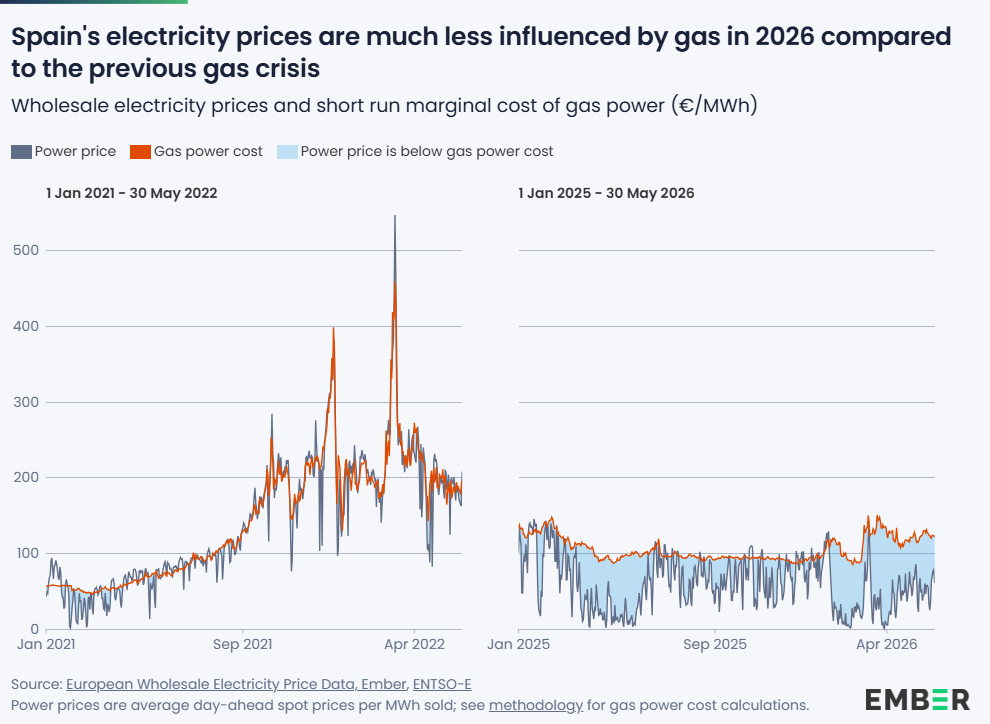
Again, compared to Italy, the difference is stark; Ember calculates that gas influenced 75% of hours in the Italian energy mix in the first five months of this year, over eight times the influence seen in Spain.
Crucially, Spain has responded to its own internal challenges with a doubling down on renewable energy investment. April 2025 saw the Iberian grid endure a significant blackout, but rather than fall back on fossil fuel-powered generation in response to this treat to the country’s grid security, Spain has sought to expand its renewable energy sector.

Last November, the government passed a degree to support grid resilience and the deployment of battery energy storage systems (BESS), and figures from Ember show that since the blackout, Spain has added an average of 1.3GW of new solar PV and wind capacity each month, just above the 1.2GW of monthly capacity additions the year before.
“Spain’s long-term, ambitious push on wind and solar is paying dividends, shielding consumers from volatile fossil fuel prices,” explained Ember senior energy analyst, Europe, Criss Rosslowe. “Reforms introduced following the April blackout have sustained the energy transition, strengthening the shielding of power prices.”
Tackling curtailment
The BESS piece is particularly significant, as the Iberian grid could stand to benefit from considerable strengthening. Not only in response to the blackout in particular, but to minimise the widespread curtailment that affects the Spanish grid, which has struggled to effectively deploy the sheer volume of renewable energy capacity that has been brought online in recent years.
Figures from Spanish grid operator Red Eléctrica estimate that renewables curtailment leapt from 0.1TWh in 2021 to 4.6TWh in 2025, driving an increase in annual grid balancing costs from €1.3 billion to €3.8 billion over this period; strengthening the Spanish grid is therefore a priority for both energy security and cost-saving reasons.
Regarding batteries, Spain now aims to have 22.5GW of operational energy storage by 2030, and Ember expects operational BESS in Spain to quadruple between 2025 and 2026.