Solar generation increased by up to 17% across several European markets during this summer’s heatwaves, according to analysis from energy think tank Ember.
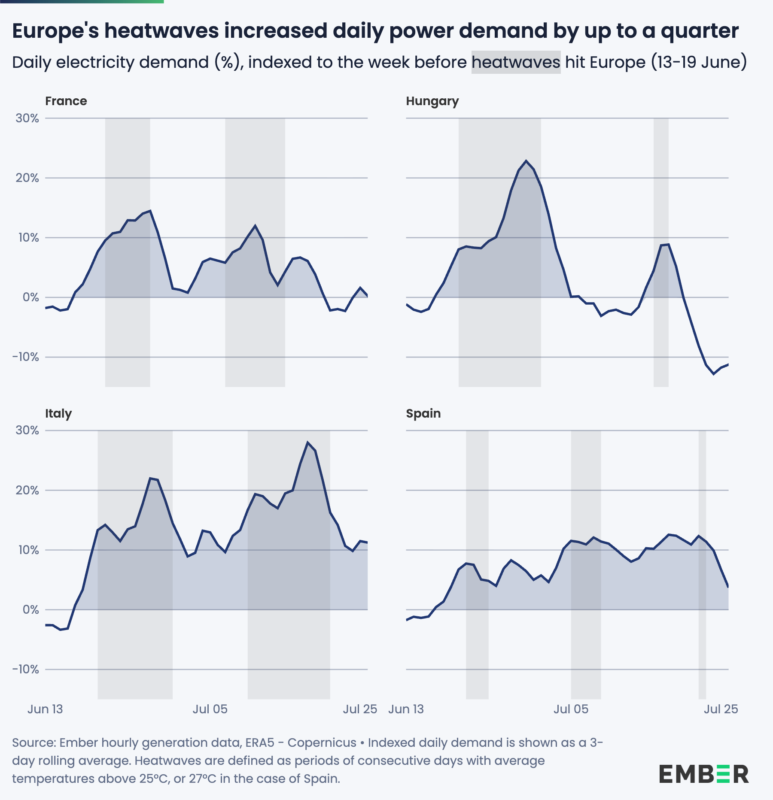
The analysis found that daily electricity demand during the late-June heatwave increased by 26% in Hungary, 22% in Italy, 11% in France and 8% in Spain, compared with the previous week. Peak demand also rose by 21% in Hungary, 13% in Italy and 8% in both France and Spain.
Try Premium for just $1
- Full premium access for the first month at only $1
- Converts to an annual rate after 30 days unless cancelled
- Cancel anytime during the trial period
Premium Benefits
- Expert industry analysis and interviews
- Digital access to PV Tech Power journal
- Exclusive event discounts
Or get the full Premium subscription right away
Or continue reading this article for free
Solar was the only major generation source to perform better than usual during the heatwaves. Average daily solar generation was 17% higher in France and Hungary and 5% higher in Spain compared with other days in June and July, Ember said. In Italy, solar generation was unchanged.
“The surge in solar output helped stabilise grids at a time when other power sources were struggling to deliver. Solar is already doing heavy lifting during heatwaves, but the real challenge starts after sundown. In the evening, when cooling demand is still high, the grid is most exposed to expensive gas-fired power,” said Chris Rosslowe, senior energy analyst at Ember.
The increase in solar output was particularly valuable as extreme heat and drought reduced the availability of conventional generation. Nuclear output was curtailed in France, Hungary, Romania and Switzerland, while five UK gas plants reduced output by a combined 2.5GW during June’s record heat. Low water levels on Italy’s river Po also threatened gas generation.
Coal generation was similarly affected. Critically low water levels in Poland’s river Vistula forced reductions at the Kozienice and Połaniec coal plants, removing around 1.3GW from the power system, while low Danube water levels affected Serbia’s Kostolac coal plants.
Hydropower also came under pressure, with EU hydropower production at its lowest level in at least a decade during May, June and July. In July, seven of the EU’s eight largest hydropower producers, together accounting for more than 90% of EU hydro generation, recorded output below their five-year averages.
Heat puts grids under pressure
According to Ember, the combination of higher demand and constrained generation increased the risk of power system disruption.
In June, an overheated transformer temporarily disconnected 70,000 consumers in Brittany, France. However, despite the challenging conditions, Ember said Europe avoided a major disruption to its power supplies.
France saw up to 29GW, or 43%, of its nuclear capacity unavailable on 12 July 2026. At least 11GW of offline capacity was marked by the plant operator as either “forced” or due to “environmental issues”, although Ember noted that it is difficult to verify exactly how many outages were temperature related. The heatwave may have affected up to 18% of France’s nuclear capacity, compared with an estimated 15% during the June 2025 heatwave.
Solar helps during the day, but evening remains a challenge
Against this backdrop, solar provided an important source of additional generation during daylight hours. According to the report, EU solar generation reached 52TWh in June and 55TWh in July, with solar accounting for 25% of EU electricity generation in both months.
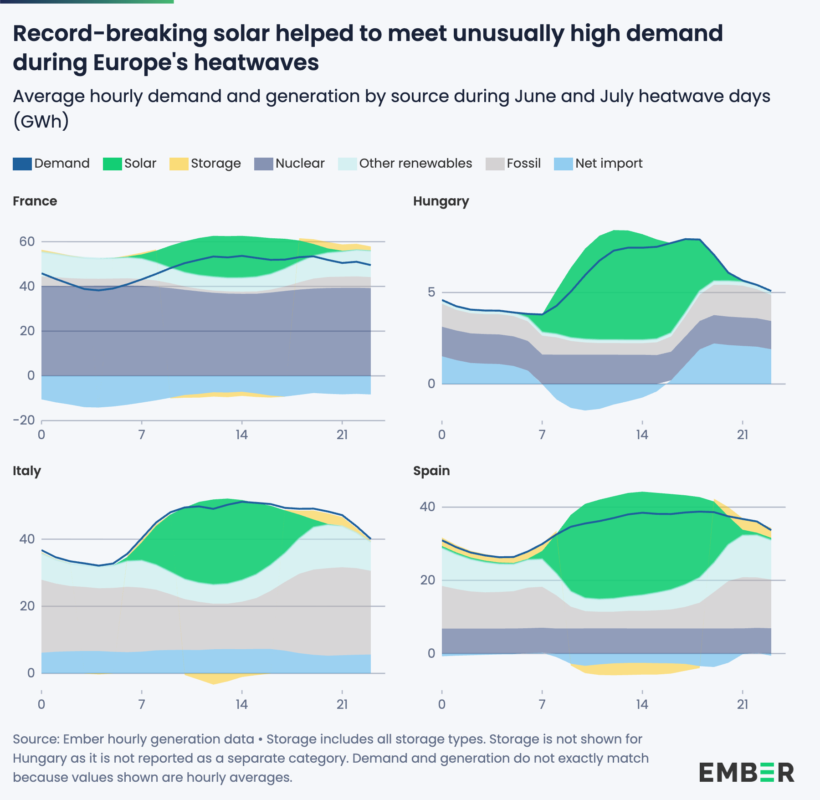
Ember estimated that during the June heatwave, a typical UK rooftop solar system produced enough electricity to power a typical household air-conditioning unit for five hours.
However, the benefit diminished after sunset, when cooling demand remained high while solar generation declined. This contributed to significant evening price spikes.
Average daily power prices during the late-June and early-July heatwaves were 119% higher in Hungary, 44% higher in France, 13% higher in Italy and 7% higher in Spain than on comparable days in the preceding week. In Hungary, prices exceeded €900/MWh (US$1038/MWh) on 30 June, while Italy reached €285/MWh and France €313/MWh on 24 June.
“While solar saves the day, battery storage can save the evening. Together, they are one of the clearest ways to make Europe’s power system more resilient in hotter summers. As solar output rises during heatwaves and other power sources struggle, storage can carry that cheap electricity into the evening,” Rosslowe added.
Ember said the price volatility highlighted the need for greater flexibility as heatwaves become more frequent. Battery storage and demand response could help shift excess daytime solar generation into the evening, when cooling demand remains elevated and the grid becomes more reliant on thermal generation.