US solar manufacturer T1 Energy has reported second-quarter 2026 net sales of US$250.1 million as construction of its planned 2.1GW G2_Austin solar cell factory progresses.
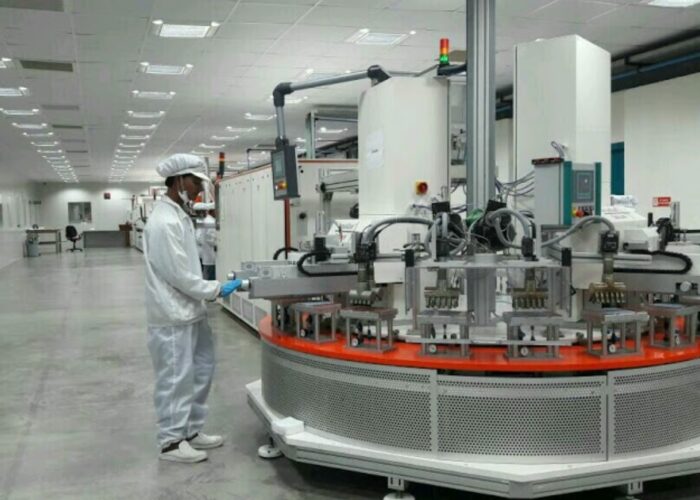
T1 produced 935MW of modules at its G1_Dallas facility during the quarter, while reporting a net loss from continuing operations of US$36.9 million and adjusted EBITDA of US$10.7 million.
Try Premium for just $1
- Full premium access for the first month at only $1
- Converts to an annual rate after 30 days unless cancelled
- Cancel anytime during the trial period
Premium Benefits
- Expert industry analysis and interviews
- Digital access to PV Tech Power journal
- Exclusive event discounts
Or get the full Premium subscription right away
Or continue reading this article for free
The company is targeting first cell production at G2_Austin in the first quarter of 2027. Construction of Phase 1 of the facility has progressed to the point where the building is ready for interior mechanical, electrical and plumbing installation, while the first containers of production-line equipment have begun arriving at US ports.
T1 said key shipments from its production-line equipment supplier for Phase I are either already in the US or in transit.
The company now expects capital expenditure for G2_Austin Phase I to reach US$510 million, including a recently added 20% contingency. T1 said the additional allowance reflects labour and materials cost pressures associated with tightness in the Texas data centre construction market.
Dan Barcelo, chairman and CEO of T1 Energy said, “We are focused on delivering strong operational and financial performance in the second half of 2026 while we continue to make meaningful progress at G2_Austin, our flagship US solar cell fab.”
T1 strengthens solar PV production outlook
In August, the company signed an agreement to supply independent power producer (IPP) Clearway Energy Group with 641MW of solar modules manufactured using domestic cells from G2_Austin.
Meanwhile, the company expects production at G1_Dallas to accelerate during the second half of 2026. T1 said its Q3 and Q4 production run rate is expected to exceed the 935MW achieved in Q2.
The company now expects full-year 2026 G1_Dallas production to come in toward the upper end of its previously disclosed 3.1-4.2GW range. T1 signed a supply deal with US tracker manufacturer Nextracker to use the latter’s steel module frames at its 5GW Dallas plant in October 2025.
Additionally, T1’s expansion strategy received a technology boost in July through its US$135 million acquisition of solar patents and other intellectual property from Evervolt Green Energy. The acquired IP covers tunnel oxide passivated contact (TOPCon) solar cell and module technology.
The company is seeking to combine the IP with its planned domestic cell production at G2_Austin, alongside commitments covering US polysilicon and wafer supply.
T1 has also backed new US trade measures targeting imported polysilicon and polysilicon derivatives. The Section 232 proclamation announced on 6 August introduces tariffs on imports from 4 December and proposes to establish some measures to encourage investment in domestic polysilicon production. But industry experts disagree on how successful Section 232 will be in establishing upstream US manufacturing capacity at scale (subscription required).
T1 said it plans to work with the US Department of Commerce to access the programme through its planned and committed investments in G2_Austin, TOPCon intellectual property and US polysilicon and wafer supply agreements with Hemlock Semiconductor and Corning.
T1 is also exploring strategic options for its Nordic portfolio, including its Norwegian data centre asset, which has a 50MW grid allocation and remains in the queue for a further 396MW of power.
The company’s immediate focus, however, remains the expansion of its US solar manufacturing footprint, with higher G1_Dallas output providing near-term module capacity while the 2.1GW G2_Austin cell project moves towards first production in early 2027.
In the first quarter of 2026, T1 produced 683.3MW of modules during the quarter, while in April it reached an annualised production rate of 3.4GW. This was broadly in line with the 3GW of module contracts T1 had executed during 2026.