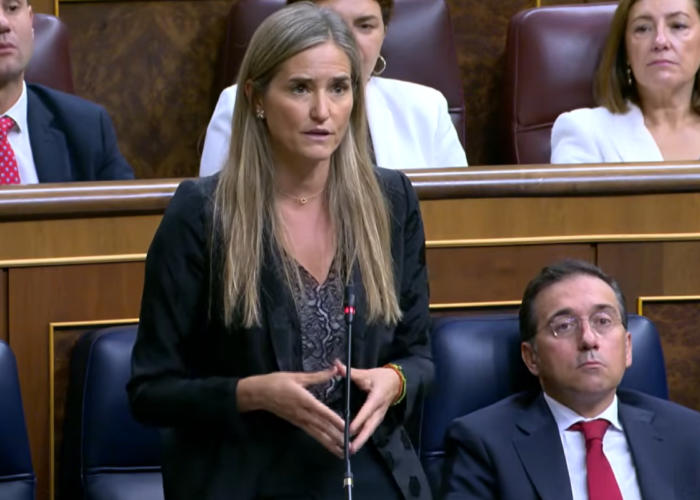
The Spanish Minister for the Ecological Transition and the Demographic Challenge, Sara Aagesen Muñoz, has ruled out a cyberattack on last month’s blackout that affected Spain and Portugal on 28 April 2025.
During yesterday’s (14 May) Congress of Deputies’ session, Aagesen said: “There is no evidence that the system operator [Red Eléctrica] has been the target of a cyberattack.”
Try Premium for just $1
- Full premium access for the first month at only $1
- Converts to an annual rate after 30 days unless cancelled
- Cancel anytime during the trial period
Premium Benefits
- Expert industry analysis and interviews
- Digital access to PV Tech Power journal
- Exclusive event discounts
Or get the full Premium subscription right away
Or continue reading this article for free
The Minister appeared during Wednesday’s session at her request to provide the latest information regarding the blackout that affected Spain, Portugal and the South of France last month.
Aagesen also shared other details regarding the “exceptional” event that left the Iberian Peninsula without electricity for several hours.
After several sessions, a special committee looking into the incident has discarded several other hypotheses, including the fact that it was not a coverage, reserve, or grid size issue, explained Aagesen, adding: “We know that [the generation losses] started in Granada, Badajoz and Seville.”
The special committee investigating the event is still analysing all the data received to determine what happened last month.
“We are identifying disconnections that may have been due to overvoltage, which could have triggered the cascading outage at the critical moment on 28 April,” added the Spanish Minister.
Another detail requiring answers is the two oscillations that occurred at 12:03, 30 minutes before the blackout, which were detected both in the Iberian Peninsula and outside. The first oscillation lasted for less than five minutes, during which strong oscillations in both voltage and frequency occurred, said the minister.
The second oscillation happened at 12:19, which lasted for three minutes. “This second oscillation has been identified and is more frequent within the European system. More specifically, it comes from the East, Center and West of the Iberian Peninsula. [It] oscillates with respect to the European Synchronous System, with respect to Germany, Italy, Austria, Denmark, …,” said Aagesen.
A few minutes later, at 12:30, the Spanish demand was 25,184MW, a “low demand” according to the Minister due to the weather conditions and time of the day. Taking advantage of these conditions and low prices, 3GW of pumped-storage hydroelectricity capacity was pumping water upwards into the reservoir at the time, to discharge as electricity later on.
Only a few minutes later, at 12:32 and 57 seconds, a process of successive losses began in the southern province of Granada. This was followed by another one 19 seconds later, this time in the western province of Badajoz, and a last one 20 seconds after the first one in the southern province of Seville. These three events resulted in up to 2.2GW of cumulative generation loss in 20 seconds.
“Immediately after these events, the cascading generation disconnection phase begins due to overvoltage,” explained Aagesen. This was followed by a loss of synchronisation with the rest of Europe and the isolation of the Iberian Peninsula.
It took until the following day, at around seven in the morning, for 99.95% of the Spanish grid supply to be replenished.