European inverter manufacturing capacity has now surpassed 100GW, making the region’s inverter manufacturing sector the largest in the world, outside of China.
This is according to the latest research from PV Tech Market Research, which publishes the PV InverterTech Bankability Ratings report. According to the report, Europe’s inverter manufacturing capacity now exceeds that of the APAC region—excluding India and China—which sits at 70GW; the US, which has 40GW of operational inverter manufacturing capacity; and India, which has close to 20GW of capacity.
Try Premium for just $1
- Full premium access for the first month at only $1
- Converts to an annual rate after 30 days unless cancelled
- Cancel anytime during the trial period
Premium Benefits
- Expert industry analysis and interviews
- Digital access to PV Tech Power journal
- Exclusive event discounts
Or get the full Premium subscription right away
Or continue reading this article for free
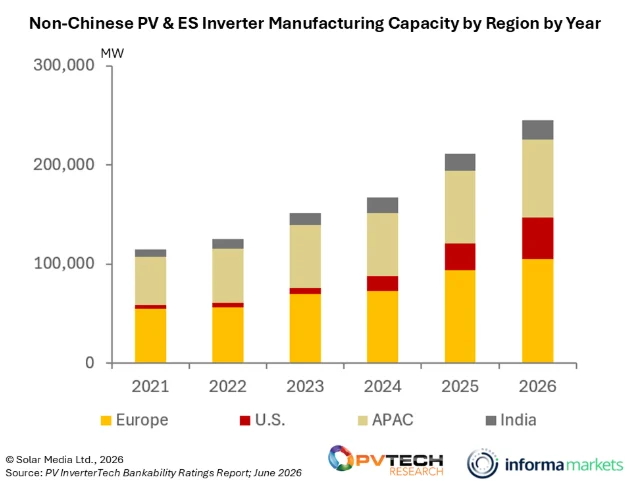
Trends in inverter manufacturing capacity across these regions are shown in the graph above. According to PV Tech Market Research’s Mollie McCorkindale, growth in the EU’s inverter manufacturing capacity has positioned Europe as “the global leader in terms of regional manufacturing capacity.”
“It would be fair to characterise Europe as a world leader in inverter manufacturing capacity,” McCorkindale told PV Tech today. “The region has successfully maintained and expanded its manufacturing footprint in this critical component of the solar energy value chain, demonstrating both technological expertise and industrial scale.”
The growth in EU manufacturing capacity has been significant; last month, McCorkindale wrote in a blog for PV Tech that she expected European inverter manufacturing capacity to hit 100GW by the end of this year, and this growth can be traced back to a number of policies implemented at the EU level.
This includes the Net-Zero Industry Act (NZIA), which aims to have 40% of deployed net zero technology manufactured domestically by 2030, but also more recent policies against inverters made in China in particular, following the EU’s designation of the reliance on imports of inverters from China alone as a ‘high-risk’ state of affairs.

In the months since, the EU banned funding for energy projects that use Chinese inverters, creating opportunities for European manufacturers to establish facilities that, according to McCorkindale, serve as a “viable alternative to Chinese dominance” in the space.
“Access to non-Chinese inverter suppliers provides strategic independence for regions like Europe and the US, reducing vulnerability to supply chain disruptions,” said McCorkindale. “While China leads in solar panel production, European strengths in inverters promote a balanced competitive landscape and encourage more collaborative global supply chains.”
‘Substantial portion’ of European inverter exports go to the US
Establishing a supply of European-made inverters for export to markets, such as the US, is another key piece of the puzzle. According to McCorkindale, “a substantial portion” of Europe’s inverter shipments go to the US, as the US has sought to reduce its reliance on clean energy components made in China or by Chinese companies.
“This allows them to serve the American market while meeting local content requirements and avoiding potential trade barriers,” explained McCorkindale.
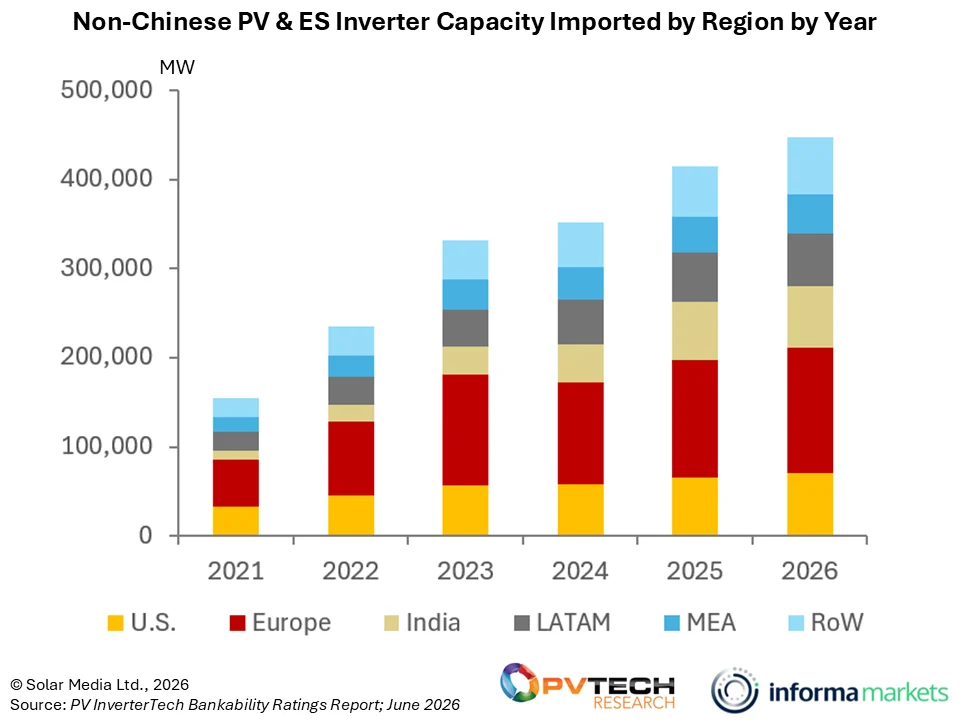
However, she noted that European developers are expected to purchase almost 20GW of European-made inverters this year, the most of any region. Europe’s inverter supply chain, more broadly, is not completely independent either, with PV Tech Market Research expecting Europe to import more inverter capacity than any other region this year, as shown in the graph above.
“Europe still relies heavily on Chinese companies for inverters and materials, indicating that despite its strong domestic manufacturing, China’s influence persists in the market,” said McCorkindale. “While Europe leads in inverter manufacturing, true supply chain independence requires developing strength in cells, modules, polysilicon and other key components where China is dominant.”
The PV Tech Market Research team produces the PV InverterTech Bankability Ratings report each quarter, which includes an analysis and rating of each company that can be used to benchmark suppliers against each other in terms of risk. Read more about the report and request a demo on the PV Tech Market Research website.