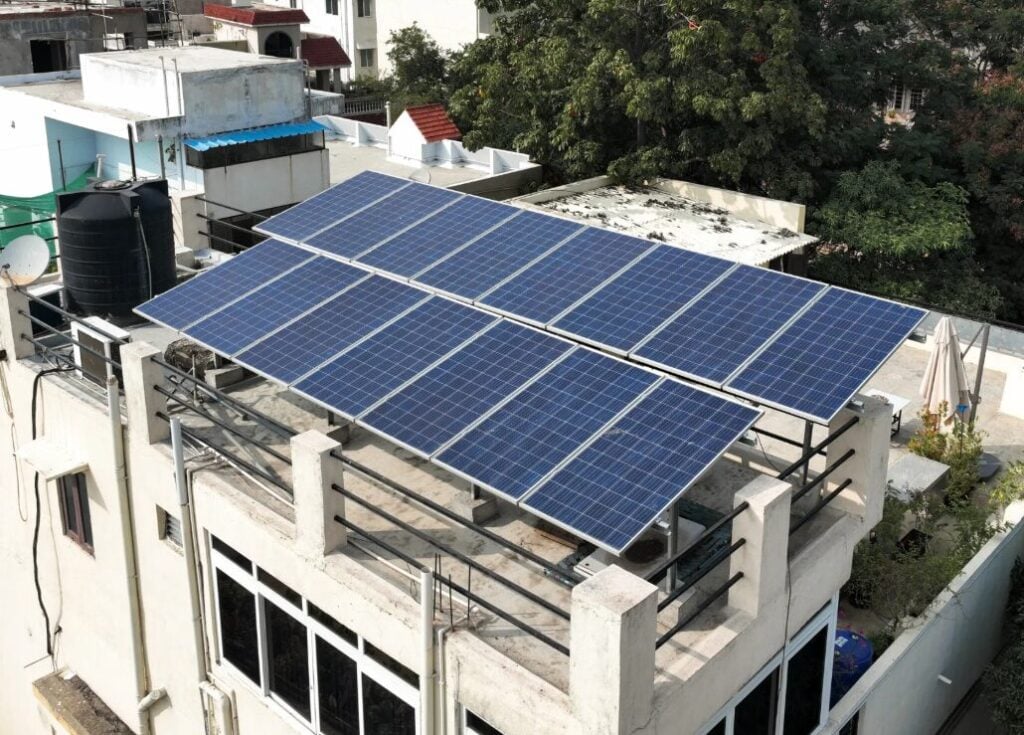
India has installed 9.56GW of rooftop solar capacity under the PM Surya Ghar Muft Bijli Yojana (PMSGMBY), according to government data presented in parliament.
Minister of State for New and Renewable Energy (MNRE) Shripad Yesso Naik told the Lok Sabha, the lower house of India’s parliament, that as of 20 March 2026, more than 2.62 million rooftop solar systems had been deployed nationwide since the scheme launched in 2024, benefiting approximately 3.24 million households.
Try Premium for just $1
- Full premium access for the first month at only $1
- Converts to an annual rate after 30 days unless cancelled
- Cancel anytime during the trial period
Premium Benefits
- Expert industry analysis and interviews
- Digital access to PV Tech Power journal
- Exclusive event discounts
Or get the full Premium subscription right away
Or continue reading this article for free
PMSGMBY is a flagship central sector scheme launched by the Indian government in February 2024, aimed at installing rooftop solar systems in ten million households across the nation.
The scheme is expected to generate 1,000 billion units of renewable electricity. Furthermore, the government estimates that up to 1.7 million jobs could be created as deployment accelerates.
Since the scheme’s launch in 2024, challenges including high upfront costs despite subsidies, maintenance requirements, limited awareness – particularly in rural areas – net metering and regulatory hurdles, quality concerns and bureaucratic barriers in application processes have persisted.
In response, the government has taken key regulatory steps to encourage rooftop solar adoption including subsidy applications, approvals and disbursals that are now managed via a national portal, enabling direct transfer of funds to residential consumers.
The application has also been simplified, with technical feasibility requirements waived and automatic load enhancement permitted up to 10kW. Net metering agreements have been integrated into the application process to further reduce delays.
To improve financing access, collateral-free loans are being offered through nationalised banks at concessional rates, currently set at repo rate plus 50 basis points (around 5.75% per annum), with tenures of up to 10 years. The policy framework has also expanded to include renewable energy service company (RESCO) and utility-led aggregation (ULA) models, while vendor registration processes have been simplified to ensure a larger pool of qualified installers.
Alongside regulatory and financial measures, the government is investing in ecosystem development. Capacity-building and training programmes are being rolled out to create a skilled workforce, supported by nationwide awareness campaigns across print, television and radio. Progress is being closely monitored through regular engagements with states and DISCOMs, including periodic regional review meetings.
According to the MNRE, as of February 2026, rooftop solar installations are led by Gujarat at 6.67GW, followed by Maharashtra with 5.22GW and Rajasthan at 2.07GW. At the other end of the spectrum, Meghalaya has just 0.21MW installed, Nagaland 1MW, and the Union Territory of Lakshadweep 1.6MW.