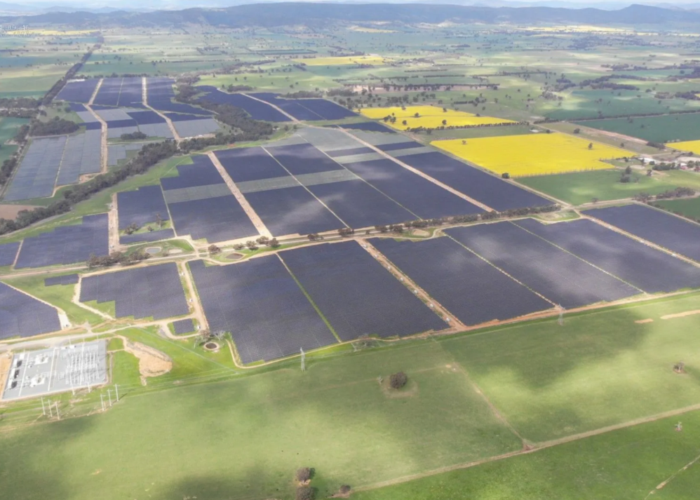
New system-level modelling from the Australian Centre for Advanced Photovoltaics (ACAP) has revealed that achieving ultra-low-cost solar targets could create a 2,000GW-scale solar PV market in Australia.
In doing so, ACAP believes this could fundamentally transform the nation’s energy system while unlocking vast export opportunities in green metals and industrial products.
Try Premium for just $1
- Full premium access for the first month at only $1
- Converts to an annual rate after 30 days unless cancelled
- Cancel anytime during the trial period
Premium Benefits
- Expert industry analysis and interviews
- Digital access to PV Tech Power journal
- Exclusive event discounts
Or get the full Premium subscription right away
Or continue reading this article for free
The collaborative research project, led by Professor Kylie Catchpole and Professor Andrew Blakers from the Australian National University (ANU), with contributions from UNSW researchers Dr Nathan Chang and Dr Simao Lin, represents what is claimed to be the first integrated modelling to quantify the full industrial and export opportunity created by ultra-low-cost solar at a national scale.
Using the newly developed FIRM Energy model, the team examined how the Australian Renewable Energy Agency’s (ARENA) ambitious 30-30-30 target could reshape Australia’s economic landscape.
ARENA’s 30-30-30 vision aims to achieve 30% solar module efficiency at an installed cost of 30 cents (US$0.20) per watt by 2030, delivering a levelised cost of electricity below AU$20 per megawatt hour.
This represents a dramatic reduction from current costs and would position Australia to leverage its abundant solar resources for both domestic decarbonisation and large-scale green commodity production.
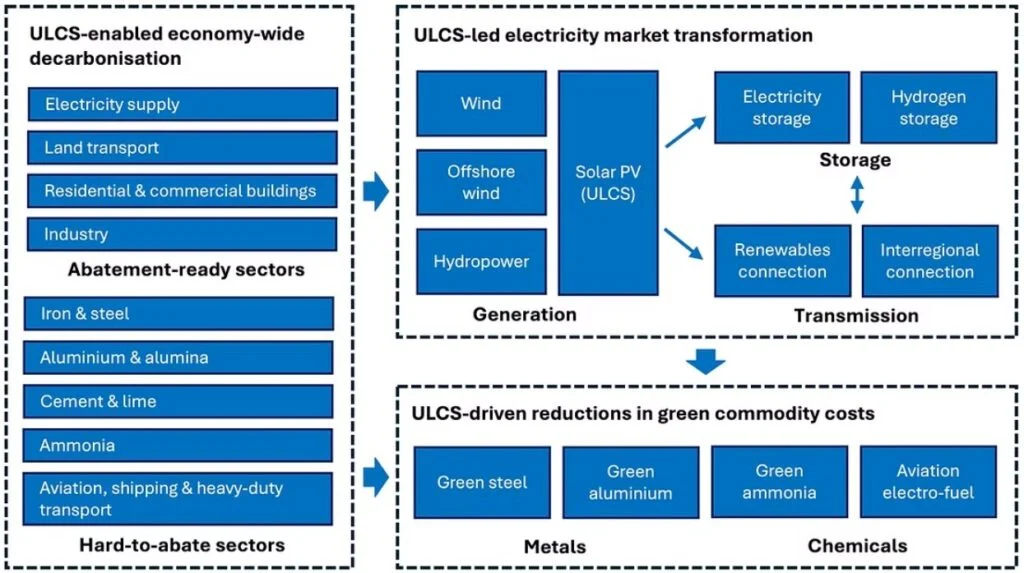
The ACAP modelling shows that ultra-low-cost solar could support national energy systems delivering 1,000TWh per year for domestic use and 2,600TWh annually for export. This export potential lies in the delivery of green metals and industrial products that could fuel international renewable energy developments alongside the production of green fuels, such as ammonia.
“The magnitude of the opportunity revealed by the analysis is very exciting,” said Dr Bin Lu from ANU, who developed the integrated modelling framework.
“Used smartly, 2,000GW of solar PV could power a fully decarbonised domestic economy and support large-scale production of green metals for export – positioning Australia as a global supplier of green products while dramatically reducing national emissions.”
Transforming industrial economics
The research demonstrates that ultra-low-cost solar fundamentally changes the economics of Australia’s energy transition.
Under the 30-30-30 scenario, electricity markets can deliver 100% renewable energy at costs well below today’s wholesale prices, with those savings flowing directly into heavy industry.
The modelling indicates that green aluminium, ammonia and steel production can reach cost parity with conventional production methods, while aviation electro-fuels move significantly closer to commercial viability.
This finding shifts the national conversation from questioning the cost of decarbonisation to examining the scale of industrial opportunity.
“Australia has abundant solar resources and some of the world’s richest mineral reserves, such as iron ore and bauxite,” Dr Lu explained.
“Used smartly, cheaper renewable energy technologies could power Australia’s transition to a global supplier of green products.”
The project’s key innovation lies in its integrated, system-level approach. ACAP said. Rather than treating industrial decarbonisation, electricity market transformation, and green commodity production as separate challenges, the study captures their interactions within a high-resolution modelling framework using the FIRM Energy model, which evolved from an electricity-sector optimisation tool into an integrated, economy-wide energy system model.
ARENA has launched several initiatives to drive down solar costs and realise its vision for ultra-low-cost solar.
The AU$100 million Solar ScaleUp Challenge, which opened in June 2024, invites professionals across the international solar landscape to break down barriers to installing, operating and maintaining solar PV projects.
Last year, robotics company Luminous secured AU$4.9 million through the initiative to deploy its AI-powered LUMI installation robot at utility-scale solar plants in partnership with global engineering firm Equans.
ARENA has also committed AU$60 million specifically for ultra-low-cost solar research and development in Australia, supporting the technological advances needed to achieve the 30-30-30 target.
The funding programme, announced as part of ARENA’s broader strategy to position Australia as a renewable energy superpower, focuses on breakthrough research that can dramatically reduce solar costs while improving performance.
These investments complement broader manufacturing initiatives, including ARENA’s US$98 million commitment to SunMan’s 500MW PV module manufacturing hub, which aims to establish domestic production capacity while driving down costs through innovation and scale.
The SunMan facility represents a major step toward building local manufacturing capability that can support the massive deployment envisioned in ACAP’s modelling.