
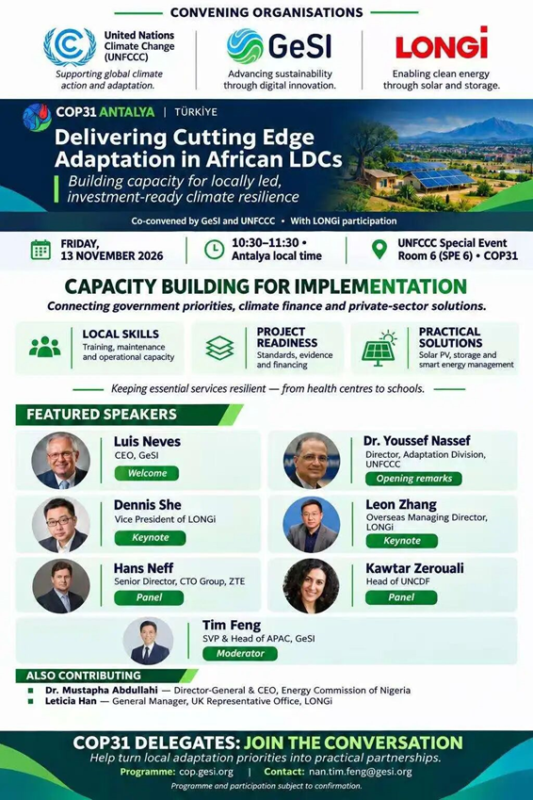
A side event at COP31 in Antalya, entitled “Delivering Cutting Edge Adaptation in African LDCs,” jointly hosted by UNFCCC, GeSI and LONGi, focused on climate adaptation and resilience in less developed countries worldwide. Luis Neves, CEO of GeSI; Dr. Youssef Nassef, Director at UNFCCC; Hans Neff, Senior Director of the CTO Group at ZTE; Kawtar Zerouali, Head of UNCDF; Dennis She, LONGi VP and General Manager of LONGi Energy Storage; and Leon Zhang, LONGi Overseas Managing Director, were in attendance and shared practical experience and insights from their respective fields.
Dennis She delivered a video address to the conference. He said that for LONGi, climate adaptation and energy access are not just lofty terms; they have long been embedded in the company’s project development and operations around the world, especially in less developed regions.
“In my view, climate adaptation is not a distant or unrealistic vision. When health centres can continuously refrigerate vaccines, water pumps can operate normally, and essential services can be guaranteed in a timely and sustained manner when communities need them most, climate adaptation truly becomes reality. Reliable electricity is what underpins all of this.”
For many less developed countries, where grids do not reach or power supply is unstable, “solar + storage,” especially microgrid and off-grid solutions, can provide a practical foundation for improving local public services and livelihoods.
Since 2023, LONGi’s off-grid and microgrid solutions have been deployed widely around the world. The solution integrates solar, storage, and intelligent control systems, making the design, deployment, and operation and maintenance (O&M) of reliable power supply systems simpler. Supporting digital design tools also help local partners compare different options and assess project economics before construction begins.
“But successfully building a system is only the beginning. Achieving long-term value requires local people to be able to operate and maintain the system; it requires clear performance standards, viable financing solutions, and support throughout the project lifecycle. Most importantly, solution design must prioritize local core needs—this is the core of capacity building,” Dennis She continued.
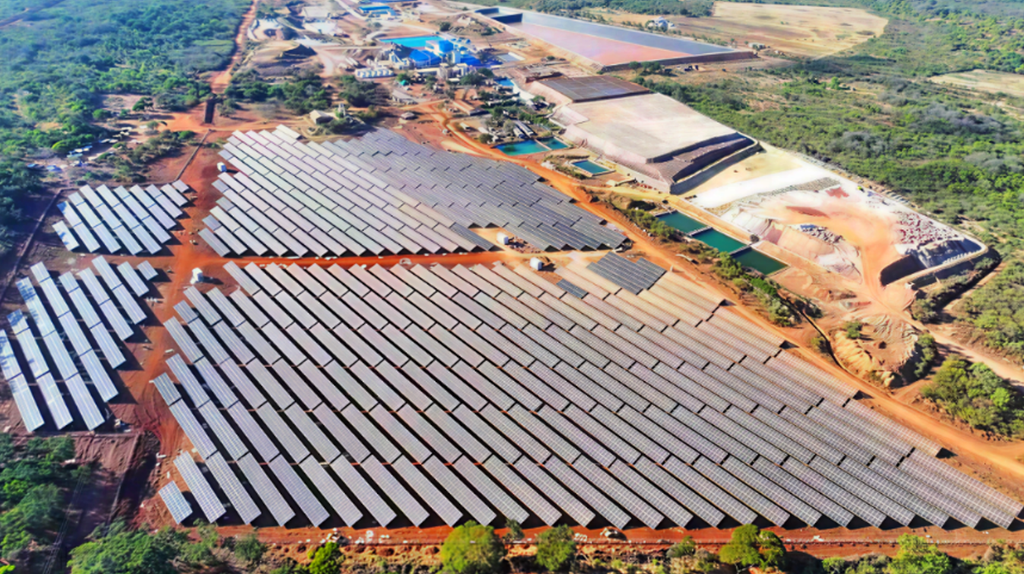
Therefore, LONGi is working with African governments, local developers, installers, service providers, and financial institutions in various forms of cooperation. In particular, the LONGi Academy training program combines Chinese technology with local experience to optimize project preparation, construction and O&M, leaving the skills needed for long-term O&M in local hands. This helps ensure sustainable operation after project delivery and truly enables green energy projects to improve local livelihoods and well-being.
Leon Zhang, the company’s Overseas Managing Director, also attended the side event and delivered a presentation titled “Solar+Storage Integration: Clean Energy Accessible to All.” Zhang said that nearly 600 million people in Africa still lack access to electricity. For African people, climate adaptation means stable lighting in newborn clinics, cold-chain vaccine storage, and functioning water supply facilities. “LONGi firmly believes that integrated solar + storage solutions have much greater value to offer and are an indispensable part of building climate resilience.”
As a leading global solar-storage technology company, LONGi has continuously participated in climate-related dialogues since the 24th Conference of the Parties (COP24). It first introduced “Solar for Solar,” ensuring that energy required across the entire manufacturing chain comes from clean electricity. Later, it established in-depth cooperation with organizations such as UNHCR to promote clean energy solutions in multiple regions worldwide.
“But through repeated exchanges and practices, we have realized that technology is only meaningful when it truly benefits people,” Zhang continued. “This is exactly the vision LONGi wants to convey at COP31—integrating solar and storage into complete systems that are easy to deploy, easy to maintain, and can be rapidly scaled and replicated.”
Based on this vision, LONGi officially launched the LONGi ONE integrated solar-storage solution in April 2026. It is built around three core concepts: One System, One Platform, and One Responsibility.
One System: Solar, storage and green hydrogen coupling, integrated and delivered as a single system;
One Platform: AI-based software manages the entire system to ensure stable operation and stable output;
One Responsibility: A unified point of contact for end users, lowering the barrier to using energy systems over the 25 to 30 year asset lifecycle and facilitating implementation.
Zhang highlighted LONGi’s cases in Cameroon, Nigeria, Mozambique, Zimbabwe, Djibouti and Malawi. “In particular, in these projects, LONGi does not merely export PV modules; we also conduct local personnel training and provide spare parts and follow-up O&M support,” he explained.
However, practice has shown that high financing costs in African countries hinder local clean energy deployment. “It is well known that the cost of solar power generation has fallen by 95% over the past 15 years, but this dividend has not yet reached the people of Africa. The reason is that financing costs in African countries are extremely high, with financing rates reaching as high as 15%,” Zhang continued. “If guarantee mechanisms can be introduced rather than relying solely on subsidies—solar has long been subsidy-free in China and broader regions—they can reduce investor risk and lower capital costs, allowing many projects to break through barriers and become economically viable.”
“We believe clean energy should be accessible to all, but if Africa is left behind, the energy transition cannot be truly global. For us, solar + storage provides electricity, but for many African people solar + storage provides development opportunities,” Zhang concluded.
