Feasibility studies for a solar PV project need to be more thorough to avoid wasting significant time and money assessing the viability of a project that turns out to be unworkable.
This is the opinion of Douglas Geist, chief sales officer at Lithuanian solar software developer PVcase, who speaks to PV Tech Premium exclusively about its latest platform, Concept, which it is launching at today at the RE+ trade show in Las Vegas. Geist says that Concept is designed for use in the “missing middle” of utility-scale solar project development, after initial site selection and before in-depth engineering work can be assessed.
Try Premium for just $1
- Full premium access for the first month at only $1
- Converts to an annual rate after 30 days unless cancelled
- Cancel anytime during the trial period
Premium Benefits
- Expert industry analysis and interviews
- Digital access to PV Tech Power journal
- Exclusive event discounts
Or get the full Premium subscription right away
Or continue reading this article for free
Performing this kind of work quickly and effectively is essential, as, according to Geist, “a site that’s ruled out early ultimately costs them very little”.
“The longer they get along with a project, the more this will cost them in terms of real money, and in terms of opportunity cost, they could have spent working on something that could have actually seen the light of day,” explains Geist. “They’ve wasted months and months of time in order to get to a ‘no’ answer, and this is what we want to be able to help them solve with the Concept platform.”
Working with and streamlining data
When asked about the platform itself, Geist points to a component library, developed in tandem with accreditation company DNV, that gives users access to the most up-to-date DNV-verified component files for vital products such as modules and inverters.
However, maintaining and updating such a database can be a complex task in an industry such as solar, characterised by a very fast rate of technological innovation; earlier this month, speakers at PV Tech’s PV ModuleTech Europe event discussed how new modules are being developed faster than testing standards and practices can keep up, leading to challenges for module deployment in the field.
When asked about this, Geist says that it is “exciting” to work on a component library for such a dynamic industry.
“One of the things that’s exciting about the solar industry as a whole is that the technology is changing so rapidly,” he says. “[With] our team being primarily from the solar industry, we have a pretty good finger on the pulse of the technologies of today and what’s coming in the future through our relationships with other industry partners. Getting that information to be updated in things like our component library is a priority for us and for our partners, as well as the customers.”
‘A single source of truth is super important’
Geist explains that users can enter their own product specifications onto the platform if they receive new information from suppliers, so there is a degree of dynamism to the component library, too. He adds that the findings generated by the platform can be exported to other PVcase products, such as the Ground Mount platform, which aims to assist in engineering and construction work.
“You can bring the data into any of our products from anywhere; you can take the data from our products and go anywhere with it,” he says.
Platforms like these reflect a changing relationship between project developers and data; two years ago, PV Tech Premium spoke to PVcase CEO David Trainavicius, who highlighted what he called the “data risk” in project development, where companies not familiar with data analysis were being required to work with data on a large scale without any means of integrating it. Concept is born of a similar notion: that developers have access to such a wealth of data from a range of sources that working through that data in a centralised and streamlined manner is a key priority.
“There’s no doubt that our customers, or developers, have lots and lots of data,” says Geist. “Their issue isn’t that they don’t have enough data; their issue is that the data is really spread across a variety of GIS tools, spreadsheets and a variety of early-stage layouts—done in autoCAD or a web-based design functionality—but they’re trying to make these go/no-go decisions based on the data currently being fragmented across all of these places. Ultimately, we want to try to centralise that at various different stages of the process.”
Geist says that he has heard from his customers that “being able to have a single source of truth in this entire process is super important”, and that such a source of information “would streamline their current process”.
Costs and project attrition remain challenges for developers
Throughout our conversation, Geist references a survey of 405 solar industry professionals that PVcase conducted earlier this year, interviewing both PVcase customers and those not presently using the company’s platforms.
The survey speaks to a close relationship between PVcase and its customers, which informs how the former develops its software; when asked about whether some of the decisions made for the Concept platform were based on recommendations from PVcase customers, or processes that PVcase itself wanted to implement, Geist says that “it’s very difficult to pull those two things apart”.
The survey highlighted that project attrition—a measure of projects at which work begins but never reach commercial operations—had increased notably between 2025 and 2026, and Geist says that almost half of the respondents said at least half of their projects never reach the construction phase.
Geist said that “the costs were something we heard a lot about”, reflecting increasing component prices and narrower margins for a number of solar developers, which has made project realisation challenging. Just in the last few weeks, European solar module and inverter prices have increased and PV Tech Premium spoke to Renewabl CEO JP Cerda about how high power purchase agreement (PPA) prices are affecting the dealmaking landscape.
Integrating local sentiment into a planning tool
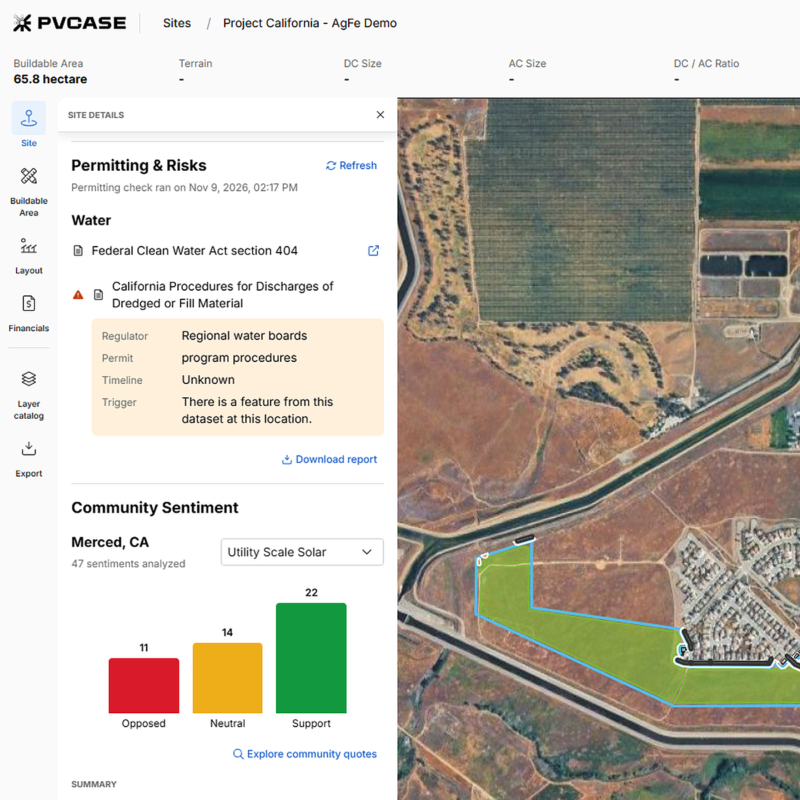
Another challenge for developers is effectively managing the responses of local residents to a solar project, which Geist says is a “really important factor now”. Both Concept and the earlier-stage Prospect site selection tool include a local sentiment component, based on local media reporting on residents’ responses to other solar projects, so developers can see generally how receptive a local area’s residents have been to solar projects in the past.
“It’s become one of the more important layers from our customers’ perspective in being able to make these decisions about whether or not this is the right place for us to focus on being able to build, as much so as ‘can I get a grid connection point in this particular area?’” says Geist.
However, he acknowledges there are limits to how involved a software company can become in such a discussion between a project developer and a community group, and says that the relationship between these parties “is the most important here”, rather than the software platform used to plan projects involving these groups.
“Being able to identify what is the right community, and letting a developer know that as early as possible in the process of deciding that this is where they need to do a project, will help them be able to know that they should be approaching the community there, or addressing the local government in terms of trying to find what would be an advantages for the local community that could be paired along with the projects,” says Geist.