US aerospace and clean-energy firm Reflect Orbital has raised US$73.5 million in a new funding round to advance the development and deployment of its space-based sunlight-reflection technology, bringing the company’s total funding to more than US$100 million.
The California-based company is developing orbital reflectors designed to redirect sunlight towards targeted locations on Earth. The technology aims to extend solar power generation beyond daylight hours by reflecting sunlight onto solar installations after sunset. It is also intended to support lighting requirements during search-and-rescue operations and disaster response.
Try Premium for just $1
- Full premium access for the first month at only $1
- Converts to an annual rate after 30 days unless cancelled
- Cancel anytime during the trial period
Premium Benefits
- Expert industry analysis and interviews
- Digital access to PV Tech Power journal
- Exclusive event discounts
Or get the full Premium subscription right away
Or continue reading this article for free
The funding follows the company’s Series A round in May 2025 and includes participation from existing investors Sequoia Capital, Lux Capital and Starship Ventures, alongside new investors Buckley Ventures, Convective Capital, The Uncommon Group and Salesforce Ventures, among others.
“We’ve made substantial progress on our journey to deliver net new, clean solar energy to a world that urgently needs it,” said Ben Nowack, CEO of Reflect Orbital. “This includes several firsts, from numerous technological breakthroughs to our upcoming test missions. We’re taking a deliberate, science-led approach to deployment and are motivated by the practical benefits our technology can bring here on earth. We’re grateful to our investors for sharing our mission and ambition.”
The latest investment will fund Reflect Orbital’s initial satellite launches, further development of its orbital reflector technology and the expansion of commercial partnerships across the energy and lighting sectors.
The company recently filed an application with the US Federal Communications Commission (FCC) for a developmental satellite designed to test its spacecraft and communications payload, subject to regulatory approval.
Reflect Orbital expects to launch its first demonstration mission in the second quarter of 2027. The mission has received FCC approval and is intended to collect data on the deployment and performance of orbital reflectors in low Earth orbit (LEO), supporting the company’s plans to scale the technology.
The company has also secured additional launch opportunities for 2027 and recently announced the purchase of two dedicated launches from India’s Skyroot Aerospace.
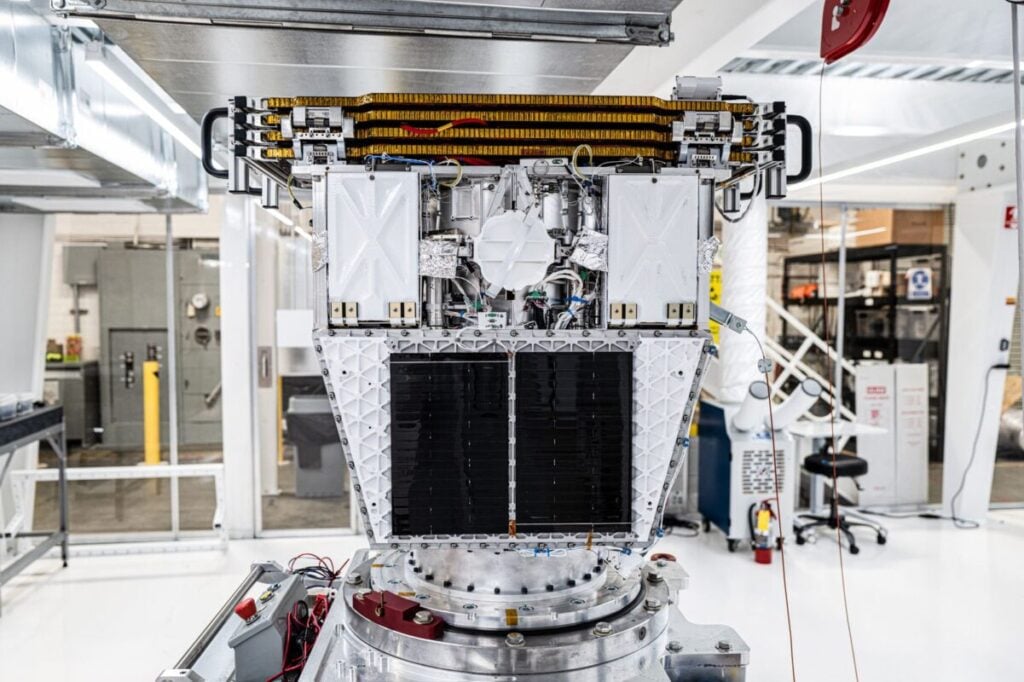
Reflect Orbital said it is scaling its manufacturing operations alongside its launch preparations. The company reports producing a large reflector quadrant every 3.5 days. The reflector material is designed to be 28 times thinner than a human hair, foldable to the size of a shoebox and flat and transparent when tensioned.
It also produces a four-boom deployable structure each week to tension the mirrors and builds a 12,000-part satellite from scratch every two months.
The planned demonstration mission will provide data on the performance of the reflector technology in orbit, a key step towards assessing its potential application in extending solar generation hours.
Growing demand for solar PV in the space sector
The development comes amid growing interest from space technology companies in the solar PV sector. In a recent PV Tech Premium feature, freelance environmental journalist Catherine Early examines how the satellite industry’s expansion is creating opportunities for terrestrial solar PV manufacturers [subscription required].
Recently, SpaceX entered a strategic partnership with Germany’s Singulus Technologies, securing a turnkey production line for heterojunction (HJT) solar cell manufacturing to support the expansion of its Starmind satellite production in Bastrop, Texas. The equipment is scheduled for delivery in the first half of 2027, with the partnership also covering potential additional production lines.
Meanwhile, Australia’s Space Machines Company (SMC) has partnered with Sydney-based SunDrive Solar to develop locally manufactured solar arrays for spacecraft, using SunDrive’s copper-based HJT solar cells.
The collaboration aims to reduce reliance on imported space-grade solar arrays and develop lower-cost solutions for large-scale satellite deployment. The first phase of the research and development programme runs until April 2027 and will deliver a body-mounted solar module for SMC’s next-generation Optimus Viper spacecraft, designed for low Earth orbit, along with prototype flight-sized panels.
Led by the DOE’s Integrated Energy Systems Office (IESO), the Space Photovoltaics Research and Development Partnership Intermediary Agreement (PIA) is open to university and industry research laboratories working on advanced space PV technologies, photovoltaic characterisation and stress testing, and near-commercial pilot-scale space PV solutions.