The US Securities and Exchange Commission (SEC) has initiated an investigation into US PV manufacturer T1 Energy’s public disclosures regarding its eligibility for Section 45X tax credits.
The Texas-based module manufacturer disclosed the investigation last week after publishing its financial results on Thursday 12 November, saying that it was informed by the SEC’s Fort Worth Regional Office back in September 2026.
Try Premium for just $1
- Full premium access for the first month at only $1
- Converts to an annual rate after 30 days unless cancelled
- Cancel anytime during the trial period
Premium Benefits
- Expert industry analysis and interviews
- Digital access to PV Tech Power journal
- Exclusive event discounts
Or get the full Premium subscription right away
Or continue reading this article for free
“The Company intends to cooperate fully with the SEC investigation. It is not possible to predict the duration or outcome of the investigation at this time,” wrote T1 Energy in a statement.
Following that disclosure, T1 Energy’s stock had initially dropped from US$1.96 at the end of the day on Thursday, when it disclosed the SEC investigation, to US$1.66 at the beginning of the day on Friday before stabilising at US$1.9, with the after-hours price going down at the time of publishing.
Following this announcement, Law firm Holzer & Holzer said it was investigating whether T1 Energy complied with federal securities laws, however it did not disclose any more information.
US Commerce grants 232 import waiver for up to 1.7GW solar cells
On top of this 45X tax credits investigation, T1 Energy unveiled that it received an expedited US Department of Commerce (DoC) 232 import waiver for up to 1.725GW of solar cells. This means that when the Section 232 pricing measures come into force on 4 December, the company will be exempt.
According to the Texas-based module manufacturer, it is in talks with the US DoC to access the Section 232 onshoring plan, which is intended to reduce the minimum import price (MIP) and duties on imported module sub-components.
Set to come into force on 4 December 2026, the US will introduce a 15% tariff on imports of products using polysilicon and set minimum prices for polysilicon and its derivatives. However, the DoC also created an onshoring incentive mechanism that may temporarily waive tariffs for solar manufacturers that commit to building domestic production capacity of polysilicon, ingots/wafers or solar cells in the US.
Commerce’s 1.7GW solar cell waiver comes as T1 Energy disclosed on an earnings call that the first solar cells at the G2 Austin factory are now expected to begin in April 2027. When construction of the TOPCon solar cell plant began in December 2025, with a first phase delivering 2.1GW of annual nameplate capacity, commercial operations were expected to begin by the end of 2026.
The company is still contemplating expanding its annual cell capacity by 3.1GW “to serve unmet customer demand”.
“What we’d say is that assuming we’re doing financial close by year-end, we would expect to finish construction, installation, commissioning, and ramping by about mid-year,” explained Dan Barcelo, CEO of T1 Energy, during an earnings call.
On the topic of Section 232, T1 Energy said that it had contracts and options to produce 5GW of domestic modules with domestic polysilicon and/or wafers from Hemlock Semiconductors and Corning. Last year, Corning and T1 Energy had signed a supply agreement for US-made polysilicon and wafers, with the supply set to begin in the second half of 2026.
The module manufacturer also mentioned that it has “uncontracted availability at G1_Dallas for 2027 – 2030 in what is expected to be a rising module pricing environment post Section 232 proclamation.”
“From the largest utility-scale, high-quality customers, we are now seeing it in the mid-$30s for the imported cells going towards $0.40, and mid-$40s for domestic cells,” said Barcelo regarding MIP.
“On pricing, I think that the MIP and the duties have been quite a night and day scenario for a post-232 world, and those very large customers are responding to that pricing,” added Barcelo.
Production up in Q3 2026
Finally, in its financial results, T1 said it produced 1,056MW of solar modules in the third quarter of 2026, up both from Q2 2026 and Q3 2025, as shown in the chart below.
The Texas-based module manufacturer also secured nearly 1.6GW of supply agreements following Section 232 tariffs announced in August of this year. In its financial results, the company mentioned that this is “fielding indications of strong demand for 2027”.
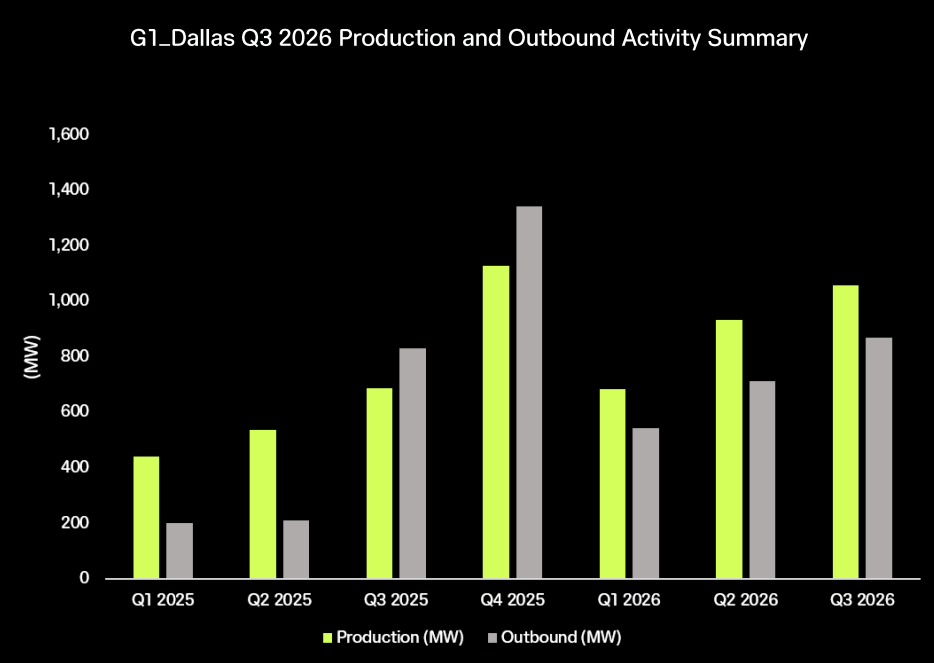
“There is a lot of noise around AI and the data centers and moratoriums, but what we get is, again, from very large utility-scale developers focused on 2027, 2028, touching 2029 for real projects with real hyperscalers.
“That demand is very, very real. Solar and storage is dominating most of that growth as the markets await for turbines and gas and other solutions. Solar and storage is still in the dominant demanded aspect. Again, from the 232 perspective, night and day from how we feel we are positioned for that”, explained Barcelo during the earnings call.
For next year, the company has over 3.5GW of its 2027 module manufacturing capacity under contract for scheduled deliveries for that same year. These module supply agreements are expected to use a blend of imported solar cells and domestically produced ones from the Austin cell factory.
Moreover, the company reported a net loss from continuing operations of US$34.7 million as a result of its decision to build module inventory to facilitate 2027 deliveries on new customer offtake agreements.
For full-year 2026, it forecasts module production between 4-4.2GW at the Dallas module assembly plant, while it has delivered preliminary production guidance for 2027 of 5.3GW.
Earnings call transcript from Investing.com.