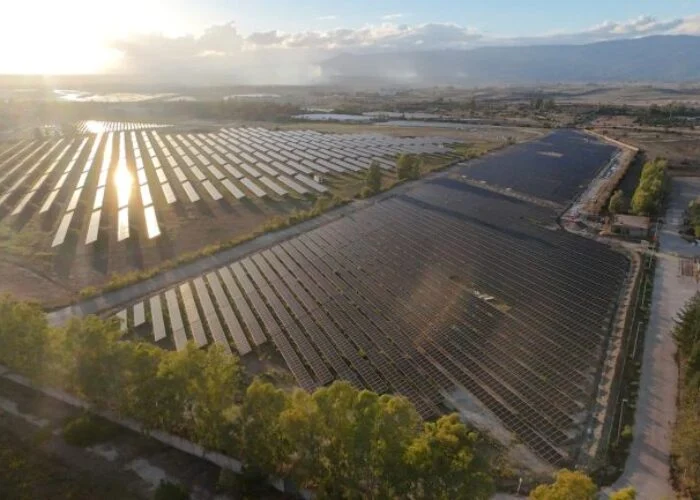
Italy is the most attractive European country for solar PV development, according to the chief of staff of German independent power producer (IPP), Encavis.
“For PV only, it’s definitely Italy,” Jan-Philip Kock told PV Tech in an exclusive interview. “It’s a big market with lots of industrial customers that you want to cater to.”
Try Premium for just $1
- Full premium access for the first month at only $1
- Converts to an annual rate after 30 days unless cancelled
- Cancel anytime during the trial period
Premium Benefits
- Expert industry analysis and interviews
- Digital access to PV Tech Power journal
- Exclusive event discounts
Or get the full Premium subscription right away
Or continue reading this article for free
Italy also still has a high density of gas in its energy mix, which generally raises power prices to the benefit of project developers and owners.
Kock is speaking at the SolarPlus Europe 2026 conference in Milan, Italy, later this month. The conference, hosted by PV Tech publisher Solar Media, brings together the leading figures in the European solar sector for discussions on the key subjects affecting the industry today.
As well as industrial demand and power prices, Kock said that “Italy has found quite a mixed balance between true subsidies and enforcement schemes that help both the customer and the solar industry. For example, Energy Release.”
The Italian government’s Energy Release scheme incentivises high-intensity industries to support renewable energy projects by offering subsidised electricity tariffs in exchange for investments in renewables. We have also seen a range of notable solar project developments and financing in Italy this year, including investments from the European Investment Bank (EIB) and plans for a 300MW+ agrivoltaics portfolio.
Despite a slight decrease in 2025, Italy’s solar PV additions have soared in the last three years.
By contrast, he says that Spain and Germany have been “difficult” markets for solar developers of late. In the case of Spain, he said: “There has been just too much solar added in too little time,” and that companies now have to focus on diversified portfolios and offerings.
“This is a trend we see all over Europe. Solar-only companies are facing more and more difficult times.”
He also points to British solar funds, like NextEnergy Solar Fund, which are moving away from solar-only assets across the UK and Europe and refocusing on energy storage and other renewables, as they have traded consistently below their net asset value (NAV).
A rise in co-location of solar and battery energy storage assets has become a talking point across the industry, particularly in Europe. In February 2026 alone, PV Tech heard from industry players who said that the opportunities for integrating energy storage were growing in the face of volatile power prices, and that storage integration was “overhyped” and should not be seen as a “silver bullet” for success.
European solar market challenges
On a big-picture level, Europe’s solar industry has entered a cooling period after its white-hot expansion between 2022 and 2024.
As Kock explained in the full version of our interview, available now with a PV Tech Premium subscription, this has brought about changes to the way companies operate. He identified three major challenges facing the sector in 2026.
“Not all the players have the long-term vision you need to be successful. So the next couple of years probably won’t be too much fun for everybody in the industry. It is what it is. You have to accept that.”
His second concern is that “Not everybody is ready to become a real industrial player.” In our full conversation, he described the change from the “old world” of solar development, where companies sought profits project-by-project, to a more mature, integrated, industrial model.
“I guess many liked the old world of solar, where it was about hunting financial cash flows that, I would say, by coincidence, were generated by green assets,” he explained.
Finally, he said there needs to be a recognition that “sustainability alone doesn’t add value anymore.
“It’s not enough to produce green electricity. You have to produce something that is cost competitive, and also actually adds to Europe’s energy independence.”
You can find the full version of this interview with a PV Tech Premium subscription, here.