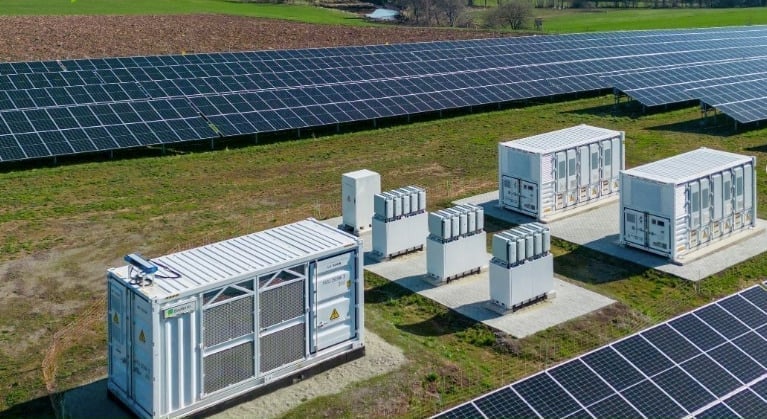
Co-located storage has been “overhyped” as a prop for commercially underperforming solar assets in Europe and should not be regarded as a “silver bullet”.
That was a key takeaway from a panel discussion on energy storage business models at this week’s Energy Storage Summit 2026 in London, hosted by PV Tech and sister website Energy-Storage.news’ publisher Solar Media, part of the Informa Group.
Try Premium for just $1
- Full premium access for the first month at only $1
- Converts to an annual rate after 30 days unless cancelled
- Cancel anytime during the trial period
Premium Benefits
- Expert industry analysis and interviews
- Digital access to PV Tech Power journal
- Exclusive event discounts
Or get the full Premium subscription right away
Or continue reading this article for free
Panel moderator Anna Darmani, principal analyst at market research firm Wood Mackenzie, highlighted how Europe’s energy storage market is dominated by standalone systems, with some exceptions such as Spain, where co-location of storage with solar has become a priority since the Iberian Peninsula power blackout last year. She asked the panellists their views on the future of co-location in Europe.
“We did the analysis on the share of hybrid projects coming online [globally], and Europe is behind any other market that has the same level of renewable development in terms of co-located storage,” Darmani said. “So I’m curious to see what your take on that is, is it going to change in the future, and how?”
Tom Smout, head of energy storage at consultancy LCP Delta, said: “Co-location has a place, but I think it’s quite overhyped by a lot of people. It can be good business, but for quite boring reasons, where it’s a good way to use the land that you have, with a great connection, and those are meaningful assets. And sometimes good business is just using the assets you have and realising their value.
“But from a system perspective, standalone storage is the most important because it provides the up and down frequency regulation. And from a portfolio perspective, if you have a solar asset which is eating a lot of negative prices, you’re better off with a standalone battery as a hedge, rather than putting a battery on site with that solar asset to hedge it.
“There’s a place for co-location, but I do sometimes worry that … a lot of people who have or are worried about building stranded solar assets are responding by building batteries that are going to become stranded batteries. Don’t just build a mediocre asset to salvage one that is underperforming; try and build a good asset and balance out your portfolio.”

Dan Connor, CEO of net-zero platform Dais Energy Ventures, echoed this view. “Don’t try and make your solar project work by putting storage on it, because if the solar doesn’t work by itself, it’s unlikely that the storage is going to suddenly make it work and be the silver bullet,” he said.
“I did a co-located asset in the UK with a previous company, and that was in the UK with very established structures around how to meter and manage all of these things and do all of that. And that was a nightmare. How do you contract for it? How do you get contracted revenues versus the PPA that you’ve got on your solar farm that is maybe pay-as-produce? So then your battery is always kind of subservient to what your solar is doing. How does that work? If you put that on a spreadsheet, it looks like it can make sense, but the reality of it is that it’s very difficult. Co-located [storage] absolutely has a place, but only after standalone has been established.”
Offering a different perspective, Dario Hernandez, head of energy storage at NextEnergy Capital, said that in some European countries with saturated grids, co-location might be the only option for storage:
“One common theme in every single market is that the grid is extremely saturated; the lack of grid connection points is astonishing. And, ultimately, you might be left with the only option to collocate the battery if you want to get storage in the ground. So I think, in southern Europe and solar [dominated] countries, we will see collocation going big time.”
This article was first published on our sister site Energy-storage.news.