PV manufacturing capital expenditure is expected to rebound this year following two years in the doldrums as the industry weathered a global module oversupply, new figures show.
Data in the latest edition of the ‘PV manufacturing and technology quarterly’ report by PV Tech’s Market Research arm forecasts an uptick in global PV capex in 2026 to just over US$29 billion.
Try Premium for just $1
- Full premium access for the first month at only $1
- Converts to an annual rate after 30 days unless cancelled
- Cancel anytime during the trial period
Premium Benefits
- Expert industry analysis and interviews
- Digital access to PV Tech Power journal
- Exclusive event discounts
Or get the full Premium subscription right away
Or continue reading this article for free
This is still some way short of the US$36 billion of capex spending seen in 2023, but a significant increase on the US$22.45 billion and US$21.8 billion seen in 2024 and 2025, respectively, as oversupply suppressed investment activity across the industry.
The expected increase in capex this year is particularly marked in cell production, with spending in this part of the supply chain expected to increase from US$6.4 billion in 2025 to US$9.9 billion in 2026.
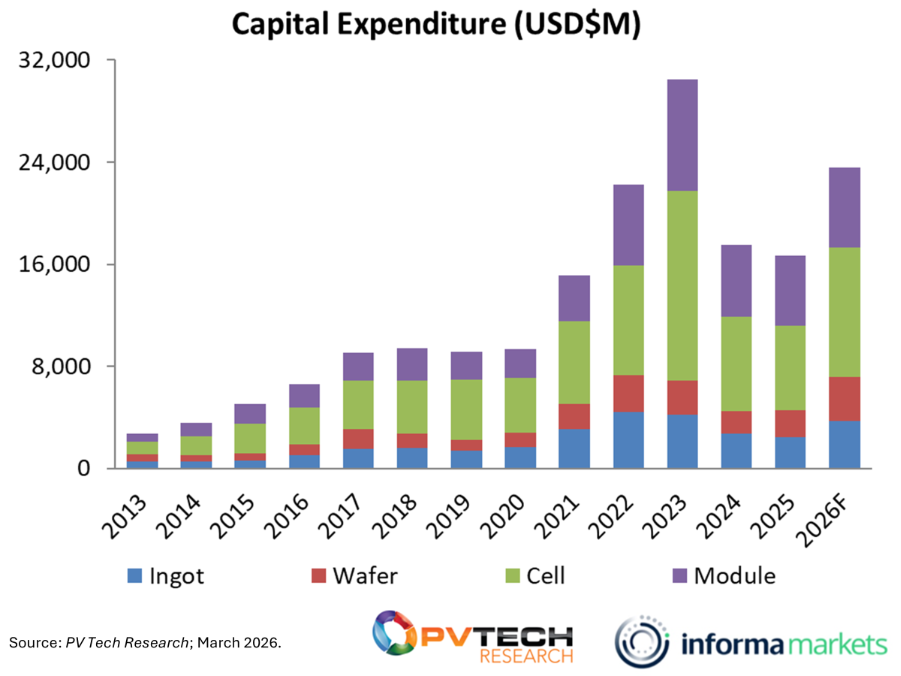
The key drivers for the rebound, analysed in a blog post by our market research colleagues (subscription required), include a ramp-up in domestic PV production in the US and India, a shortage of upstream manufacturing, particularly of wafers and cells, outside of China, and the emergence of new manufacturing hubs, particularly in the Middle East.
“All of these shifts are being intensified by a growing global movement to diversify supply chains outside of China and strengthen local production,” writes PV Tech’s head of market research, Moustafa Ramadan.
Looking ahead to 2030, the report anticipates investments outside China will continue to move upstream, increasingly focusing on wafers and polysilicon as cell manufacturing capacity expands.
“Governments are expected to play a pivotal role in shaping these priorities with a strategic focus on building domestic supply chains to enhance energy security,” added Ramadan.
The Q1 edition of the ‘PV manufacturing and technology quarterly’ report, the definitive benchmarking resource for the PV technology value chain, is out now and available here. PV Tech Premium subscribers can read the blog post discussing the capex trends here.