When Ankit Singhal returned to India in 2010 after completing his master’s degree at the University of Southern California, he joined his father’s business selling high-tech products to the Indian market. Within a couple of years, however, he identified a fundamental problem in the manufacturing sector that would eventually lead him to create MAPPES.io, a digital platform designed to map entire industrial ecosystems.
“I realised that there was a gap in the manufacturing sector, where it was hard to understand, especially for the high-technology sector, who would be a potential customer,” Singhal explains. “And it was also hard for Indian companies especially to find new technologies that are getting invented all over the world, or new suppliers globally.”
Try Premium for just $1
- Full premium access for the first month at only $1
- Converts to an annual rate after 30 days unless cancelled
- Cancel anytime during the trial period
Premium Benefits
- Expert industry analysis and interviews
- Digital access to PV Tech Power journal
- Exclusive event discounts
Or get the full Premium subscription right away
Or continue reading this article for free
The traditional methods of discovery—Google searches, personal networks, and annual trade shows—were proving inadequate. “Google will only give you that information which you are searching for, not anything else apart from that,” Singhal says. More troublingly, many Indian companies remained unaware of technologies that had existed for 40 years, “especially those technologies which were not directly in their domain but are relevant to them from a different domain”.
A different approach to industrial intelligence
The solution Singhal envisioned was a platform where information would be funnelled to users rather than requiring them to hunt for it. “We came up with this idea of MAPPES, where you would come to a platform and search for your own technology. Let’s say you make solar cells. You just search for ‘solar cell’, and you follow solar cell, and that’s it. Now, anytime a new supplier, customer, raw material or application gets added in this value chain, you get a notification.”
MAPPES—which stands for Mapping Product Ecosystem—launched in 2017, though Singhal had begun manually mapping products 13 years ago. “It started like that. So we started 13 years ago. And that’s exactly how we started. I was actually sitting in my pyjamas at night, just mapping every product manually, one by one.”
Today, the platform combines a comprehensive product map with a social network overlay, creating what Singhal describes as “a social network around high-technology products”. The key differentiation from platforms like LinkedIn, he explains, is that whereas when you post anything on LinkedIn, it goes into your personal or professional network, on MAPPES.io, it goes into the product network.
Mapping the solar value chain
For the solar industry, MAPPES.io provides a detailed visualisation of how products connect throughout the manufacturing ecosystem. The platform maps the complete journey from polysilicon through to end applications, including byproducts and alternative pathways. “Polysilicon converts to silicon ingot, ingot becomes silicon wafer, silicon wafer becomes solar cell,” Singhal demonstrates, walking PV Tech through the platform’s interactive value chain visualisation. “Solar cells will become modules, and then modules will go into power plants, and then power plants will then power green hydrogen. Green hydrogen will again be used to make polysilicon. So you come back to where it started.”
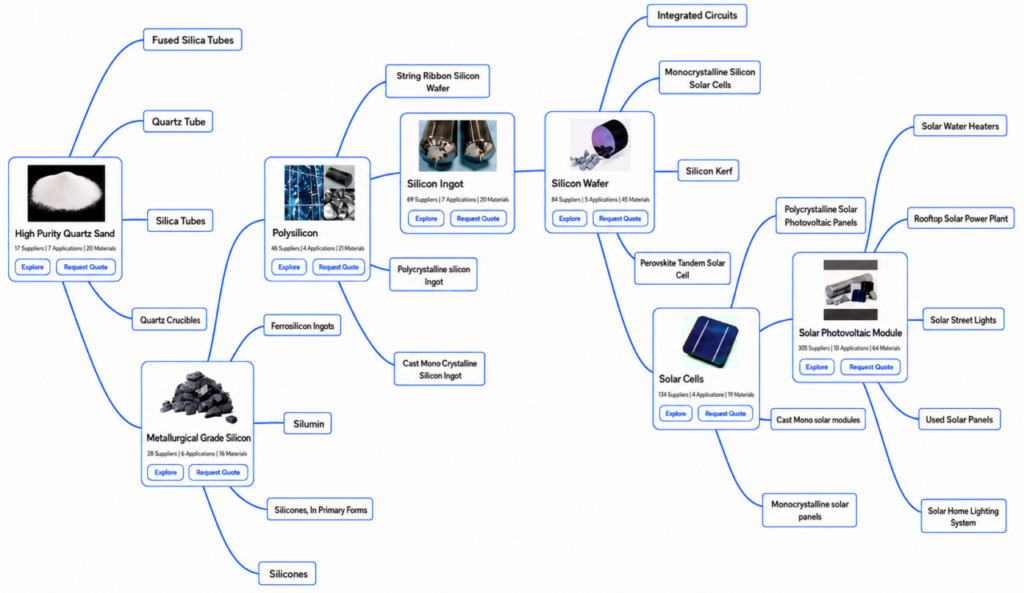
The platform also captures the complexity of byproducts and alternative applications. Silicon wafer, for instance, can branch into the semiconductor industry for integrated chips, while silicon kerf—the waste generated when cutting ingots into wafers—has its own lifecycle, potentially being converted into silicon metal or silicon-carbon composite anodes for lithium-ion batteries.
For each product, MAPPES.io compiles global manufacturer lists that can be sorted by country, capacity and other parameters. Users can access company pages featuring automatically scraped news, current and announced production capacities, and contact information for personnel who have joined the platform.
Application to the US supply chain
The platform’s value becomes particularly apparent when examining rapidly developing markets like the United States, where policy drivers, including Section 232 tariffs and various anti-dumping duties, are reshaping the PV manufacturing landscape.
“The way I see what’s happening in the US, some of it has already happened in India,” Singhal says, drawing parallels between the two markets. India began by building solar panel manufacturing, then cells, then wafers and ingots. “So all of that is now starting to build up in the US as well.”
However, Singhal identifies a critical blind spot in how the industry typically approaches supply chain development. “Most of the time, the community – and that’s true for any industry, but let’s say the solar community – generally only talks about five products, six products,” he observes. The focus remains on the main value chain—polysilicon, ingot, wafer, cell, module—while overlooking “all the adjacent products that are needed to support the solar ecosystem”.
This oversight creates bottlenecks. “What that means is there are bottlenecks which will come within a year once these manufacturing plants are established. And we are seeing that in India as well. And the same will hold for America,” Singhal says.
Taking silicon ingot production as an example, Singhal explains that crystal growth furnaces require isostatic graphite parts, quartz crucibles and argon gas. “These are the products that will need to be localised very soon, because again, you can’t rely or depend on some other country. In this case, let’s say China, because they are one of the biggest suppliers of ingot pullers and also the isostatic graphite parts.” The platform helps identify these gaps and opportunities. “There will be big manufacturers like the Teslas and the Reliances of the world who will be making the bigger products like the ingots and the wafers and the cells and the panels, but then there are all the other companies, the small and medium scale companies, who are figuring out how to enter this solar ecosystem. What value can they bring?”
Multiple use cases
MAPPES.io serves different functions for different users within an organisation. “Every company on a platform is both a buyer and a seller,” Singhal notes, unlike traditional listing sites such as Alibaba or ThomasNet.
Business development teams can identify potential customers by application. Procurement teams can find raw materials, equipment, and suppliers. Strategy teams can conduct portfolio gap analysis, exploring what additional products they might manufacture. “If you are making solar cells, you’re like, hey, what is something else that I can manufacture? And it could be silicon wafers for that matter, or it could be solar modules.”
“Let’s say I search for silicon wafer. If I click on silicon wafer, then as a solar cell manufacturer, you can think about who the different manufacturers of silicon wafer are. Who are the potential customers for silicon wafer? What does it take to make silicon wafer? What are the raw materials? Who are the suppliers? What machinery? What are the different applications?” Singhal explains.
“And you can basically create a use case to present to your management team that, hey, we should make silicon wafer because this is the kind of competition there is. This is the kind of market out there. We already know the ecosystem, who the suppliers are. These are the applications.”
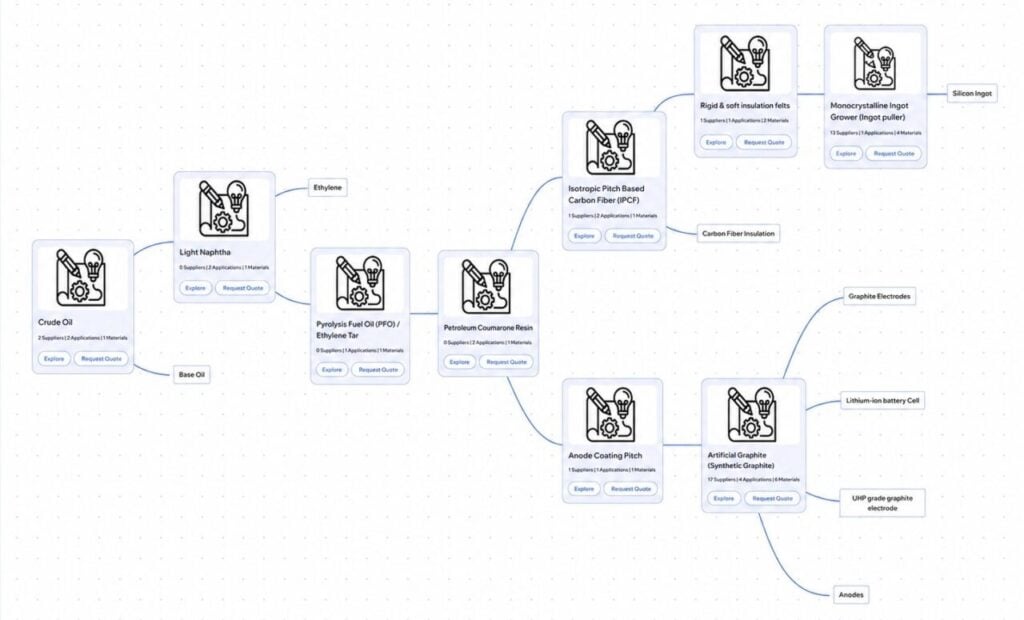
The platform also reveals connections between seemingly separate industries. Singhal shares an example involving Reliance Industries, which has expanded from oil and petrochemicals into solar, carbon fibre, green hydrogen and batteries. By mapping the value chain, MAPPES.io revealed how crude oil converts to light naphtha, then to ethylene, which produces ethylene tar as a byproduct. This tar can be converted into petroleum coumarone resin, which then becomes either anode coating pitch (used for graphite anodes in lithium-ion batteries) or isotropic pitch-based carbon fibre (used in rigid insulation felts for silicon ingot pullers).
“So if I am Reliance or if I’m looking to partner or sell to Reliance, I would want to understand this value chain,” Singhal explains. “All of a sudden, you can see how this value chain becomes important.” For investors, the platform provides crucial context. “Investors don’t understand manufacturing space as much, right? So they are all seeking to invest in solar and semiconductor, but they don’t know which company to invest in, what does the market look like. They only know what the company will tell them.”
Future development
MAPPES.io is developing an AI agent interface that Singhal hopes to present at the upcoming PV CellTech conference in San Francisco. “You don’t have to go and search for this information. You can just talk to our AI tool and ask who’s the supplier,” he explains. The agent will draw on the platform’s intelligence while filtering out AI hallucinations through its verified product network.
Looking further ahead, carbon footprint mapping represents another potential feature. “For every product, if you know what materials are used, what machinery you use, if you know the carbon footprint of that product, in the future, you’ll be selecting the supplier based on their carbon footprint,” Singhal says. The platform may also evolve to offer more granular information on specific PV technologies such as TOPCon, though this depends on user contributions. “The information [on MAPPES.io] is generated by the ecosystem, not by us,” Singhal emphasises. As users post more detailed technical content, the platform’s AI layer can decode research papers and other materials to create increasingly detailed maps.
A tool for rapid growth
MAPPES.io operates on a freemium model, with basic access available for free and full access requiring an annual membership of around US$3,000. The platform currently covers not just solar but also semiconductors, green hydrogen, lithium-ion batteries, carbon fibre and optical fibre—reflecting Singhal’s insight that “every industry is correlated somehow. At least they are one or two steps away from every other industry out there.”
As the global PV manufacturing industry experiences unprecedented growth, particularly in markets like the United States, where domestic supply chains are being rapidly established, tools that can map complex ecosystems and identify opportunities and bottlenecks before they emerge become increasingly valuable. MAPPES.io offers a way to see not just the obvious connections in the solar value chain, but the hidden links that could determine competitive advantage in an industry racing to scale.
Ankit Singhal will discuss the topic of building resilience in the US solar supply chain at our annual PV CellTech USA conference in San Francisco on 13-14 October. For full details and booking, click here.