The replacement and expansion of decommissioned solar PV projects will account for 23% of new solar capacity additions by the 2040s, as projects reach the ends of their operational lives and new technological innovations incentivise the replacement of outdated components.
This is according to Wood Mackenzie, which today published a report on the impacts on the clean energy transition of solar and wind project decommissioning. ‘Renewing renewables: The next chapter in the energy transition’ uses wind as the primary example of how projects will come to the ends of their operational lives, and need to be replaced, but many of the trends identified are relevant to the solar industry.
Try Premium for just $1
- Full premium access for the first month at only $1
- Converts to an annual rate after 30 days unless cancelled
- Cancel anytime during the trial period
Premium Benefits
- Expert industry analysis and interviews
- Digital access to PV Tech Power journal
- Exclusive event discounts
Or get the full Premium subscription right away
Or continue reading this article for free
The scale of the challenge is significant; Wood Mackenzie estimates that in the 2040s, projects accounting for more than 2.5TW of wind and solar capacity will reach the ends of their operational lives, forcing project owners to make a decision about the future of the asset.
Indeed, using the example of the European wind industry, the report notes that meeting European Commission deployment targets requires 37GW of new wind additions each year between 2023 and 2030. The industry is already falling short of this target, without even considering the fact that a further 17GW of capacity will be decommissioned in this period; this means that, in effect, Europe must add 39GW a year to reach the 2030 target.
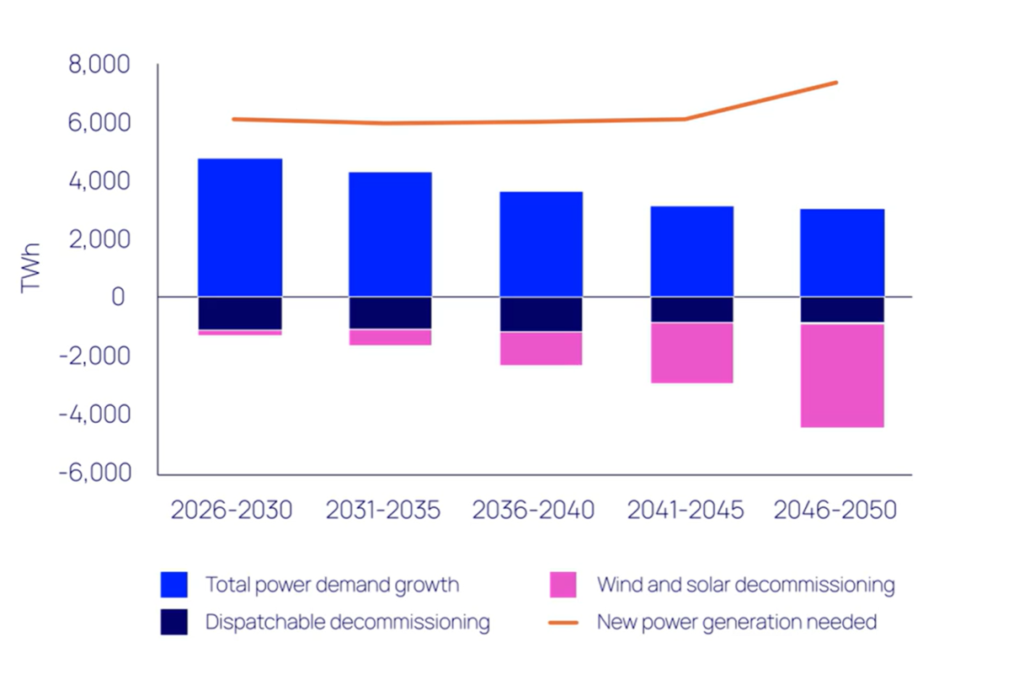
This is illustrated effectively on the graph above, from Wood Mackenzie, which shows how solar and wind decommissioning, in pink, will take a significant volume of generation off the grid, particularly from 2040 onwards. This comes as power demand will continue to grow, meaning that close to 8,000TWh of new generation will be needed by 2050 to account for growing power demand and the reduction in generation from existing solar and wind assets.
Thinking ‘actively’ about end-of-life work
Earlier this year, speakers at Solar Media’s Clean Power 2030 Summit said that project developers must “actively” think about end-of-life activities when building an asset, and that simply dismantling a project at the end of its life would be an unwise decision. Instead, asset owners typically aim to revamp a project, the process of replacing parts and components with new versions to restore it to its original output, or repower the project, the process of adding new components to improve the capacity or output of that project.
While one of the speakers at this summer’s event, Joe Miletic, founder and director of UK-based consultancy Solclaris, told PV Tech Premium that concerns about module quality means that some solar asset owners would rather revamp a project than repower it, the Wood Mackenzie report suggests that the rate of technological advancement, particularly for the solar sector, means that repowering could be an attractive option.
The report says that there is “greater technological advancements” in solar than in other renewable energy industries, such as wind; the report estimates that over the past decade, a “new technology” has entered the solar sector every other year.
“In a repowering context, this means solar assets have a shorter operational lifetime than they are designed for, as asset owners look to capitalise on new technological advancements rather than repair existing assets,” reads the report, which was written by Wood Mackenzie’s Søren Lassen, Chris Seiple and Charles Coppins.
Solar has significant growth potential
Despite the scale of this challenge, the Wood Mackenzie report also notes that the solar PV industry could be well-positioned to capitalise on this need to replace operating capacity, as the speed at which new technological innovations are being deployed means that solar projects that are repowered could see a significant improvement in generation.
The report notes that module efficiencies have increased by 69% between 2005 and 2025, and says that technology is already “available” that could increase cell efficiency by more than 50% by 2045. Similarly, project sites are becoming smaller, with average project sites today “as much as” 30% smaller than projects of the same capacity in 2010.
As a result, the report concludes that decommissioning work will drive “more than 70% of installations” of new renewable energy projects across Europe. However, the report’s authors note that this trend will not be universal, with decommissioning work contributing to juts 1% of new capacity additions in Asia.