Welcome to the PV Tech Best of the Week roundup, covering the week’s biggest stories from the global solar PV industry.
This week, the latest report from the International Renewable Energy Agency (IRENA) says that the world’s renewable energy capacity must double, but that the strong growth potential of solar PV makes this target “feasible”; other top stories include figures from Anza that show how US solar module prices are up more than 40% since the updates made to the Section 232 rules and Abu Dhabi’s targeting of 14GW of operational solar PV by 2030, up from an earlier target of 10GW, and more than 35GW five years later.
Try Premium for just $1
- Full premium access for the first month at only $1
- Converts to an annual rate after 30 days unless cancelled
- Cancel anytime during the trial period
Premium Benefits
- Expert industry analysis and interviews
- Digital access to PV Tech Power journal
- Exclusive event discounts
Or get the full Premium subscription right away
Or continue reading this article for free
IRENA says global renewables capacity additions must double
Annual global renewable energy capacity additions will need to almost double to 1.2TW between 2026 and 2030 if the world is to meet the energy transition targets set out at the COP28 summit in 2023.
This is the headline takeaway from ‘Delivering on the UAE Consensus: Tracking progress toward tripling renewable energy capacity and doubling energy efficiency by 2030’, the latest report from the International Renewable Energy Agency (IRENA); the ‘UAE Consensus’ is the group of targets agreed upon at COP28 that include, among other goals, tripling renewable energy capacity by 2030.
The report notes that the world added 693GW of new renewable energy capacity in 2025, bringing cumulative operational capacity to 5.15TW, which equals a 15.5% growth rate over capacity additions in 2024.
IRENA also argues that solar PV is well-positioned for future growth, saying that the industry could drive new renewable energy capacity additions and make the achievement of the 2030 goals “feasible”.
Read more about the latest IRENA report here.
US solar module import prices up more than 40% since Section 232 tariffs
The median price for solar PV modules imported to the US has increased by more than 40% since the imposition of tariffs set under Section 232 by the Trump administration in August.
This is according to the latest data from Anza, which compares average price data for imported modules prior to the new Section 232 rules and prices for modules purchased since 7 August, which are expected to be delivered after 4 December, the date at which the minimum import prices introduced in the new Section 232 rules will take effect.
Anza notes that, between these periods, the average price of a module imported to the US has increased from US$0.27/W to US$0.38/W. Anza president Aaron Hall confirmed to PV Tech that the average price of tunnel oxide passivated contact (TOPCon) modules sat at US$0.38/W, the price of passivated emitter rear cell (PERC) modules was US$0.385/W and the price of heterojunction (HJT) modules was a low of US$.39/W but that much higher prices have been reported.
Read more about the latest US module prices here.
Abu Dhabi aims for 14GW of solar PV by 2030, 35GW by 2035
Abu Dhabi’s utility, Emirates Water and Electricity (EWEC), is targeting more than 35GW of solar capacity by 2035.
The utility has set an interim target of 14GW of PV by 2030, up from an earlier target of 10GW, as it scales its installed capacity to beyond 35GW by the middle of the next decade. The planned PV deployment will be backed by 15GW of battery storage capacity, enabling ‘round-the-clock’ provision of solar-generated power.
In this latest statement of intent, Mohamed Almarzooqi, chief assets officer of EWEC, said: “We are actively procuring the utility-scale solar photovoltaic, battery storage and reverse osmosis desalination capacity required to deliver this outcome, structurally reducing the reliance of the system on gas-fired generation. Through this transformation, EWEC is enabling the UAE and Abu Dhabi to build a highly diversified, resilient, and low-carbon system that seamlessly meets rising demand while strengthening water and energy security.”
Read more about the new Abu Dhabi targets here.
Canadian International Trade Tribunal ends anti-dumping duty on Chinese solar modules
The Canadian International Trade Tribunal (ITT) has terminated anti-dumping (AD) and countervailing duties (CVD) on certain solar PV modules and laminates from China. The Canada Border Services Agency will therefore no longer impose anti-dumping and countervailing duties on Chinese solar panels and laminates.
The order was originally made on 25 March 2021 and the expiry review ( RR‑2020‑001) – continuing, without amendment, its finding made on 3 July 2015, in inquiry NQ‑2014‑003 – has not been renewed and used to cover PV modules consisting of crystalline silicon PV cells, thin-film PV products produced from amorphous silicon (a-Si), cadmium telluride (CdTe) or copper indium gallium selenide (CIGS). Modules with a power output not exceeding 100W were already excluded from the order.
According to the Canadian ITT, the expiry review lacked the support of domestic producers, and for this reason, it terminated the order.
Read more about the latest change to Canadian duties here.
Rhode Island judge overturns EPA cancellation of Solar for All programme
A federal judge in Rhode Island has ruled that the US Environmental Protection Agency (EPA) unlawfully terminated the US$7 billion Solar for All programme, which was designed to expand solar access and reduce electricity costs for low- and moderate-income households.
US District Judge Mary McElroy granted summary judgment to the plaintiffs and vacated the EPA’s termination of the programme. The court found that Congress intended the agency to continue administering grants that had already been obligated.
“The court ruled the Trump Administration never should have terminated Solar for All because Congress intended it to continue, and EPA broke the law when it killed the programme and pocketed the money,” said Southern Environmental Law Center, senior attorney Nick Torrey.
Read more about the ruling here.
Premier Energies commissions 7GW TOPCon cell plant
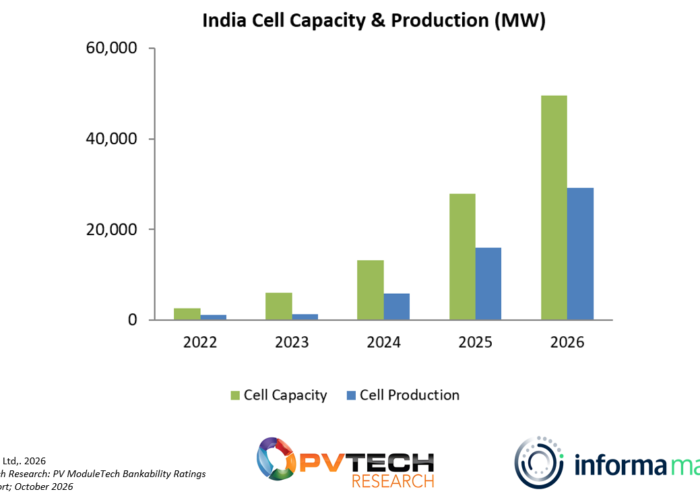
Indian solar manufacturer Premier Energies has commissioned a 7GW n-type tunnel oxide passivated contact (TOPCon) G12R solar cell manufacturing facility in Naidupeta, Andhra Pradesh, taking its total solar cell manufacturing capacity to 10.6GW.
The facility, spread across 101 acres, was developed with a capital expenditure of INR 32.93 billion (US$343.6 million). It has a production capacity of approximately 88,000 solar cells per hour. The company said the facility has entered trial production and is India’s largest solar cell manufacturing plant.
Chiranjeev Saluja, managing director at Premier Energies, said: “The timing of this 7GW capacity addition is therefore significant: as the line stabilises and ramps up, it gives us the scale to serve that demand with greater supply reliability and operating efficiency. Together with our planned backward integration into ingots and wafers, this strengthens our strategy of building a fully integrated and globally competitive solar manufacturing platform while supporting India’s clean energy transition.”