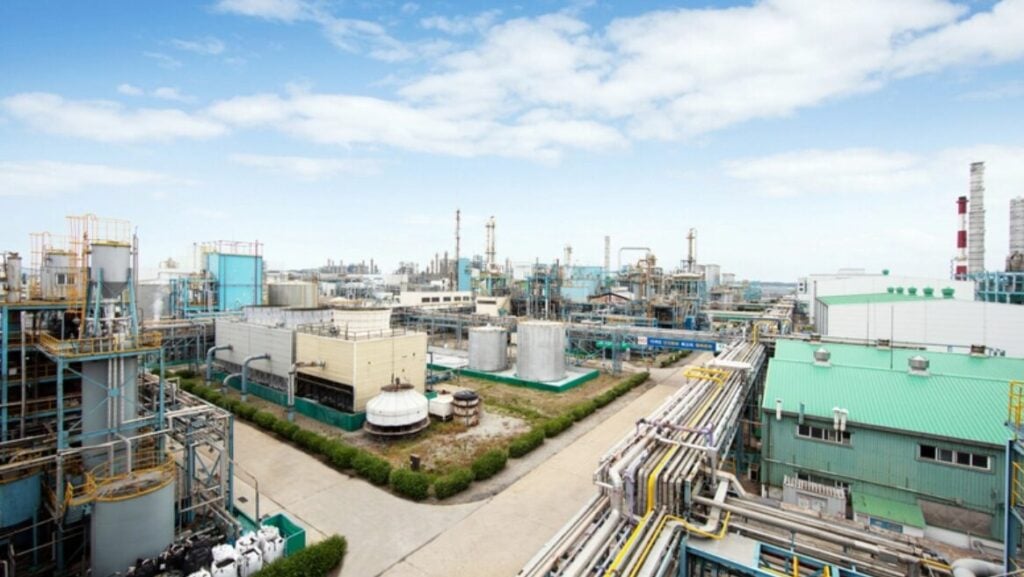
South Korean polysilicon manufacturer OCI Holdings has announced plans to double its annual solar-grade polysilicon production to 70,000MT by 2029 “to address rapidly escalating US AI infrastructure power demand,” according to the company.
This is a key takeaway from the manufacturer’s latest financial results, published last week. OCI Holdings confirmed to PV Tech this week that the company’s current polysilicon and wafer manufacturing capacities are sold out under “new long-term supply agreements” with US customers, as developers look to meet growing appetite for new solar projects in the US.
Try Premium for just $1
- Full premium access for the first month at only $1
- Converts to an annual rate after 30 days unless cancelled
- Cancel anytime during the trial period
Premium Benefits
- Expert industry analysis and interviews
- Digital access to PV Tech Power journal
- Exclusive event discounts
Or get the full Premium subscription right away
Or continue reading this article for free
The company also announced plans to expand the annual wafer manufacturing capacity of its Vietnamese subsidiary, Neosilicon Technologies, to 11.5GW by 2029. The company started work at a 2.7GW wafer manufacturing facility in January of this year, and OCI Holdings expects to expand the subsidiary’s cumulative manufacturing capacity to 3.75GW, 7.5GW and 11.5GW across the next three years.
The expansion of polysilicon supply will be a positive step for the industry, which has seen a number of industry leaders struggle in recent months. German polysilicon producer Wacker Chemie recorded an 8% year-on-year decline in sales in the first quarter of this year, while Chinese firm Daqo New Energy reported an 88.3% quarter-on-quarter decline in sales earlier this year.
Johannes Bernreuter, head of polysilicon market analysis firm Bernreuter Research, told PV Tech Premium that this decline was likely due to Daqo’s compliance with new rules set out by the Chinese government, under which polysilicon producers cannot sell below the cost of production; considering sustained low manufacturing prices across the Chinese solar industry in recent years, this led to a dramatic fall in polysilicon sales for the company.
‘Ramp-up of cell manufacturing’ for the US
For companies based outside of China, such as OCI Holdings, there could therefore be an opportunity to expand polysilicon sales, and drive profits, particularly with US companies a willing buyer.
OCI Holdings also noted that its Vietnam subsidiary is a non-prohibited foreign entity (PFE) in US law, meaning that companies using Neosilicon’s polysilicon would not be prohibited from benefitting from supportive tax credits, and Joe Henessy, analyst at PV Tech Market Research, told PV Tech this week that OCI Holdings’ polysilicon manufacturing expansion is “big news for the US market”.
“From their perspective, the more companies with non-PFE polysilicon, the better, as it gives more routes for the growing manufacturing industry,” he explained.
“For me, the most interesting part of the announcement is the wafer capacity,” Henessy added. “This shows the ramp-up of cell manufacturing in the country, where currently most of the cells used are imported. In the coming years, wafers are likely to be the next part of the supply chain under scrutiny, after the country builds enough cell manufacturing to meet most of its demand.”
It is worth noting too that OCI Holdings acquired a 65% stake in the Vietnam wafer plant last October from Elite Solar, as the facility was nearing completion, and this means that through its partnership with Elite, together they now have an integrated supply chain from polysilicon to modules for export to the US. For its part, Elite Solar is also planning a module factory in the US.
In its latest financial results, OCI Holdings noted that it plans to “deepen strategic partnerships through additional long-term agreements (LTAs)” in the US, and “build a US solar downstream value chain”.
However, OCI Holdings has divested from some of its US assets, including the La Salle solar project in Texas, in which Arva Power acquired a 50% stake in May. The company retains a 6.5GW solar PV and battery energy storage system (BESS) pipeline across the state.
Revenue and profits up for OCI Holdings
OCI Holdings’ latest announcement comes alongside its financial results for the second quarter of the year, which include revenue of KRW1.023 trillion (US$710 million) and operating profits of US$74 million. These figures are up 14.7% and 894.8%, respectively, from the first quarter, and the company attributed the latter growth to “profitability improvement” and the sale of the La Salle project.
The company’s subsidiaries also posted improved financial metrics, including an 8.3% quarter-on-quarter increase in revenue for OCI TerraSus, the company’s polysilicon production subsidiary, and a 66.7% increase in revenue for OCI Enterprises, the North American subsidiary.
“Surging electricity demand driven by AI data centers is significantly strengthening growth momentum for solar energy in the US market,” said OCI Holdings chairman Woo-hyun Lee. “Leveraging our differentiated non-PFE competitive advantage, OCI Holdings will expand investments across the solar value chain and proactively adapt to shifts in the global supply chain.”
The company’s own financial presentation makes references to changes in the US energy sector, and how OCI Holdings could benefit from this. The company notes that the average prices of power purchase agreements (PPAs) signed in the US increased from US$56/MWh to US$65/MWh between 2024 and the first quarter of 2026, making this a more lucrative investment landscape.
However, more recent figures from LevelTen Energy show that North American solar PPA prices, in particular, fell between the first and second quarters of this year, and the increasingly protectionist slant of US policy means that overseas companies, like OCI Holdings, could face challenges as they look to export to the US, regardless of non-PFE status.
“I don’t think it’s a huge surprise that companies from abroad are willing to take the risk of selling to the US solar sector, given the premium you get,” explained Henessy. “A company like United Solar has a very similar model. The main risk will be the Section 232 investigation, which is still ongoing.
“In my view, there will always be some reliance on imports even in the future, but given that the US already has some existing polysilicon and wafer capacity it will be less vulnerable than in the past.”